
Narragansett
Library & Archive
The history, identity and preservation of this population, with general species learning clearly identified.
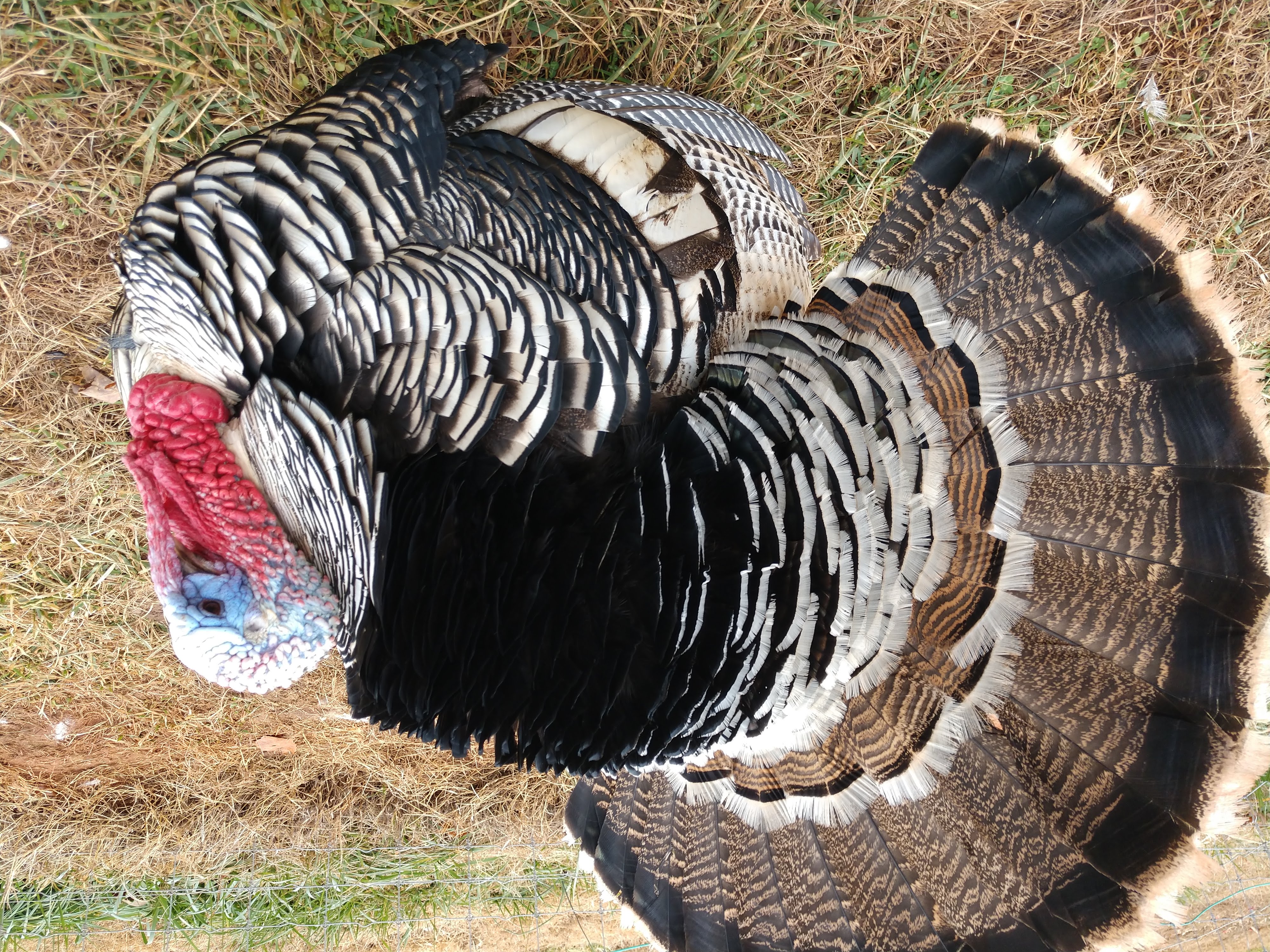
An adult male Narragansett turkey displaying its tail; an existing source-identified photograph. · TemulsLightningPoncho · CC BY-SA 4.0 · License terms
Read. Understand.
Carry knowledge forward.
Reports keep the source, date and meaning of a fact together. Articles follow the animal’s story. Essays connect that knowledge with the choices preservation asks of us.
Meet the Narragansett: the connected breed account
Origins, characteristics, scientific identity, care, life stages and conservation, with general species foundations identified.
Read the original →Guide · This breedNarragansett: life cycle and growth in view
Interactive life stages, credited eggs or young-animal examples, documented development windows and measured growth studies where available.
Read the original →Report · This breedA sex-linked change to the bronze pattern
Porter's reference explains Narragansett coloration as a modification of a bronze-base pattern in which gray or dull dark areas replace the coppery bronzing. The factor is sex-link
Read the original →Article · This breedInterpreting this population in practice
How its documented identity shapes learning and conservation.
Read the original →Article · This breedNarragansett: history & heritage
Place, people, development and documented heritage.
Read the original →Article · This breedNarragansett: animal identity
Distinctive traits, recorded roles and population identity.
Read the original →Report · This breedNarragansett: scientific identity
Family, genus, species and scientific naming authority explained.
Read the original →Article · This breedNarragansett: ecology & human landscapes
Habitats, domestication and the landscapes shared with people.
Read the original →Report · This breedNarragansett: conservation & challenges
The pressures this population faces, status and dated evidence.
Read the original →Guide · This breedNarragansett: care foundations
Species care foundations alongside this breed’s identity.
Read the original →Guide · General turkeysThe ground remembers: blackhead risk in a mixed poultry farm
Why chicken history matters when choosing turkey ground, and why diagnosis and prevention cannot be replaced by a remedy.
Read the original →Guide · General turkeysA turkey requires more than a chicken ration
Cooperative Extension describes turkey starter and grower requirements as different from those of chickens. Feeding a ration designed for chicken growth can fail to support the tur
Read the original →Guide · General turkeysGetting a poult established in its new environment
University of Maine Extension treats brooding as an important foundation for poult health and survival. The environment should be prepared before arrival, with suitable warmth, cle
Read the original →Guide · General turkeysHeritage breeding and the limits of a label
University of Kentucky's poultry-breeding guidance distinguishes heritage turkey varieties from commercial lines when discussing natural mating. It also notes that not every variet
Read the original →Guide · General turkeysWhy mixing with chickens can create extra risk
Penn State Extension explains that keeping chickens and turkeys on the same site increases disease risk to turkeys. Histomoniasis, commonly called blackhead, involves a protozoal p
Read the original →Article · General turkeysDesigning a living range: general turkey husbandry
Pastured turkeys need more than an open field. NCAT describes systems that combine outdoor access with shelter, shade, dependable water, supplied feed and suitable roosts. Heritage
Read the original →Article · General turkeysForaging and balanced nutrition: general poultry ecology
A ranging bird can harvest seeds, insects and plant material that a confined bird cannot reach. FAO describes this as a changing local feed resource, shaped by crops, household act
Read the original →Guide · General turkeysFlock health: a shared poultry foundation
Biosecurity means interrupting the routes by which infection reaches birds or moves between flocks. It applies to small conservation populations as well as commercial farms. A heal
Read the original →Article · General turkeysNatural reproduction and heritage turkey conservation
Domestic turkey color populations are commonly called breeds, but poultry standards treat them as varieties. The Livestock Conservancy's heritage definition requires natural mating
Read the original →Article · General turkeysMore than one Indigenous domestication history
Ancient mitochondrial DNA research published in 2010 identified a distinctive domestic turkey lineage in the precontact southwestern United States and supported at least two occurr
Read the original →Article · General turkeysBones can record relationships with people
A 2018 study combined ancient mitochondrial DNA with stable-isotope analysis of archaeological turkey remains from Mexico. The two methods address different questions. DNA investig
Read the original →Article · General turkeysWhat the photograph shows—and what it cannot tell us
From a first impression to a useful field observation
Read the original →Article · General turkeysKeeping a living breed: animals, families and a place in the world
Why conservation needs more than a familiar name
Read the original →Report · General turkeysHistory & heritage · General species
An original chapter in the species world. Individual breed histories and identity stay in their own collections.
Read the original →Report · General turkeysScientific identity · General species
An original chapter in the species world. Individual breed histories and identity stay in their own collections.
Read the original →Report · General turkeysEcology & human landscapes · General species
An original chapter in the species world. Individual breed histories and identity stay in their own collections.
Read the original →Report · General turkeysConservation & challenges · General species
An original chapter in the species world. Individual breed histories and identity stay in their own collections.
Read the original →Guide · General turkeysUnderstanding the animal: care foundations
Digestion, nutrition, daily observations and the differences that matter between animal groups.
Read the original →Report · General turkeysA status is not a census.
An original research report on conservation categories, taxonomy, population evidence and preserving a living inheritance.
Read the original →A foundation for deeper understanding.
Our first priority is teaching: bringing the animal’s history, characteristics and conservation challenges together in one place. Official breed organizations and research sources support further learning. Member records and submissions can come later.
Continue in the Narragansett world →