
Turkeys
History & heritage
One living story. Knowledge kept together.
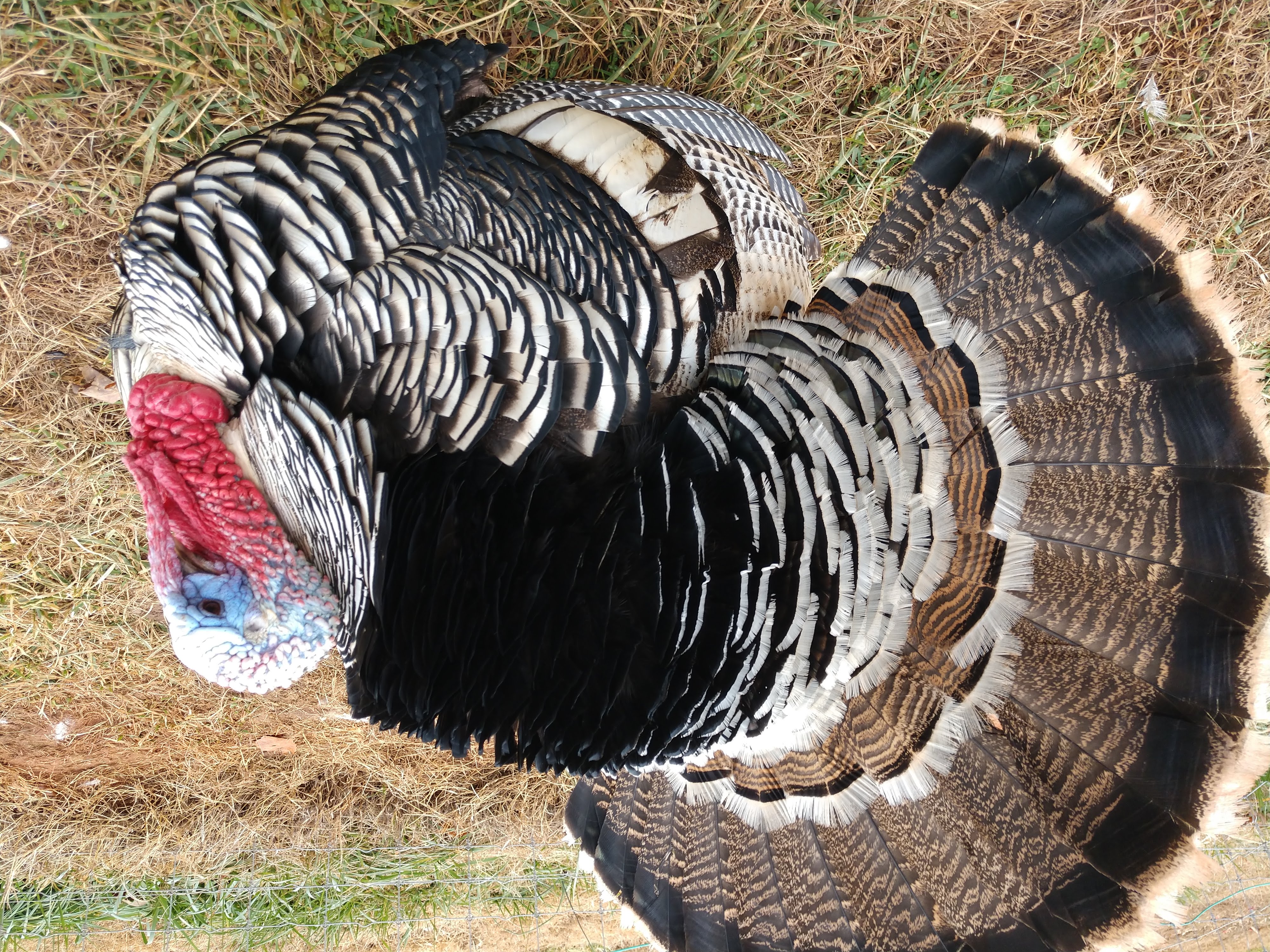
An adult male Narragansett turkey displaying its tail. · TemulsLightningPoncho · CC BY-SA 4.0 · License terms
Follow the story behind the name.
Domestic turkeys connect to Meleagris gallopavo, the wild turkey, and to Indigenous histories of animal management in the Americas. Smithsonian accounts describe domestication traditions in Mexico and the American Southwest. This history predates modern holiday markets and deserves its own place in teaching rather than appearing as a seasonal footnote.
Today's varieties also reflect later selection for appearance and production. Smithsonian genetic research emphasizes differences between domestic birds and wild ancestors. Heritage preservation focuses on identifiable populations and the traits maintained through breeding; it should not treat a domestic turkey as a direct substitute for any wild population simply because the species name is shared.
Domestic animal history is made of many local stories. A species tells us about broad biological relationships; a breed or strain connects those relationships with a landscape, a community and generations of selection. The histories in this world follow those individual populations so regional differences can remain visible.
Some populations were deliberately developed from named foundation stock. Others took shape through long use in a region before a formal standard or studbook existed. The date of a breed society’s founding therefore need not be the date the animals first existed. Historical accounts need to identify which event a date describes.
Begin with a breed’s own story
More than one Indigenous domestication history
Ancient mitochondrial DNA research published in 2010 identified a distinctive domestic turkey lineage in the precontact southwestern United States and supported at least two occurrences of turkey domestication in North America. Southwestern and Mesoamerican histories should therefore not be collapsed into a single undifferentiated event. The study demonstrated that Indigenous husbandry involved organized and sophisticated breeding practices.
Mitochondrial DNA tracks maternal relationships, so these findings are not a complete map of every ancestor contributing to domestic turkeys. They also do not mean that a modern heritage variety is the direct, unchanged continuation of a particular archaeological flock. Domestic turkey history includes later movement, selection and breeding. Recognizing distinct early management traditions restores an important part of the animal’s history while retaining the limits of the genetic evidence. Archaeological bones and preserved droppings can carry biological information that complements the objects and settlements through which people’s relationships with turkeys are reconstructed.
Sources for general species learning
Keep learning from official information.
These research portals help locate further material. A search link is a route for exploration; it is separate from the sources used for the article above. Domestic breed information, wild-species assessment, historical books and new research need their own context.
- FAO DAD-IS · Domestic breed information
- IUCN Red List · Species assessments
- Biodiversity Heritage Library · Historical literature search
- USDA National Agricultural Library · Research search
- Google Scholar · Scholarly literature search
- Open Library · Book catalogue search
- HathiTrust · Digitized catalogue search