
Turkeys
Care foundations
One living story. Knowledge kept together.
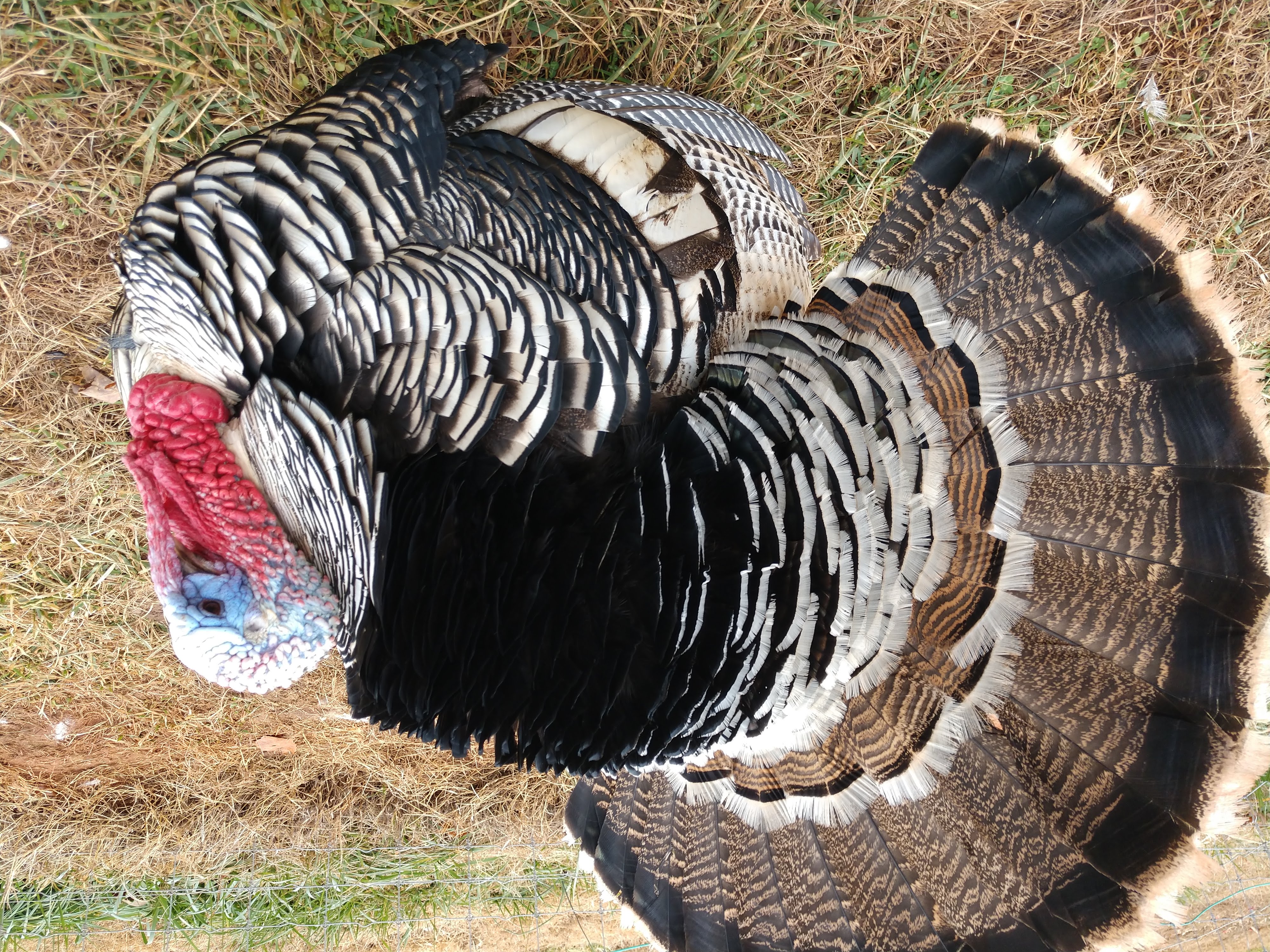
An adult male Narragansett turkey displaying its tail. · TemulsLightningPoncho · CC BY-SA 4.0 · License terms
Understanding turkeys: care foundations
Turkeys have different nutritional requirements from chickens and need feed appropriate to their species and life stage. Good husbandry and biosecurity are important even in small heritage flocks. Chicken flocks can carry organisms such as Mycoplasma that threaten turkeys; mixing species and adding birds from different sources can introduce disease. Brooding, growth and mature breeding birds should be explained separately. Conservation value does not exempt a bird from ordinary welfare, nutrition and disease prevention needs.
These are general species foundations. The breed's own history and traits help explain how it developed, while an individual animal's age, environment and purpose shape its daily needs. Preservation includes keeping animals healthy enough to express normal behavior and maintain future generations. Compare dependable husbandry guidance with breed registry descriptions, and distinguish inherited traits from assumptions about toughness. Teaching the reasons behind care decisions gives readers a stronger foundation than applying one feeding formula to every animal.
University Extension · Merck Veterinary Manual · Merck Veterinary Manual
Read the species care foundation guide →The ground remembers: blackhead risk in a mixed poultry farm
Why chicken history matters when choosing turkey ground, and why diagnosis and prevention cannot be replaced by a remedy.
Blackhead disease, or histomoniasis, is caused by Histomonas meleagridis and can seriously damage a turkey flock. The common name is misleading: Merck explains that an obviously black head is not a reliable defining sign. Waiting for that appearance can delay help. Prevention starts with understanding transmission and the history of the ground, rather than memorising a colour to look for. [1]
Chickens can carry the organism and the cecal worm involved in transmission while showing little illness. Infected worm eggs can persist in the environment, and earthworms can carry the worm stages. Thus, a field that looks empty and clean may still present risk. Merck advises raising turkeys apart from other galliform birds and avoiding chicken-contaminated ground. [1]
Separate pens help, but traffic between them can move contamination. USDA’s biosecurity guidance identifies footwear, equipment and other movement as possible routes for poultry disease. For a small farm, assign a deliberate cleaning and entry routine rather than relying on a fence alone. Ask a poultry veterinarian how to manage a property that has already held chickens or had suspected histomoniasis. [2]
Drooping wings, reduced appetite, weakness or yellow droppings may be reasons for concern, but they do not diagnose histomoniasis. FDA describes damage to the ceca and liver and the particular susceptibility of turkeys. A veterinarian or diagnostic laboratory can distinguish this disease from other causes of illness. Arrange assessment promptly and ask how to handle samples or a dead bird safely. [3]
FDA states that there are currently no animal drugs approved to prevent, treat or control blackhead disease in the United States. Older accounts of nitarsone use should not be treated as current instructions: its approval was withdrawn after marketing ceased. That regulatory history makes prevention especially important. Online claims about household remedies are not equivalent to evidence of a safe, effective treatment. [3]
Conservation Legacy field exercise: map where chickens and turkeys have lived, keep dates of flock movements and record any laboratory diagnoses. Link the map with bird identities and breeding records. There is no universal short waiting period that this article can promise makes contaminated ground safe. Preserving the land history gives the next keeper something concrete to discuss with a veterinarian before valuable breeding birds arrive.
A turkey requires more than a chicken ration
Cooperative Extension describes turkey starter and grower requirements as different from those of chickens. Feeding a ration designed for chicken growth can fail to support the turkey's requirements. A shared poultry label does not make feeds interchangeable.
Life stage is important. A newly growing poult, an older bird and a breeding adult need assessment in relation to growth and reproductive demands. Feed decisions should consider the complete balance rather than only the crude-protein number.
Water and feeder access matter alongside formulation. Birds must be able to find and use the equipment, while feed should remain dry and free of contamination. An apparently full feeder is not proof that every bird is eating.
Heritage varieties should not automatically be expected to follow the growth pattern of commercial broad-breasted birds. A production example gives a context, not a universal timetable. Condition, mobility and continuing health provide essential information.
The practical approach is to select a suitable turkey ration and monitor the actual animals. Persistent poor growth or abnormal appetite deserves professional assessment rather than an assumption that rare birds simply develop unpredictably. Outdoor foraging may contribute activity and variety but does not establish that all nutritional needs are supplied.
Getting a poult established in its new environment
University of Maine Extension treats brooding as an important foundation for poult health and survival. The environment should be prepared before arrival, with suitable warmth, clean bedding, and accessible feeding and watering equipment.
New poults need observation to confirm that they locate and consume feed and water. Merely placing equipment in the brooder does not establish successful use. Watching the birds helps identify a quieter or weaker individual that a group view can miss.
Brooder design also concerns crowding and piling. The usable space and safe placement of equipment should be assessed together. Heating arrangements must be maintained to reduce fire and injury risks as well as provide warmth.
Growth changes what the equipment must accommodate. Water spillage and accumulated waste can make litter unsuitable, while a crowded feeder can restrict access. Reassessment should continue as the poults develop.
Source information and health history belong in the rearing plan. A hatchery's programme status can be useful, but it does not eliminate the need for daily management or confirm freedom from every disease. The goal is a stable start supported by observation, not an assumption that a successful delivery means every poult is already thriving.
Heritage breeding and the limits of a label
University of Kentucky's poultry-breeding guidance distinguishes heritage turkey varieties from commercial lines when discussing natural mating. It also notes that not every variety will reliably become broody. Preserving breeding capacity and obtaining a hatch are related but separate questions.
A fertile egg needs appropriate handling and incubation to develop. A hen's interest in nesting does not establish fertility, and an incubator cannot make an infertile egg fertile. Parent birds, eggs and equipment each contribute to the outcome.
Breeding records should identify the parents or breeding group and the dates involved. A feather-colour name describes a variety but does not independently prove the parentage of a particular poult in a mixed group.
Responsible breeding also includes the future care of the offspring. A successful hatch adds animals needing suitable nutrition, space and competent handling. Increasing numbers without preparing for those requirements does not serve conservation.
The practical lesson is to assess function and documentation together. A heritage identity gives historical context, while observations and records show what the living birds are doing. Individual fertility concerns, persistent hatch failures and breeding injuries require appropriate poultry expertise rather than a conclusion drawn only from the variety's reputation.
Why mixing with chickens can create extra risk
Penn State Extension explains that keeping chickens and turkeys on the same site increases disease risk to turkeys. Histomoniasis, commonly called blackhead, involves a protozoal parasite that can be carried through a cecal worm. Chickens may contribute to this infection cycle without being affected in the same way as turkeys.
This makes a mixed flock more than a housing decision. Shared ground and manure matter alongside direct contact. A poultry veterinarian should help assess the site and appropriate separation rather than assuming that apparently healthy chickens pose no risk.
Penn State also describes Mycoplasma infections that can be carried in backyard flocks and, in some cases, transmitted through breeding birds. Source and health history therefore matter when obtaining poults or breeding stock.
Not every intestinal parasite is shared between chickens and turkeys. The coccidia affecting these birds are host-specific, another reason that chicken medication or prevention practices should not be copied without advice.
Signs such as poor appetite, respiratory difficulty or altered movement can have several causes. Diagnosis and locally appropriate control belong with a veterinarian or diagnostic laboratory.
Flock health: a shared poultry foundation
Biosecurity means interrupting the routes by which infection reaches birds or moves between flocks. It applies to small conservation populations as well as commercial farms. A healthy-looking new bird can still carry an infection; keep arrivals separate and work with local poultry professionals on suitable quarantine and testing before introduction. Returning exhibition birds also create a contact pathway.
Separate flock footwear and equipment from items used elsewhere. Remove manure and dirt before disinfecting surfaces, because organic material can impair disinfectants. Keep feed stores clean, address spilled grain and control rodents. Limit wild-bird access to housing and water. When birds become ill, restrict movement of people, birds and equipment while obtaining a diagnosis. These are species-wide precautions, not evidence that any particular heritage breed is resistant or susceptible to a named disease.
Sources for general species learning
Keep learning from official information.
These research portals help locate further material. A search link is a route for exploration; it is separate from the sources used for the article above. Domestic breed information, wild-species assessment, historical books and new research need their own context.
- FAO DAD-IS · Domestic breed information
- IUCN Red List · Species assessments
- Biodiversity Heritage Library · Historical literature search
- USDA National Agricultural Library · Research search
- Google Scholar · Scholarly literature search
- Open Library · Book catalogue search
- HathiTrust · Digitized catalogue search