Heritage turkey conservation follows living breeding flocks and their continuity. A named color variety can have its own history and conservation category while belonging to the same domestic species as other turkeys. Preserve that distinction when reading a list: varieties should not automatically be counted as separate biological species or assigned the risk status of wild turkeys. Explore documented standards, production history and the people maintaining those flocks.
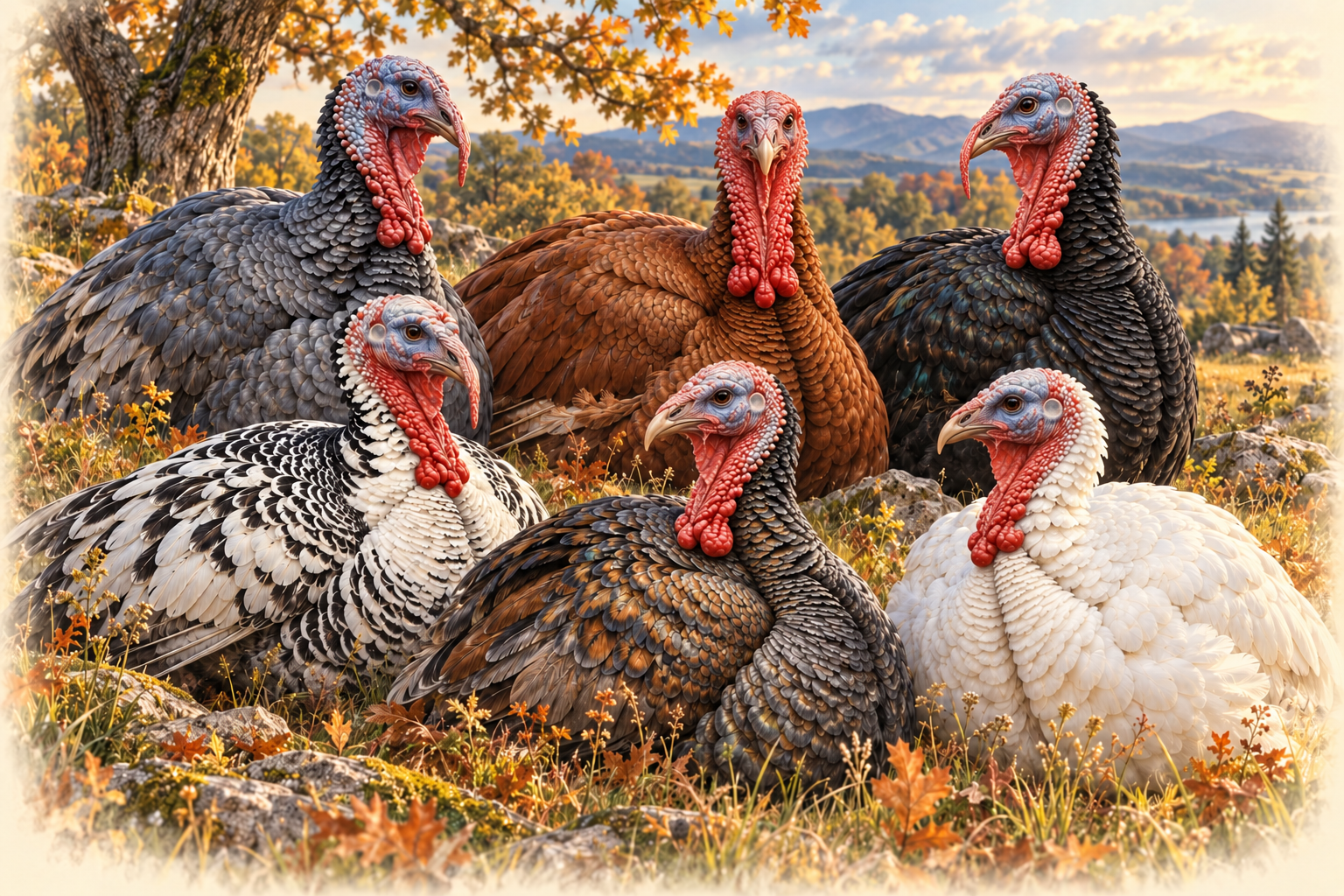
White feathers helped avoid dark pinfeathers on a dressed carcass. Beltsvilles retain the ability to mate naturally, an important practical distinction from broad-breasted commercial strains. Their smaller table size suited families, although restaurants and retailers often preferred larger birds.
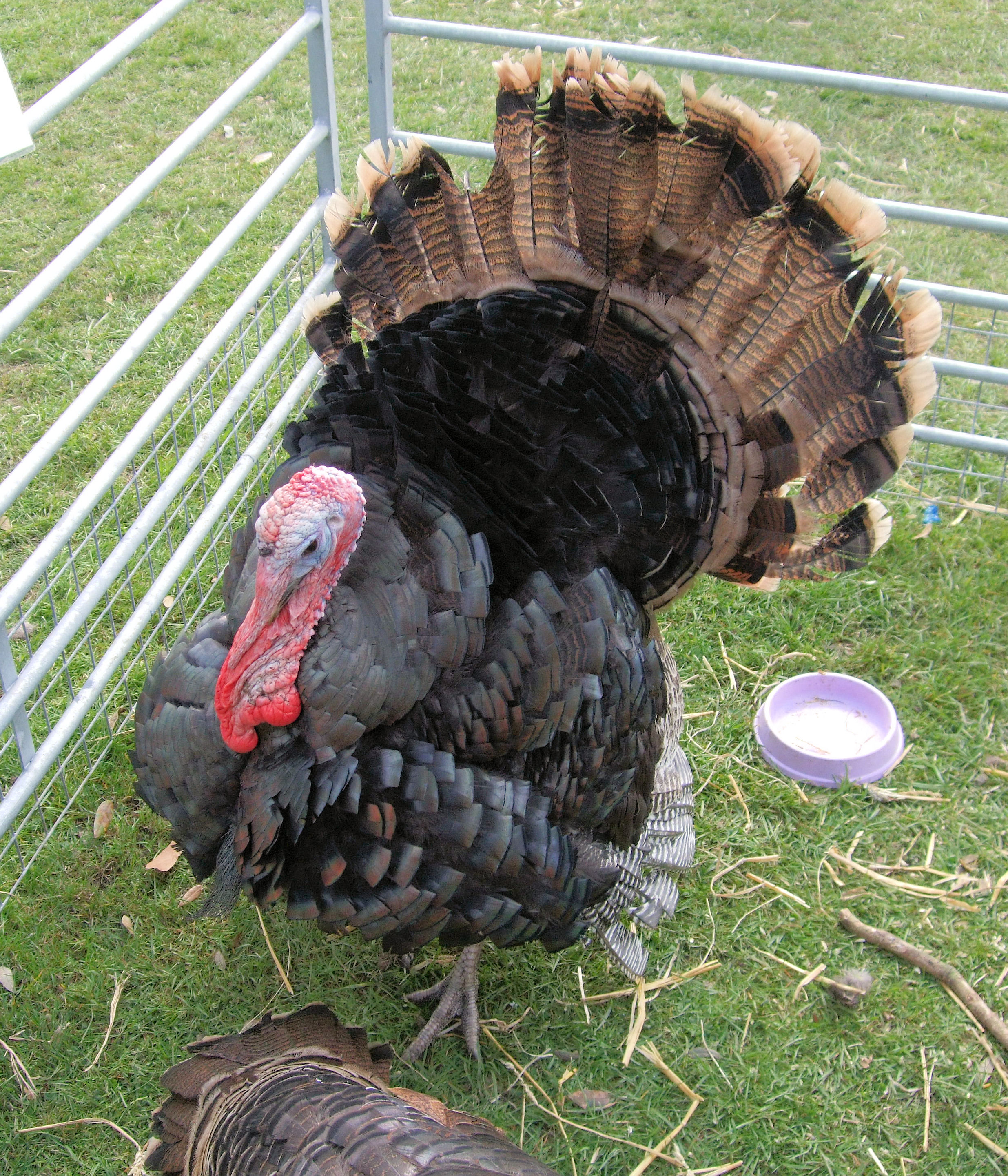
Their metallic bronze sheen reflects the history behind their name. Standard Bronze retains a heritage conformation distinct from Broad-Breasted Bronze. The latter underwent intensive selection for body and breast size that greatly reduced natural mating ability.
Slate or blue color can arise through different genetic mechanisms and background colors. The recognized appearance is steel gray, with black flecking possible. Different shades described colloquially as blue are not automatically identical standardized birds.
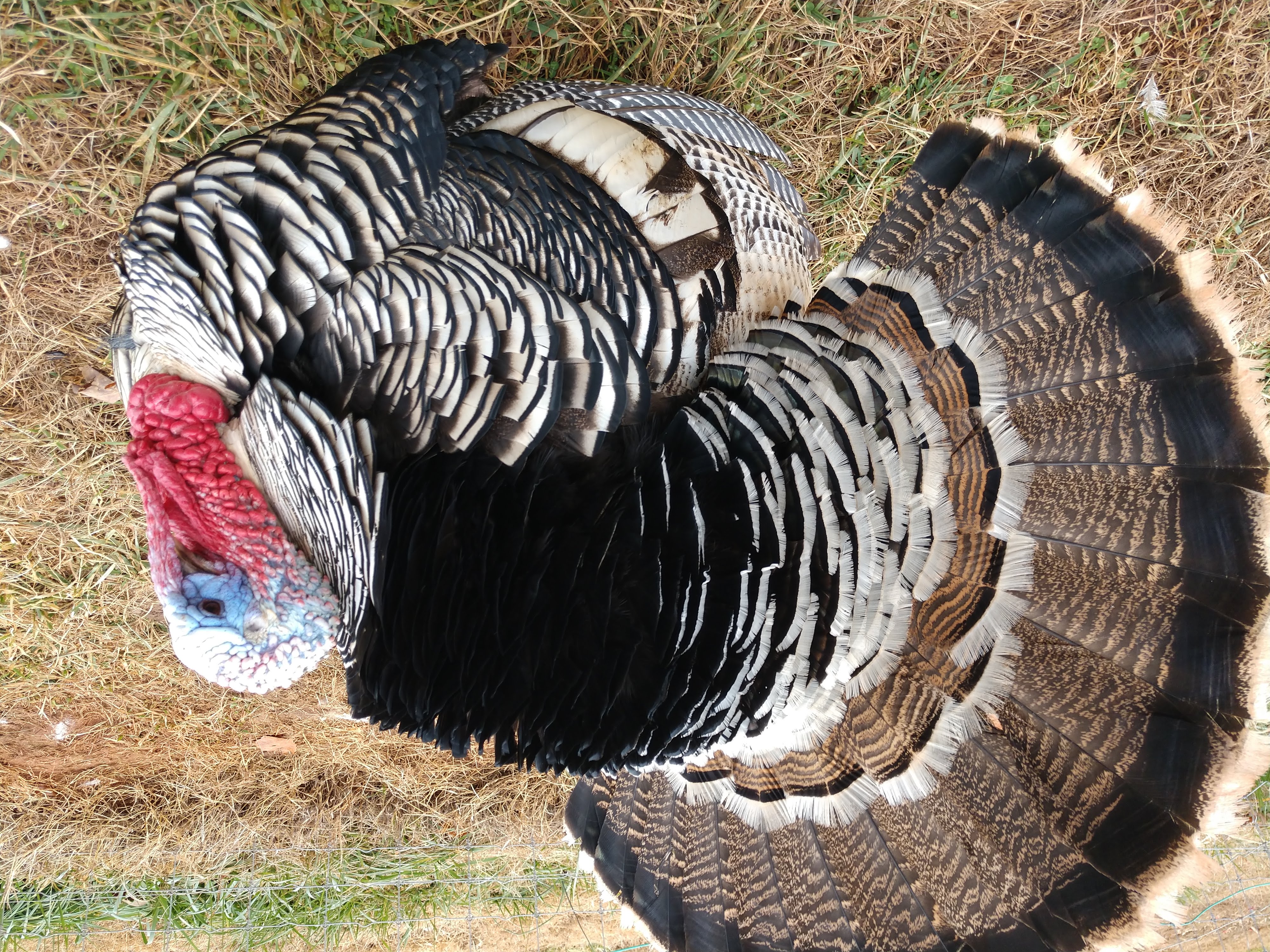
Black, gray, tan and white feathers create a pattern resembling Bronze with gray replacing much of its metallic copper. White wing bars are another useful identification feature. Its farm history combined foraging, reproduction and selection for productive table birds.
Adult feathers are black with a green sheen; young poults may show temporary pale or bronze feathers before adult plumage develops. Pink adult shanks and dark eyes accompany the characteristic color. Calm disposition and early maturation were historically important utility selection goals.
Royal Palms carry white feathers sharply marked with black, including distinctive tail bands. They are relatively small turkeys with a strong ornamental role, active foraging and good flight ability. Hens can brood, making natural flock reproduction possible under suitable management.
Rich red-brown body feathers contrast with white flight and tail feathers. Its historical table role included selection for a substantial breast and flavorful meat. It became commercially important in the 1930s and 1940s before broad-breasted strains took over.
Authentic White Hollands have longer legs and smaller breasts than broad-breasted commercial Whites. Their historical advantage was a clean-looking carcass without dark pinfeathers. White plumage alone cannot establish that a bird belongs to this heritage population.
Enter the breed world →A Midget White turkey illustrating one named variety within the broader Other Heritage Turkey Varieties group; this grouped heading is not one breed. · TurkZilla · CC BY 2.0
Watchvariety group
Other heritage turkey varieties
A variety name describes a maintained domestic population or color form; it does not create a separate zoological species. A useful learning profile should name the actual variety, explain its history and identify the standard or breeder organization relevant to that population.
Critical, Threatened, Watch and Recovering are this organization’s domestic-breed categories. Their definitions vary between livestock, rabbits and poultry. A category threshold is not a census of this breed, and a registry’s annual registrations are not a count of every living animal.
Compare future population figures by assessment year, geography and the animals counted. Keep a wild relative’s IUCN assessment separate from a domestic breed’s status.
Scientific field notes
Where these animals belong.
Domestic turkeys belong to Meleagris gallopavo. Their named heritage varieties describe domestic populations within the species, rather than separate species.
Ranks follow the linked reference’s treatment. Domestic names and wild relatives may be handled differently by other authorities.
Kingdom
Animalia
Phylum
Chordata
Class
Aves
Order
Galliformes
Family
Phasianidae
Genus
Meleagris
Species / domestic context
Meleagris gallopavo
Explore beyond appearance
Four questions for a living legacy.
01
Variety names and standards
What does the source actually establish, and which claims still need evidence?
02
Natural breeding and flock continuity
How did people, place and practical use shape the population we see today?
03
Census definitions and geographic scope
Which living breeding families can carry the population into another generation?
04
Brooding, housing and practical care
What would responsible stewardship require in time, facilities and ongoing support?
Knowledge belongs with its animal world.
Explore general turkeys knowledge in the species library. Each population has its own collection for breed-specific history, identity and conservation reports.