
Donkeys
Care foundations
One living story. Knowledge kept together.
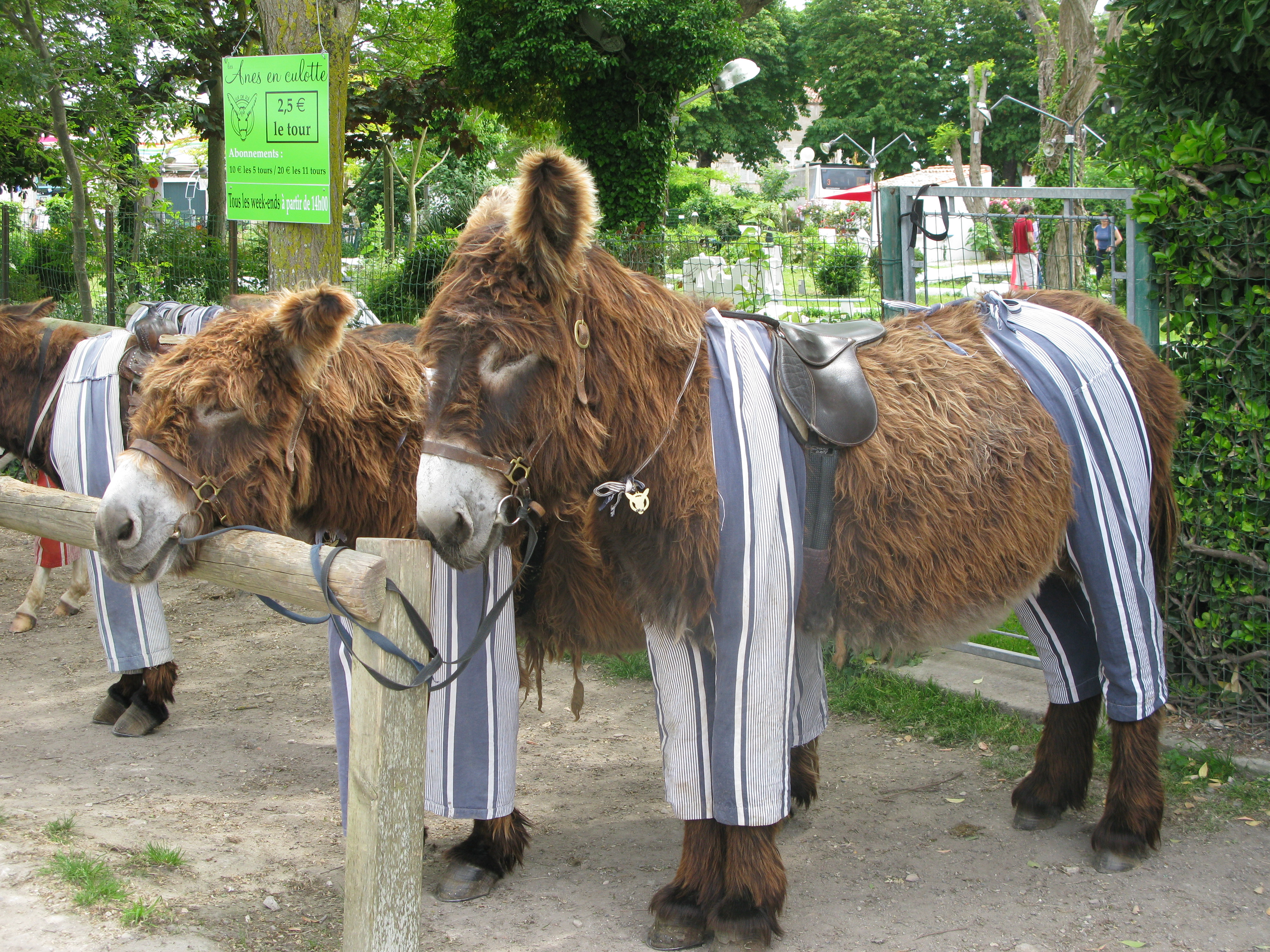
Poitou donkeys in Saint-Martin-de-Ré, photographed in 2013. · Jiel Beaumadier · CC BY-SA 4.0 · License terms
Understanding donkeys: care foundations
Donkey feeding cannot be assumed to match a similarly sized horse. Merck describes lower energy requirements and high-fiber, low nonstructural-carbohydrate feeding approaches. Rich pasture or unnecessary concentrate can promote excessive body condition. Conversely, severe restriction or starvation is dangerous because donkeys can develop hyperlipemia. A sound teaching article should explain the distinction between reducing excess energy and depriving an animal of forage and essential nutrients. Individual condition, teeth, workload and reproductive state matter.
These are general species foundations. The breed's own history and traits help explain how it developed, while an individual animal's age, environment and purpose shape its daily needs. Preservation includes keeping animals healthy enough to express normal behavior and maintain future generations. Compare dependable husbandry guidance with breed registry descriptions, and distinguish inherited traits from assumptions about toughness. Teaching the reasons behind care decisions gives readers a stronger foundation than applying one feeding formula to every animal.
Merck Veterinary Manual · Merck Veterinary Manual
Read the species care foundation guide →When a donkey stops eating: why a quiet change deserves attention
Appetite, hyperlipaemia and the difference between sensible weight management and food deprivation.
A donkey standing quietly beside its feed may look comfortable. That impression can be misleading. The Donkey Sanctuary’s clinical guidance describes sham eating: an unwell donkey may appear to chew while consuming little. Compare what disappears from the feeder with the donkey’s usual intake, manure output and behaviour. A new reduction in appetite deserves prompt veterinary contact rather than a wait for dramatic rolling or collapse. [1]
Donkeys are particularly vulnerable to hyperlipaemia, a serious disturbance associated with negative energy balance. When energy intake is inadequate, mobilisation of body fat can become harmful. Illness, pain and stress may initiate the problem; pregnancy and lactation raise nutritional demands. Being overweight does not protect a donkey from it. Diagnosis requires veterinary examination and blood testing, rather than judging the animal’s outline. [1]
Restoring an appropriate energy supply is part of veterinary treatment, alongside finding the original cause of poor intake. Dental discomfort, other painful illness or changes in routine may need investigation. This is why a sweet feed offered at home is not a complete treatment strategy. Owners can help by reporting the last confirmed meal and recent changes, while the veterinarian decides how to assess and support the animal. [1,2]
Donkeys are efficient users of forage, so a ration suitable for a working horse can supply excessive energy for some adult donkeys. University of Florida guidance stresses species-specific nutrition and body-condition assessment. The Donkey Sanctuary explicitly warns against starving a donkey with laminitis because of hyperlipaemia risk. Weight reduction should use a suitable, monitored feeding plan that maintains intake and accounts for teeth, age and reproductive stage. [2,3]
Bonded companionship can influence how a donkey copes with change. The Donkey Sanctuary advises considering companions during hospitalisation to limit separation stress and encourage eating. Ask the receiving veterinary facility how to handle a bonded pair safely. This recommendation is not proof that separation causes every appetite problem; illness still needs examination even when a plausible stressful event occurred. [1]
Conservation Legacy field exercise: record normal feed intake and behaviour before an emergency happens. If intake changes, note the time, feed offered and remaining, manure changes, medication and recent moves or separation. Keep photographs as supporting observations rather than diagnostic labels. A preservation record becomes more useful when it describes what an owner saw, when they saw it and what the veterinarian subsequently established.
Efficient fiber use does not mean no nutritional needs
The Donkey Sanctuary's clinical nutrition chapter explains that donkeys generally have lower energy requirements than similarly sized horses and ponies and are efficient users of fibrous forage. Feeding a sedentary donkey as though it were a working horse can therefore supply excessive energy.
A suitable diet must still meet nutritional needs and permit appropriate foraging. Lower energy requirements are not a justification for withholding food. Growth, pregnancy, nursing, work and recovery from illness alter the animal's circumstances.
Dental function matters especially when forage is coarse and fibrous. An animal may appear to mouth food without actually consuming it, a behaviour the clinical guidance calls sham eating. Watching chewing without checking intake can miss a serious problem.
Body-condition assessment should use a donkey-appropriate method rather than simply applying a horse score. Fat deposits and changes need to be interpreted for this species. A qualified adviser can assess forage, condition and life stage together. The important distinction is between controlling excess dietary energy and causing inadequate intake; a donkey's efficient digestion makes individual assessment more necessary, not less.
Quiet behaviour and the importance of a companion
Donkeys may show pain or distress less dramatically than horses. The Donkey Sanctuary describes this as stoicism, which can make illness easy to underestimate. A dull or unusually quiet donkey should be treated as an urgent veterinary concern, especially when appetite changes.
Reluctance to move is not automatically stubbornness. Fear, discomfort and uncertainty can produce freezing or defensive responses. Understanding the reason for the behaviour is safer than escalating force and assuming the animal simply refuses to cooperate.
Domestic donkeys can form strong bonds, often with another donkey. Separation can cause substantial stress and may affect feeding. The companion relationship should therefore be considered when planning transport, hospital care or other changes.
These observations are connected. A change after separation may involve both behaviour and health, rather than being only sadness or only a feeding problem. Calm, knowledgeable handling and attention to the donkey's normal routine help identify change. Individual reactions vary; the label donkey does not predict one identical temperament. A behaviour professional and veterinarian can help when fear or discomfort makes routine care difficult.
Pregnancy and a species-specific newborn assessment
The Donkey Sanctuary's clinical foal chapter emphasizes preventive care of the pregnant female and early attention to newborn problems. Gestation length varies, so a calendar prediction alone does not establish whether the foal is mature or whether birth is imminent.
The dam's nutrition and health affect colostrum and milk production. Pregnant and lactating donkeys have a particular need for attention to adequate intake and hyperlipemia risk. A donkey becoming quiet or eating less during these stages warrants prompt veterinary assessment.
The newborn needs to establish nursing and maternal acceptance. Protective antibodies are obtained through colostrum, and a veterinarian can assess passive transfer. A foal standing beside its mother is not proof that it has obtained enough.
Donkey foals can chill when wet despite their apparently substantial coat. Clean, dry shelter and suitable bedding support the early transition to independent temperature control. Their smaller size and species-specific physiology also matter to veterinary assessment. Horse instructions, particularly medication calculations, should not be copied casually. A weak, rejected or orphaned foal needs a professionally organized care plan rather than improvised feeding.
A dry refuge and knowledgeable foot care
The Donkey Sanctuary of Canada emphasizes covered, dry shelter, non-slip flooring and a comfortable bed. A donkey's hardy reputation does not remove its need to escape wet or extreme conditions. The shelter must be accessible to the animal, not merely present somewhere in the field.
Flooring and drainage affect the feet as well as the cleanliness of the coat. Watching the areas where donkeys stand and rest can reveal whether mud, slipping or persistent dampness is becoming a problem. Seasonal reassessment matters because a useful dry-season space may work differently after prolonged rain.
Donkey hooves require a farrier who understands their differences from horse hooves. A routine interval should be tailored to the individual and terrain rather than copied from a general example. Grooming also provides a chance to inspect skin and limbs for changes.
Observe daily appetite, droppings, willingness to move and interaction with companions. These details give context to a veterinary examination. The combination of suitable surroundings, competent foot and dental care and a known behavioural baseline supports welfare much more reliably than assuming that a quiet donkey is always comfortable.
Sources for general species learning
Keep learning from official information.
These research portals help locate further material. A search link is a route for exploration; it is separate from the sources used for the article above. Domestic breed information, wild-species assessment, historical books and new research need their own context.
- FAO DAD-IS · Domestic breed information
- IUCN Red List · Species assessments
- Biodiversity Heritage Library · Historical literature search
- USDA National Agricultural Library · Research search
- Google Scholar · Scholarly literature search
- Open Library · Book catalogue search
- HathiTrust · Digitized catalogue search