
Donkeys
Scientific identity
One living story. Knowledge kept together.
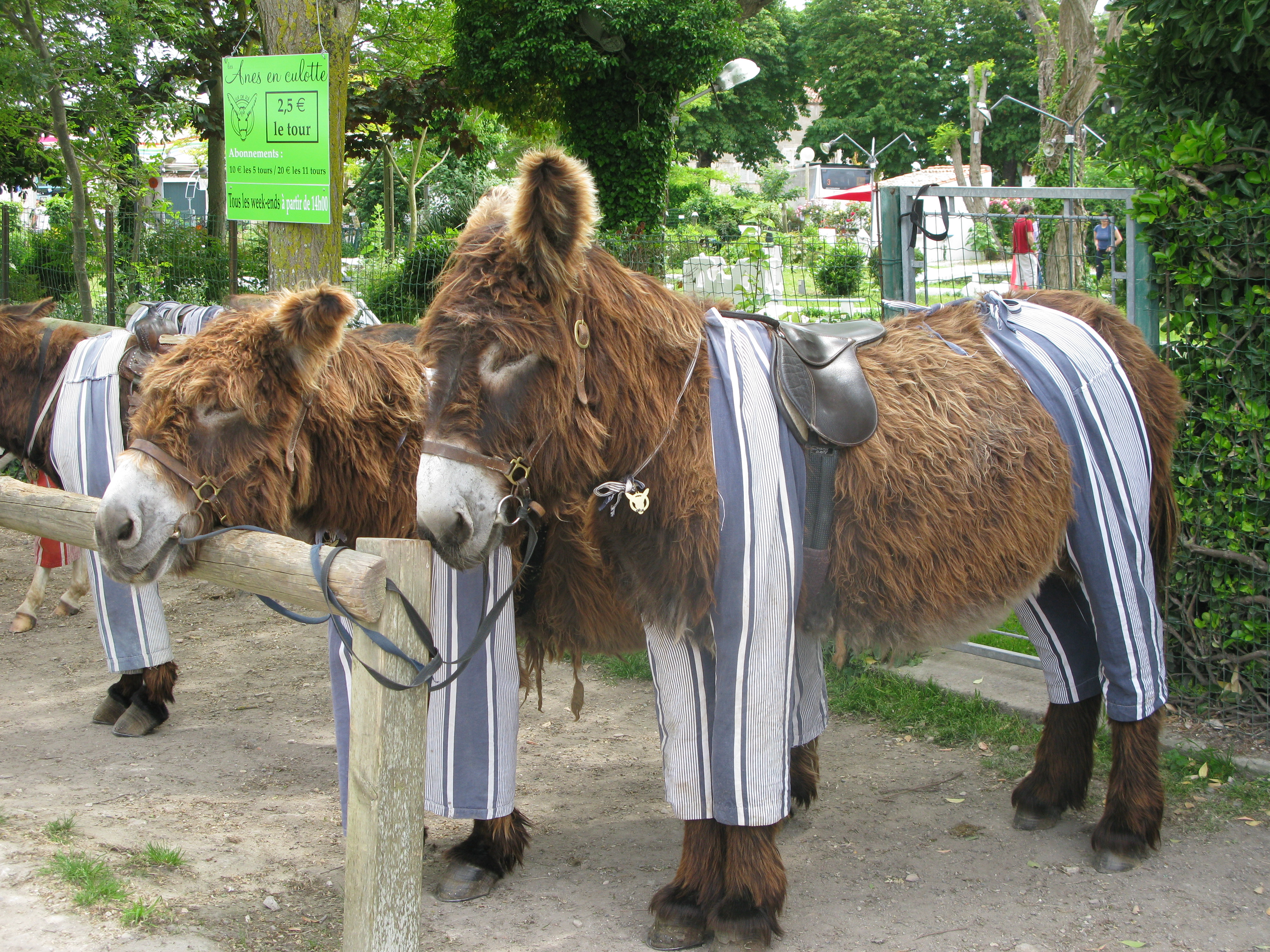
Poitou donkeys in Saint-Martin-de-Ré, photographed in 2013. · Jiel Beaumadier · CC BY-SA 4.0 · License terms
Understand the levels of identity.
This introduction follows Animal Diversity Web’s Equus asinus treatment. Its account discusses both domestic and wild populations; wild-ass conservation assessments must not be copied onto domestic donkey breeds.
Donkeys are herbivores with teeth adapted to grinding plant material. Their food choices can include grasses, herbaceous plants and browse, depending on availability. Like horses, they use hindgut fermentation, but their nutritional management should not simply copy that of a horse of similar size.
Merck's equid nutrition guidance explains the importance of high-fiber feeding and attention to energy intake for donkeys. Reducing excessive dietary energy is different from starving an animal: severe restriction can contribute to hyperlipemia. A teaching foundation should connect body condition, dental function and the animal's job to the way forage is supplied, without prescribing one ration for all donkeys.
Equus asinus Linnaeus, 1758
- Kingdom
- Animalia
- Phylum
- Chordata
- Taxonomic class
- Mammalia
- Order
- Perissodactyla
- Family
- Equidae
- Genus
- Equus
- Species
- Equus asinus
- GBIF treatment
- ACCEPTED
A taxonomic hierarchy places an animal in biological groups. A domestic breed or strain sits within a broader species framework; it is not automatically a separate biological species. A breed’s conservation status and a wild species’ IUCN status answer different questions.
Domestic naming is not uniform across all references. One authority may use a domestic species name while another treats it within a wild ancestor. The linked GBIF record shows the naming authority and the treatment used here, checked October 4, 2026. For this world, each named breed also has its own cultural and breeding identity.
Natural History Museum: how taxonomy works · Animal Diversity Web: group biology
Related equids, different animals
Donkeys and horses are close evolutionary relatives, but closeness does not make their anatomy and physiology interchangeable. Their differences are especially visible in reproduction: mating between the two produces hybrid equids, most familiar as mules and hinnies. These hybrids combine ancestry from different parental species. Their usual infertility illustrates that producing viable offspring and producing a reproductively self-sustaining population are different biological tests.
A mule is conventionally the offspring of a male donkey and a female horse; the reciprocal cross produces a hinny. A hybrid is not a new donkey breed, and its identity should not be placed within an ordinary donkey registry description. The biological differences between donkeys, horses and their hybrids also explain why horse-based assumptions can fail in clinical interpretation. Species-specific reference information matters. At the same time, an evolutionary comparison is not a diagnosis: individual size, age, condition, management and veterinary examination still determine what an animal actually needs.
Sources for general species learning
Keep learning from official information.
These research portals help locate further material. A search link is a route for exploration; it is separate from the sources used for the article above. Domestic breed information, wild-species assessment, historical books and new research need their own context.
- FAO DAD-IS · Domestic breed information
- IUCN Red List · Species assessments
- Biodiversity Heritage Library · Historical literature search
- USDA National Agricultural Library · Research search
- Google Scholar · Scholarly literature search
- Open Library · Book catalogue search
- HathiTrust · Digitized catalogue search