
Pigs
Care foundations
One living story. Knowledge kept together.
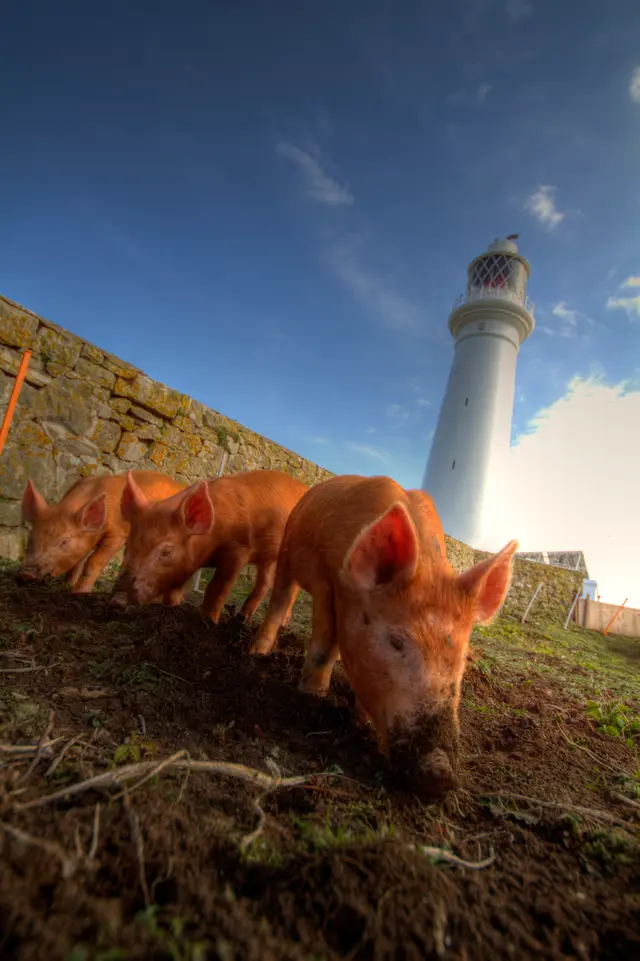
Tamworth pigs on Flat Holm Island, Wales. · Sam Sam · CC BY 2.0 · License terms
Understanding pigs: care foundations
Pigs are not ruminants. Pasture permits rooting, exploration, social behavior and foraging, but does not automatically supply a complete diet. Nutrient requirements vary with growth, body size, gestation and lactation. Feed intake is also influenced by temperature, crowding, feeder design, ventilation and feed quality. Outdoor pigs need protection from heat, dependable drinking water and shade; wallowing is part of their behavior and outdoor management. A preservation article should distinguish a breed's pasture suitability from an unsupported claim that it needs no balanced supplemental feed.
These are general species foundations. The breed's own history and traits help explain how it developed, while an individual animal's age, environment and purpose shape its daily needs. Preservation includes keeping animals healthy enough to express normal behavior and maintain future generations. Compare dependable husbandry guidance with breed registry descriptions, and distinguish inherited traits from assumptions about toughness. Teaching the reasons behind care decisions gives readers a stronger foundation than applying one feeding formula to every animal.
University Extension · University Extension · Merck Veterinary Manual · University Extension
Read the species care foundation guide →A pasture pig still needs a ration: rooting, nutrition and weather
Pasture can enrich a pig’s life, but feeding and thermal protection need their own plan.
A pig exploring soil and vegetation is doing more than finding calories. Oregon State University Extension describes pasture as an opportunity for movement and mental stimulation. These benefits help explain the appeal of heritage pigs on small farms. They do not establish that every pasture system meets every animal’s needs. Shelter, fencing, safe plants and dependable feeding remain part of the design. [1]
Pasture composition and available food change over time, while pigs still need an appropriate balance of energy, amino acids, vitamins and minerals. Penn State explains that pigs are monogastric animals whose growth and wellbeing depend strongly on diet composition. Grain, roots and kitchen leftovers do not automatically become complete feed when offered together. Use a suitable formulated ration or professional formulation rather than assuming natural variety guarantees adequacy. [1,2]
Growing pigs, gestating sows, nursing sows and breeding boars have different demands. Penn State describes phase feeding as changing the ration as pigs grow. Oregon State emphasises additional nutritional support for young pigs and the high requirements of lactating animals. The feed plan should identify the actual group, rather than treating a breed’s reputation for thriftiness as a ration specification. [1,3]
Pigs lose heat poorly through sweating. Shade, clean drinking water and suitable cooling opportunities are therefore fundamental during hot weather. Penn State highlights reduced feed intake, health effects and reproductive consequences of heat stress. Plan cooling before animals become distressed, and arrange veterinary help for severe signs. Piglets can also be vulnerable to cold, so one comfortable temperature cannot describe every life stage in a herd. [1,3,4]
Rooting changes the ground. Rotation and manure distribution need active management, as Penn State’s small-group guidance explains. A practical inspection should follow where soil is exposed, water collects and animals repeatedly gather. This is a site-management exercise, not proof that outdoor production is environmentally beneficial in every setting. The same breed can perform differently on different land, with different stocking and weather. [3]
Conservation Legacy field exercise: connect animal weights and body-condition observations with ration records, pasture moves, shelter checks and veterinary findings. Describe the feed used rather than writing only pasture-raised. If growth slows, investigate diet, health and environment before deciding the breed is inherently unproductive. For preservation, the useful story includes both the animal’s inherited characteristics and the care system that allowed those characteristics to be expressed.
A monogastric animal needs a balanced ration
Pigs are monogastric animals, and their nutritional needs differ from those of cattle and sheep. Penn State Extension emphasizes that feed composition directly affects growth and well-being. A pig's ability to eat many kinds of material does not mean every mixture supplies an appropriate balance of nutrients.
Energy, protein and the amino acids within that protein all matter. Life stage changes the purpose of the diet: a growing pig, a pregnant sow and a nursing sow should not be treated as identical feeding situations. The word protein on a feed label is only part of the nutritional picture.
Pasture can offer activity and opportunities to forage without becoming a complete diet by itself. A breed described as suited to outdoor management still needs nutritional assessment. Rustic appearance and historical use do not cancel the biological requirements of growth or lactation.
A feeding history should identify the actual ration, storage condition and water supply. It should also record changes and whether each animal can reach the feed. A qualified swine nutrition professional or veterinarian can interpret that history in relation to condition and growth, rather than relying on the assumption that a pig will find everything it needs.
The sow and piglets have different immediate needs
Birth in pigs is called farrowing. Penn State Extension's farrowing teaching describes late pregnancy as an important period of fetal growth and mammary development. Restlessness and nesting behaviour may precede birth, although these signs can be subtle. Preparation and knowledgeable observation are therefore more dependable than waiting for one dramatic sign.
Piglets arrive wet and must establish feeding and temperature control in a new environment. Chilling, inadequate colostrum and being crushed or stepped on are recognized hazards. A successful birth is consequently not the end of newborn care.
The sow and her litter occupy the same area but do not have identical thermal needs. Suitable piglet warming arrangements must protect the young without creating unsafe equipment or making the sow's environment unsuitable. Installation and monitoring matter alongside the presence of a heat source.
Every piglet deserves attention, including the smaller or less vigorous members of the litter. A headcount does not establish that all have nursed adequately. Difficult birth, exhausted or weak piglets and maternal illness require experienced veterinary help. Knowing what to observe should support timely assistance rather than encourage an untrained person to attempt obstetric procedures.
Rooting, shelter and usable space
Rooting is an ordinary pig behaviour with consequences for land management. Penn State Extension explains that outdoor pigs can disturb soil, create holes and produce muddy areas. The space required outdoors therefore concerns manure distribution and the condition of the land as well as the physical size of the animals.
Pigs still need shelter when kept on pasture. A useful shelter provides relief from weather and supports temperature management. Its effectiveness depends on ventilation, drainage and how the pigs use it, rather than on whether it looks substantial.
Feed, drinking and resting areas interact. Wet areas and manure should not make the bedding or feed dirty. Observing where pigs actually lie, drink and eliminate helps identify whether the arrangement is working.
Outdoor management needs regular reassessment as animals grow and the season changes. A pen suitable when dry may become difficult after repeated rain and rooting. Safe fencing must be maintained alongside the ground around it. The aim is an environment that supports ordinary behaviour while giving the pigs clean resources and protecting soil and water from avoidable damage.
Cold stress is an energy demand
Penn State Extension describes winter pig management in terms of heat loss and the animal's ability to compensate. Cold conditions can divert energy toward maintaining body temperature. Age, body size, bedding, air movement and the design of shelter influence the practical effect.
Keeping a pig out of rain is only part of the task. Damp bedding and drafts can make a resting place uncomfortable even beneath a roof. At the same time, ventilation remains necessary to remove moisture and maintain air quality.
Growth and feed intake should be considered in the context of the environment. A change in performance during cold weather cannot automatically be attributed to the breed or to poor-quality feed. The animal may be spending more energy on warmth, or an equipment problem may be restricting water.
Small piglets and larger pigs require different environmental assessment. A cold-weather plan should anticipate reliable drinking water, dry resting areas and safe equipment. Decisions about ration changes and housing should use local swine advice and the conditions of the actual animals, rather than one temperature or shelter specification applied to every heritage herd.
A small herd still needs biosecurity
USDA APHIS identifies African swine fever as a serious infectious threat to domestic and wild pigs. Disease prevention concerns the connections between pigs, people, vehicles, equipment, feed and other potential sources of contamination. The same principles matter for a family keeping a few pigs as for a larger producer.
Outdoor access creates a need to consider contact with feral swine. Shared tools and footwear can also connect properties even when pigs themselves never move. Looking only at the health of the visible animals misses these indirect pathways.
Keep a usable history of new arrivals and movements, and ask the herd veterinarian what separation and health checks are appropriate. A returning show animal has had an exposure history that differs from an animal remaining at home.
Human food waste requires particular attention. APHIS explains that the United States has a regulatory framework for garbage feeding to pigs. This chapter does not interpret a particular owner's legal obligations. The educational point is that scraps can introduce disease and cannot be presumed safe or nutritionally complete; current official requirements and veterinary guidance should inform any feeding practice.
Sources for general species learning
Keep learning from official information.
These research portals help locate further material. A search link is a route for exploration; it is separate from the sources used for the article above. Domestic breed information, wild-species assessment, historical books and new research need their own context.
- FAO DAD-IS · Domestic breed information
- IUCN Red List · Species assessments
- Biodiversity Heritage Library · Historical literature search
- USDA National Agricultural Library · Research search
- Google Scholar · Scholarly literature search
- Open Library · Book catalogue search
- HathiTrust · Digitized catalogue search