
Pigs
Scientific identity
One living story. Knowledge kept together.
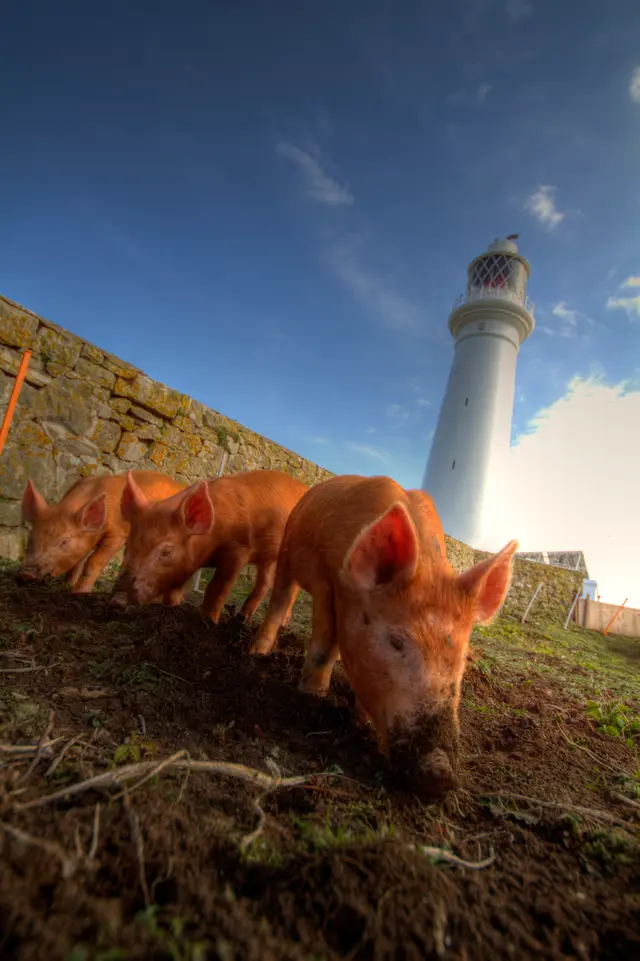
Tamworth pigs on Flat Holm Island, Wales. · Sam Sam · CC BY 2.0 · License terms
Understand the levels of identity.
Domestic pigs are associated with Sus scrofa; some classifications use the domestic designation Sus scrofa domesticus. The wild-boar species account supplies biological context, not a breed-specific risk assessment.
Pigs are not ruminants. Their omnivorous evolutionary background differs from the forage fermentation strategy of cattle and sheep. Rooting is a characteristic way of exploring and obtaining food. An outdoor pig can forage, but pasture alone does not necessarily satisfy the nutritional needs of growth or reproduction.
Management affects what those behaviors mean. A balanced diet, water, shade and a suitable environment support welfare in outdoor systems. Nutrient demand changes as animals mature and during gestation and lactation. The behavior of wild boar sounders provides ecological background, while group structure on a farm is shaped by human decisions and individual animals.
Sus scrofa Linnaeus, 1758
- Kingdom
- Animalia
- Phylum
- Chordata
- Taxonomic class
- Mammalia
- Order
- Artiodactyla
- Family
- Suidae
- Genus
- Sus
- Species
- Sus scrofa
- GBIF treatment
- ACCEPTED
A taxonomic hierarchy places an animal in biological groups. A domestic breed or strain sits within a broader species framework; it is not automatically a separate biological species. A breed’s conservation status and a wild species’ IUCN status answer different questions.
Domestic naming is not uniform across all references. One authority may use a domestic species name while another treats it within a wild ancestor. The linked GBIF record shows the naming authority and the treatment used here, checked October 4, 2026. For this world, each named breed also has its own cultural and breeding identity.
Natural History Museum: how taxonomy works · Animal Diversity Web: group biology
Why heat affects a pig differently
Pigs have limited effective cooling through sweating. Their thermal biology therefore differs from that of animals that lose substantial heat through active sweat glands. Blood flow toward the skin, respiratory heat loss and behavior become important when environmental temperature rises. Air temperature alone does not describe the challenge: humidity, solar radiation, airflow and the animal’s own heat production affect whether heat can leave the body.
Age and body size also matter. A newborn piglet can lose heat rapidly, while a large adult may struggle to shed it. Seeking shade, a cool surface or a wallow is therefore connected to physiology rather than merely untidiness. Fine hair and subcutaneous fat influence heat exchange, but neither a thick coat nor a heritage label guarantees tolerance of every climate. Research on thermoregulation separates mechanisms from assumptions, helping explain why thermal comfort must be interpreted for the individual animal and its environment.
Sources for general species learning
Keep learning from official information.
These research portals help locate further material. A search link is a route for exploration; it is separate from the sources used for the article above. Domestic breed information, wild-species assessment, historical books and new research need their own context.
- FAO DAD-IS · Domestic breed information
- IUCN Red List · Species assessments
- Biodiversity Heritage Library · Historical literature search
- USDA National Agricultural Library · Research search
- Google Scholar · Scholarly literature search
- Open Library · Book catalogue search
- HathiTrust · Digitized catalogue search