
Pigs
History & heritage
One living story. Knowledge kept together.
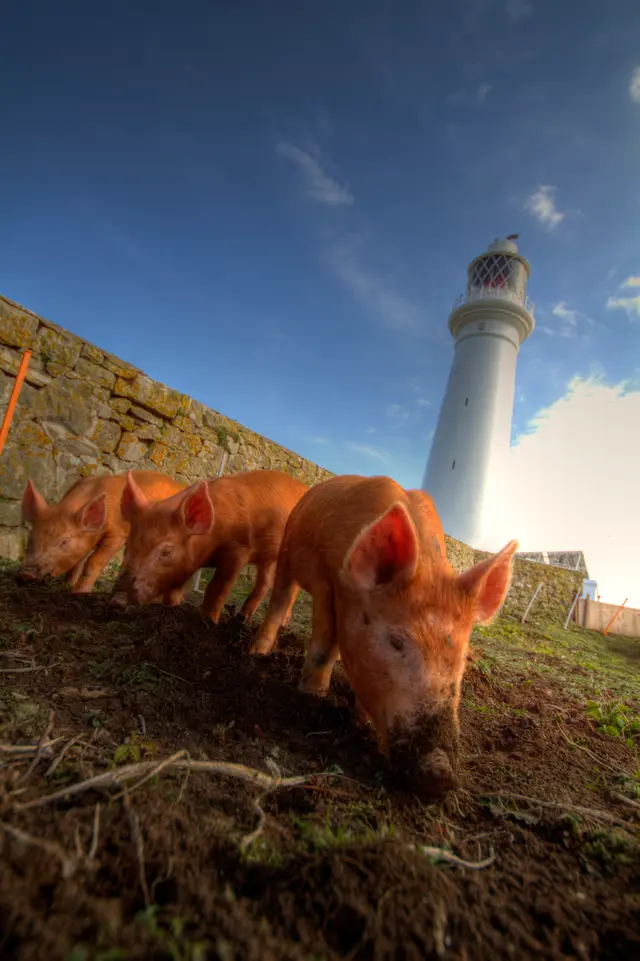
Tamworth pigs on Flat Holm Island, Wales. · Sam Sam · CC BY 2.0 · License terms
Follow the story behind the name.
Domestic pig histories connect to wild boar, Sus scrofa, while scientific naming of domestic forms can vary between taxonomic treatments. The wild-boar account is useful evolutionary background, but observations of wild populations are not automatically breed-specific facts. A heritage pig's registry and selection history must be treated separately.
Farmers selected pigs for different products and systems, including meat and fat. Some breeds became closely associated with outdoor foraging and regional food traditions. Later changes in markets and production preferences altered which populations remained useful to farmers. Following those choices explains rarity more clearly than presenting a conservation label without history.
Domestic animal history is made of many local stories. A species tells us about broad biological relationships; a breed or strain connects those relationships with a landscape, a community and generations of selection. The histories in this world follow those individual populations so regional differences can remain visible.
Some populations were deliberately developed from named foundation stock. Others took shape through long use in a region before a formal standard or studbook existed. The date of a breed society’s founding therefore need not be the date the animals first existed. Historical accounts need to identify which event a date describes.
Begin with a breed’s own story
Domestic pigs acquired new wild ancestry
Ancient DNA changed the interpretation of European pig history. A 2019 study found that pigs initially introduced from the Near East later underwent a near-complete turnover in genomic ancestry as European wild boar contributed to domestic populations. This was not simply a separate European domestication event. People continued maintaining domestic pigs while much of the underlying ancestry changed.
The result shows how domestication and gene flow can coexist. A domestic population need not remain genetically sealed from its wild relatives. Selection by people can continue acting on animals whose ancestry is becoming mixed. It also cautions against treating a breed name as a direct label for prehistoric origin. Modern heritage pigs descend through much more recent breeding histories within the species Sus scrofa. The study concerns broad ancient relationships and sampled populations; it cannot reconstruct the complete pedigree or conservation condition of an individual modern breed.
Sources for general species learning
Keep learning from official information.
These research portals help locate further material. A search link is a route for exploration; it is separate from the sources used for the article above. Domestic breed information, wild-species assessment, historical books and new research need their own context.
- FAO DAD-IS · Domestic breed information
- IUCN Red List · Species assessments
- Biodiversity Heritage Library · Historical literature search
- USDA National Agricultural Library · Research search
- Google Scholar · Scholarly literature search
- Open Library · Book catalogue search
- HathiTrust · Digitized catalogue search