
Poitou
Conservation & challenges
One living story. Knowledge kept together.
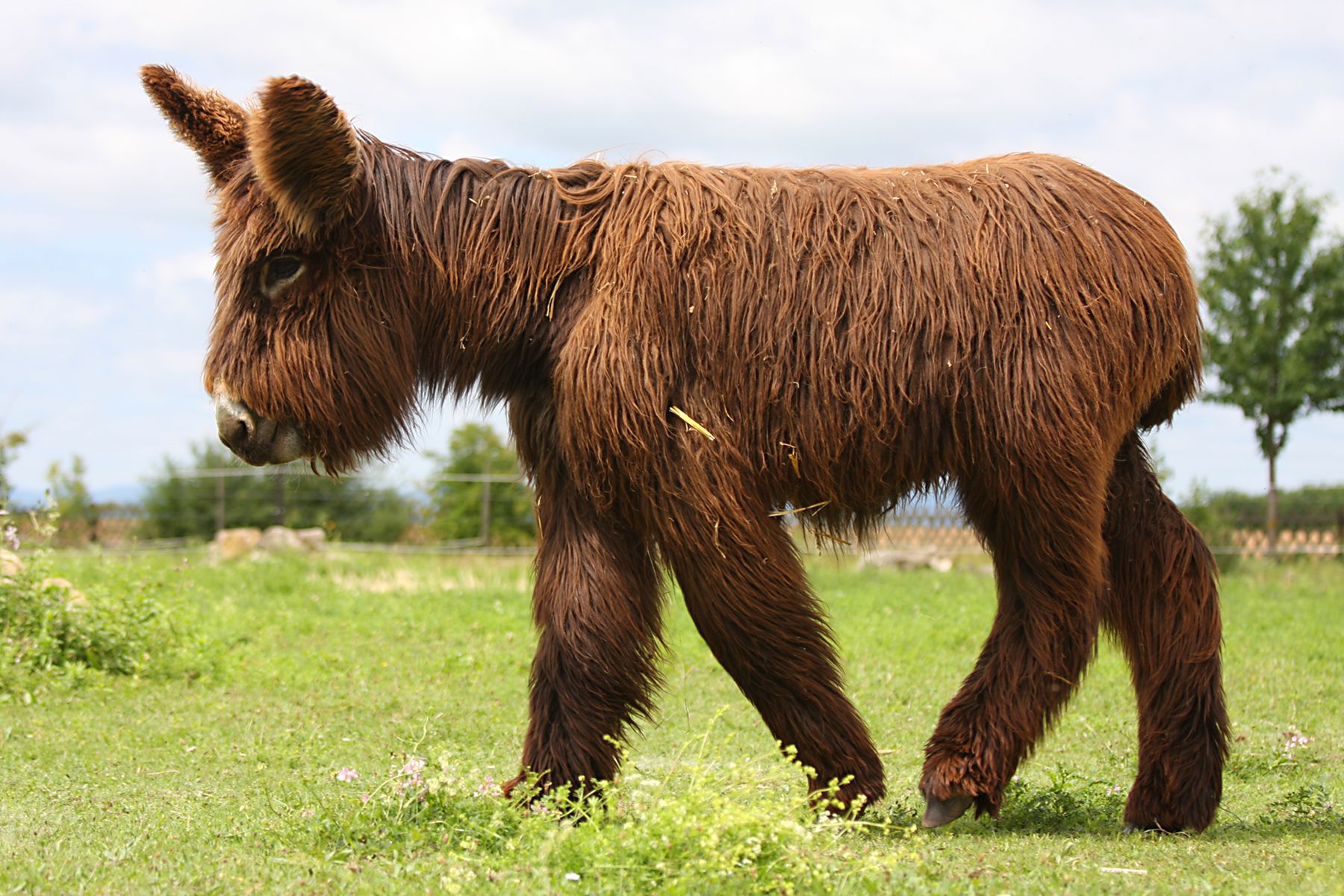
One-year-old Poitou donkey Amelie at Nature Life Ranch, Germany, in 2012. · Sudorculus · CC BY-SA 3.0 · License terms
What does this animal face?
The source reports fewer than 80 survivors by 1980 and about 2,500 pure animals registered in 2012; these are dated historical measures, not today's living census. American conservation work beginning in 2020 combined identification and DNA testing. Foal care and fertility remain important areas for experienced owners and their veterinarians.
For learners, the key distinction is between a donkey breed, a registry's standard, and the hybrid mules a jack may produce. Each answers a different question about identity. Those distinctions help readers compare photographs and historical accounts accurately.
This is The Livestock Conservancy’s domestic-population category. It conveys conservation concern without supplying a head count. Its current list and an older breed-profile fact panel may differ; keep each label with its source.
| Source | Reported category |
|---|---|
| 2026 priority list | Critical |
| Individual profile panel | Critical |
Conservation status and source-reported population evidence
Surviving donkeys
- Assessment year / period
- By 1980
- Geography / scope
- Geography not explicitly delimited in profile
Historical breed-survival figure; do not label a present-day census.
Read the source →Pure Poitous registered in studbook
- Assessment year / period
- 2012
- Geography / scope
- Studbook; geographic boundary not explicit
Registration population may include historical entries; not independently confirmed living stock.
Read the source →Animals identified and DNA tested
- Assessment year / period
- 2020–2022 search
- Geography / scope
- United States
Conservancy began census in 2020 and searched two years; identified animals entered new studbook.
Read the source →These measures describe different dates, places and populations. They should not be added together or treated as a new census conducted by Conservation Legacy.
FAO’s DAD-IS keeps domestic breed information by country and maintains population-history tools. A useful statistic retains its date, geography and definition: breeding females, registrations, sampled animals and all living animals are different measures. A historical low point is meaningful history, but should not be presented as a current census.
The Livestock Conservancy: 2026 list · FAO: population-data framework · IUCN: species assessment questions
One hundred animals.
Different breeding foundations.
Compare the same total with different numbers of breeding males and females. This simplified model illustrates why a head count alone cannot describe a population’s genetic future.
These are teaching examples, not estimates for the breed on this page. The formula assumes an idealized breeding population. Relatedness, unequal offspring contributions, changing numbers and overlapping generations require more detailed analysis. It does not predict a specific mating’s inbreeding or recommend a breeding plan.
Model basis: FAO, monitoring animal genetic resources (1992), section 4.2. Further guidance: FAO, In vivo conservation of animal genetic resources (2013).
Conservation as a regional, reproductive effort
CREGENE, a regional conservation organization, anchors the Poitou's documented history in a 1717 royal-council memoir describing an established mule-producing industry. This is firmer evidence than presenting an uncertain ancient origin as a proven founding date. It records a 1977 population of 44 animals—20 males and 24 females—distributed among fourteen owners. That is a historical warning about a severe bottleneck, not a contemporary census.
The organization's account describes a coordinated rescue decision in November 1979 involving the Marais Poitevin regional park, national studs, and mule-breeding organizations. The experimental breeding center at Dampierre-sur-Boutonne combined genetics, husbandry improvement, preservation of local knowledge, and public education. CREGENE also reports that its work following the park's herd continued until 2024, when an absorption-breeding conservation program reached its seventh generation.
This history explains why the Poitou's shaggy coat is only the starting point of its identity. Recovery required coordinated reproduction across a geographically dispersed population and attention to ancestry. An educational collection should distinguish purebred conservation from mule production: the latter explains the breed's historic purpose, while sustaining the donkey population requires donkey offspring. The account's undated total of 400 purebred animals in France is not used here as a current statistic.
Sources for general species learning
Sources behind the breed’s story.
The original history, identity and conservation teaching above draws on these cited accounts. Official links open the full material for further study.
Keep learning from official information.
These research portals help locate further material. A search link is a route for exploration; it is separate from the sources used for the article above. Domestic breed information, wild-species assessment, historical books and new research need their own context.
- FAO DAD-IS · Domestic breed information
- IUCN Red List · Species assessments
- Biodiversity Heritage Library · Historical literature search
- USDA National Agricultural Library · Research search
- Google Scholar · Scholarly literature search
- Open Library · Book catalogue search
- HathiTrust · Digitized catalogue search