
Teeswater
History & heritage
One living story. Knowledge kept together.
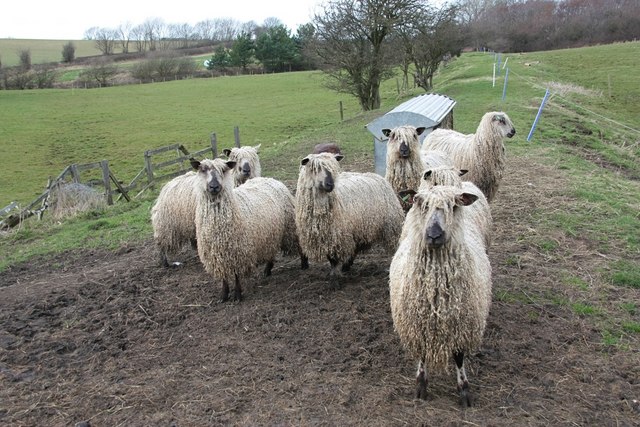
Teeswater sheep at a feeding point on a former railway line, North Yorkshire, England. · Paul Buckingham · CC BY-SA 2.0 · License terms
Follow the story behind the name.
Teeswaters take their name from the River Tees region of England. Their history includes the use of large longwool rams to produce crossbred market lambs from smaller hill sheep.
Teeswater takes its name from the River Tees region of England. Rams traditionally contributed to crossbred market-lamb systems; American development included imported semen in 1997 and first half-Teeswater lambs in 1998.
Large bodies and long, lustrous fleece distinguish this northern English sheep. Its crossing role and fiber qualities both deserve explanation. The American establishment story includes progressive breeding with imported genetic material, rather than a simple single shipment of a complete flock.
The Teeswater’s role in hill-sheep crossing
The Teeswater Sheep Breeders’ Association recounts how farmers in the Tees Valley retained rams for crossing with smaller hill ewes when the pure breed became scarce. That working role helped preserve the source breed while producing crossbred females suitable for more fertile lowland farms.
The association was formed in 1949 with breed purity and the use of Teeswater sires among its purposes. Teeswater-derived half-bred sheep became known as Mashams. These crossbred sheep are connected to Teeswater history, but they are not equivalent to the purebred population.
The association’s history also links changing wool economics in the 1970s with greater interest in crosses carrying less fleece. That is a concrete example of how markets can affect a breeding system and its source breeds. The long fleece and crossing role are therefore connected parts of Teeswater identity, rather than separate curiosities.
Sources for general species learning
Sources behind the breed’s story.
The original history, identity and conservation teaching above draws on these cited accounts. Official links open the full material for further study.
Keep learning from official information.
These research portals help locate further material. A search link is a route for exploration; it is separate from the sources used for the article above. Domestic breed information, wild-species assessment, historical books and new research need their own context.
- FAO DAD-IS · Domestic breed information
- IUCN Red List · Species assessments
- Biodiversity Heritage Library · Historical literature search
- USDA National Agricultural Library · Research search
- Google Scholar · Scholarly literature search
- Open Library · Book catalogue search
- HathiTrust · Digitized catalogue search