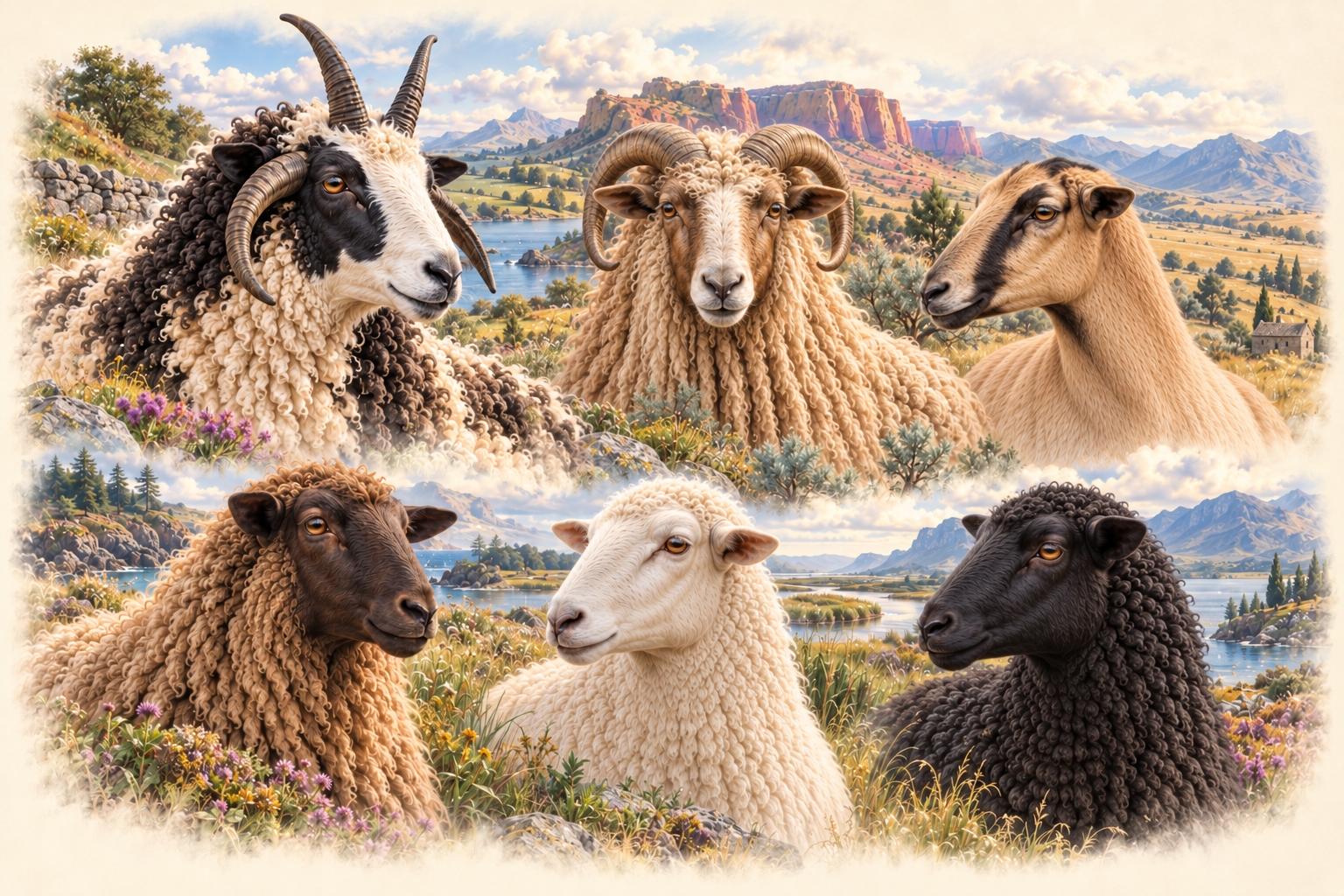
Fiber, landscapes and the families behind a flock.
Sheep heritage reaches from fleece and food to the landscapes and communities that shaped each flock. Breeds differ in the history of their use and the traits their keepers preserved. A rare breed’s future depends on more than a total head count: it also depends on breeding families, reliable records and people able to carry the flock forward. Learn the breed’s own story before assuming all sheep share one conservation problem.
The long fleece and varied colors are tied to textile uses as well as livestock adaptation. This is a cultural and biological resource. The Diné name Dibé dits'ozí refers to long-fleeced sheep, and community knowledge is part of what breed conservation needs to respect.
Wool covers the body while shorter hair occurs on parts of the legs and underside. They are active, moderate-sized sheep with meat and fiber uses. Their value lies in regional suitability and maternal function, not simply comparison with the largest commercial market lamb.
White Romeldales and patterned CVMs should both remain visible in education. The CVM's badger-face pattern can include dark facial markings, underside, and legs. Fine wool and meat usefulness matter alongside the color that often attracts handspinners.
The breed is primarily used for meat, with a hair coat, foraging ability, and a reputation as an easy keeper. It grows more slowly than some specialized meat sheep. Milk and browsing functions add context beyond a narrow comparison of sale weight.
Long isolation and survival in challenging conditions produced a distinctive resource. Wool is a principal use in the listed population. Their conservation story is especially useful for teaching how a domestic population can acquire important characteristics outside a conventional organized breed program.
Independent foraging, hardiness, and the flock's barrier-island history are central to its identity. Wool and living-history interpretation remain important uses. The population makes a direct connection between ordinary agricultural life and the environmental conditions that shaped livestock.
Red-faced sheep with a meat-oriented, dual-purpose tradition became recognizable in American farming. Their medium-grade wool is also useful. Newborn coloring and processed fleece appearance can differ, showing why one photograph or wool sample cannot tell the whole production story.
Lustrous long wool is the signature resource of English Leicester. The fleece's sheen connects the sheep to specialist textile uses. Its identity differs from modern Border Leicester and from crossbred descendants that benefited from historical Leicester improvement.
The resulting meat breed combined muscling and hardiness with the influence of a substantial longwool parent. Quiet behavior and maternal qualities appear in breed accounts. Lamb coloring changes with maturity, a useful reminder that age affects how breed photographs should be interpreted.
White faces, long bodies, and horns in both sexes characterize the horned type; ram horns are much heavier than ewe horns. Grazing and dual-purpose production belong to its agricultural identity. Horned animals should not be confused with modern polled Dorsets.
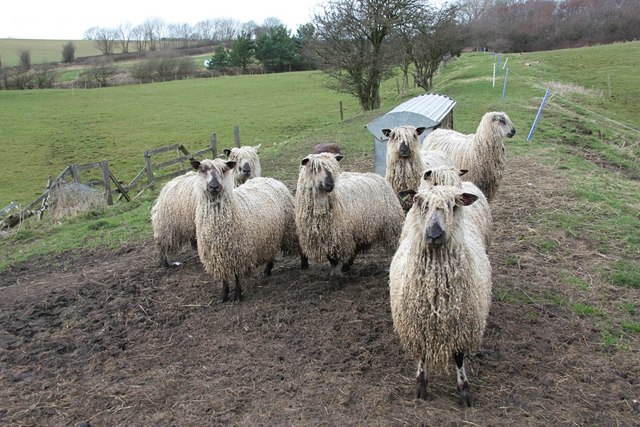
Large bodies and long, lustrous fleece distinguish this northern English sheep. Its crossing role and fiber qualities both deserve explanation. The American establishment story includes progressive breeding with imported genetic material, rather than a simple single shipment of a complete flock.
As a longwool breed, its fleece character and substantial body are important to its identity. It belongs alongside, but remains distinct from, Leicester and Lincoln. Handcraft uses can help readers understand why longwool qualities matter beyond modern market-lamb growth comparisons.
The characteristic tan-to-brown body and dark underside accompany a hair coat and meat use. Relatively small size and slower maturation reflect the population's development. Horned American Blackbelly crosses should not be assumed to be pure Barbados Blackbelly sheep.
The fat-tailed type reflects a pastoral background different from British Downs and longwool sheep. Historically the breed had multiple uses, and American conservation considers the descendants maintained locally rather than assuming all Karakul populations worldwide share identical breeding circumstances.
Large body size, long wool, and a generally calm disposition characterize the breed. The Conservancy describes suitability for cool climates and good maternal ability. Its fleece offers a clear comparison with fine-wool, hair-sheep, and Downs populations.
Small, short-tailed, agile animals retain a primitive sheep form and commonly brown or tan wild-pattern coloring. Rams and ewes can differ in horn expression. The British registered conservation population should be distinguished from other sheep advertised broadly as Soay.
Horns and a naturally shedding coat distinguish it from wool-focused English breeds. Meat use and reduced reliance on shearing help explain its appeal. It remains a specific breed, even when its traits are used to develop other shedding sheep.
The breed has a dual-purpose farming role and medium wool. Its regional setting offers a useful example of sheep shaped by upland agriculture rather than solely by exhibition standards. A generally docile reputation should remain separate from promises about an individual sheep.
Their importance centers on adaptation to a humid, parasite-challenged environment. The population is known under several regional names, including Woods and Native sheep. Those names reflect local history and should be explained rather than mistaken for separate species.
The completely black fleece is useful to handspinners seeking natural color. The Conservancy describes a short, dense wool staple and a small-bodied mountain type. This is a distinct breed, not simply a label for every dark Welsh or upland sheep.
Shetlands belong to the northern short-tailed family: small, fine-boned sheep with varied fleece colors and traditional wool value. Most rams have horns and most ewes are polled. Seasonal breeding and a naturally short tail reflect their northern development.
Jacobs are conspicuously spotted and may have multiple horns. Wool is an important use, and the combination of fleece, body, and horn characteristics is more informative than spots alone. The listed American population must be considered in its own context.
A black face, dual-purpose usefulness, and generally calm temperament form part of its identity. Feed efficiency and growth are valued, but claims about performance must be understood in the feeding conditions of the animals described.
Critical, Threatened, Watch and Recovering are this organization’s domestic-breed categories. Their definitions vary between livestock, rabbits and poultry. A category threshold is not a census of this breed, and a registry’s annual registrations are not a count of every living animal.
Compare future population figures by assessment year, geography and the animals counted. Keep a wild relative’s IUCN assessment separate from a domestic breed’s status.
Scientific field notes
Where these animals belong.
This introduction uses Ovis aries for domestic sheep. Older biological accounts may discuss wild forms alongside domestic populations; that context should remain separate from domestic-breed status.
Ranks follow the linked reference’s treatment. Domestic names and wild relatives may be handled differently by other authorities.
Kingdom
Animalia
Phylum
Chordata
Class
Mammalia
Order
Artiodactyla
Family
Bovidae
Genus
Ovis
Species / domestic context
Ovis aries
Explore beyond appearance
Four questions for a living legacy.
01
Fleece and hair-sheep differences
What does the source actually establish, and which claims still need evidence?
02
Cultural histories and local adaptation
How did people, place and practical use shape the population we see today?
03
Flock records and breeding-family diversity
Which living breeding families can carry the population into another generation?
04
Grazing systems and species-specific health
What would responsible stewardship require in time, facilities and ongoing support?
Knowledge belongs with its animal world.
Explore general sheep knowledge in the species library. Each population has its own collection for breed-specific history, identity and conservation reports.