
Lilac
History & heritage
One living story. Knowledge kept together.
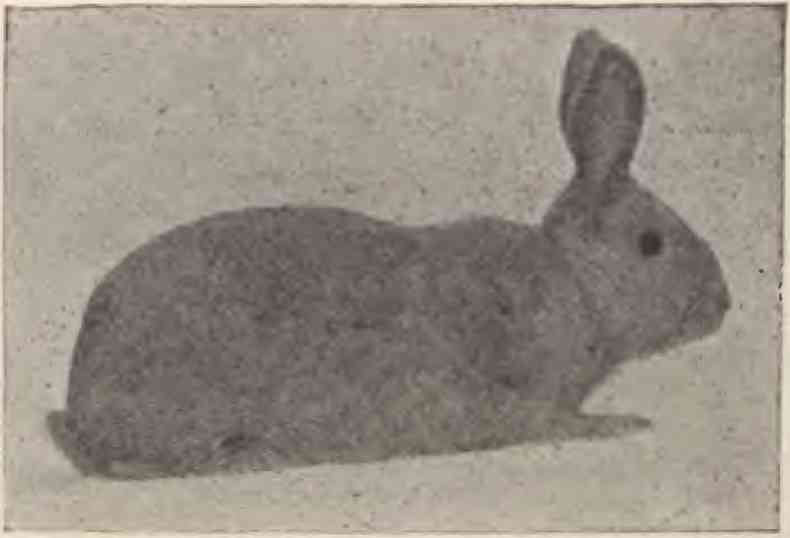
Archival Lilac buck, labeled in the 1928–1929 ARBA predecessor guidebook, printed page 61. Historical monochrome photograph; coat color cannot be judged from this image. · American Rabbit and Cavy Breeders Association · ARBA Digital Library · Public domain in the United States · published 1928 · License terms
Follow the story behind the name.
Several breeders developed Lilac-colored rabbits independently during the early twentieth century. British work included H. Onslow, Mabel Illingworth, and R. C. Punnett; related Dutch work produced the Gouda form. British strains eventually merged under the Lilac name. Imports from England reached America in 1922.
The characteristic pinkish dove-gray coat gives the breed its name. Historical strains varied in color and size, so a Lilac-colored rabbit is not necessarily the established Lilac breed. Overall type and documented breeding continuity distinguish a breed from a color mutation.
Lilac: a breed shaped by people
The National Lilac Rabbit Club describes development in the Netherlands and England, including C. H. Spruty's Gouda and R. C. Punnett's Cambridge Blue. Its account explains the blue Beveren and Havana cross used in the English work. Imports to North America followed during the 1920s. The club later became inactive and was reorganized in 1952. That sequence shows why a breed's continuity depends on people as well as animals. A lovely coat can attract attention, but a lasting community is needed to preserve knowledge, sustain breeding families and help new keepers understand what the name represents.
Sources for general species learning
Sources behind the breed’s story.
The original history, identity and conservation teaching above draws on these cited accounts. Official links open the full material for further study.
Keep learning from official information.
These research portals help locate further material. A search link is a route for exploration; it is separate from the sources used for the article above. Domestic breed information, wild-species assessment, historical books and new research need their own context.
- FAO DAD-IS · Domestic breed information
- IUCN Red List · Species assessments
- Biodiversity Heritage Library · Historical literature search
- USDA National Agricultural Library · Research search
- Google Scholar · Scholarly literature search
- Open Library · Book catalogue search
- HathiTrust · Digitized catalogue search