
Meet the
Gloucestershire Old Spots.
Gloucestershire Old Spots developed in England’s Vale of Berkeley. Their farm history includes orchards and dairy by-products, linking a spotted, lop-eared pig with practical small-farm resource use.
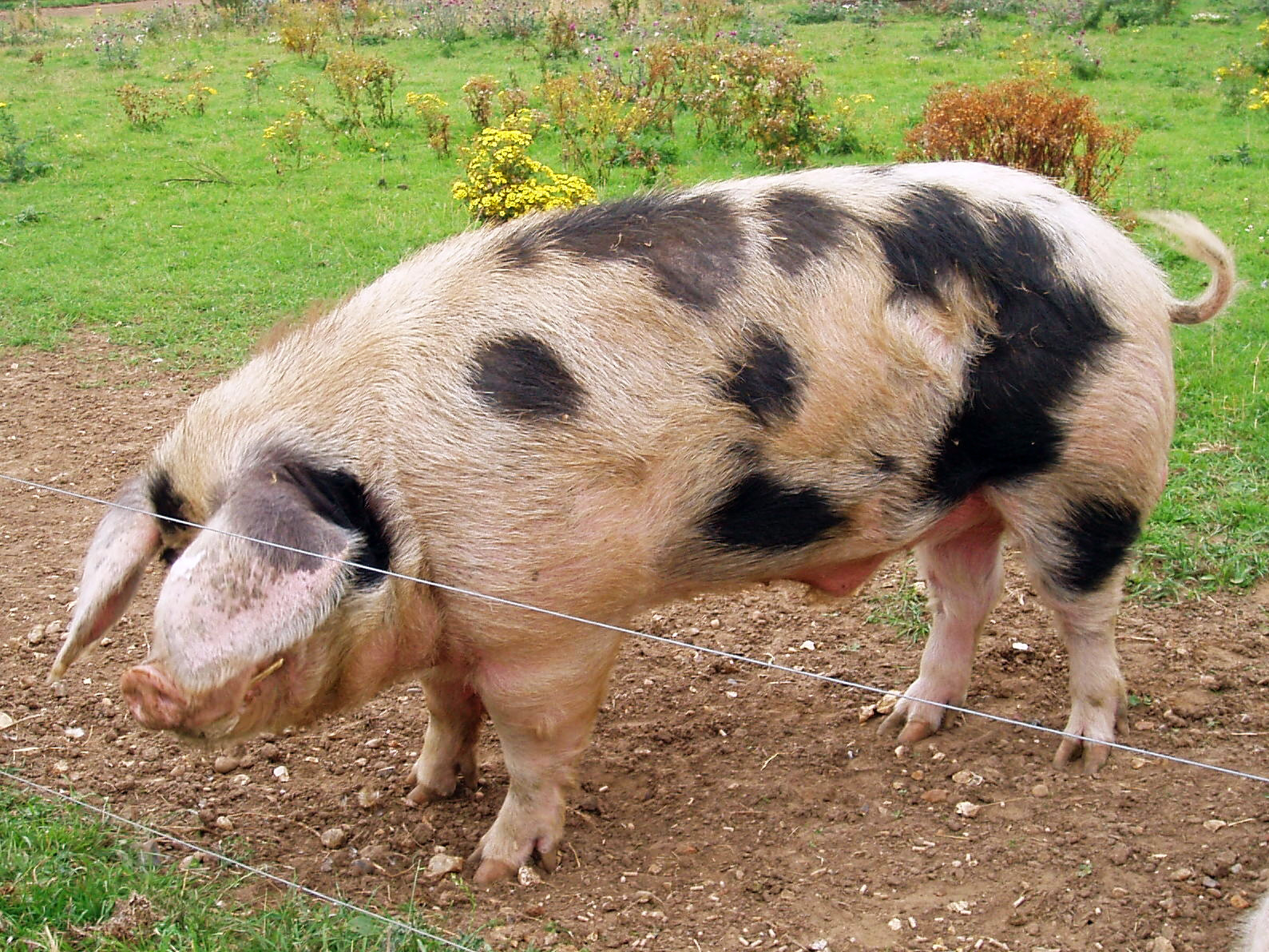
Amanda Slater · CC BY-SA 2.0 ↗ · Reuse terms
Origins, people & changing purpose
History & heritage
Gloucestershire Old Spots developed around the Vale of Berkeley in England during the nineteenth century. Small farms kept them around dairies and orchards, using whey, fallen fruit, and other available feed resources. Their nicknames include cottage pig and orchard pig. The story that apples caused their spots is folklore rather than a biological explanation.
Sources for this passage
Interpreting the breed's agricultural heritage
The orchard pig belongs to a farm economy in which dairying, fruit growing, and animal husbandry supported one another. That relationship makes an engaging environmental history, but a list of traditional by-products is not a nutritionally complete modern ration. Explain how the system worked before drawing conclusions about what an individual pig should eat.
The apple-bruising story is memorable precisely because it joins coat pattern to local farming. It belongs in a folklore discussion, with its status explicit. A biological account should not convert that story into an explanation of inherited pigmentation. Readers can enjoy the tradition while learning to distinguish cultural meaning from mechanism.
Recognizing the breed
Size, details & appearance
Look closely at the features that make this animal distinctive.
Amanda Slater · CC BY-SA 2.0 · License
Size reference
Source-reported weight references ↗ · checked October 5, 2026.
Market weight and adult weight describe different stages. Values are reference information, not individual growth guarantees.
Meat, Lard/Back Fat
Docile
Animal identity
A pale coat with black spots and large lop ears distinguishes the breed. Its heritage reflects a mixed-farm economy in which livestock used agricultural by-products. Coat pattern is useful for recognition, but documented breeding background and overall type remain important.
Sources for this passage
The structure beneath the spotted coat
Gloucestershire Old Spots of America's breed page connects the familiar color with a complete functional type. It describes a medium-length head with a slightly dished nose, forward-dropping ears, a long level back, and broad loin. Straight strong legs and well-filled hams accompany that outline; the spots alone do not explain the animal.
The page calls for at least fourteen well-placed teats. That detail introduces maternal function as part of breed assessment rather than an afterthought. It also lists objections involving structure and coat, showing that the selection framework concerns more than keeping one black patch on white skin.
An October 2025 update changes pedigree naming so that females take their dam's name and males their sire's. The older colored family groups described farther down the page are identified as historical. Those group colors denote lineage labels, not differently colored coats. Preserving the distinction prevents a reader from expecting a red or blue Old Spots pig.
Scientific identity & inheritance
Sus scrofa Linnaeus, 1758
- Kingdom
- Animalia
- Phylum
- Chordata
- Taxonomic class
- Mammalia
- Order
- Artiodactyla
- Family
- Suidae
- Genus
- Sus
- Species
- Sus scrofa
- Domestic population
- Gloucestershire Old Spots
Scientific identity
Pigs are not ruminants. Their omnivorous evolutionary background differs from the forage fermentation strategy of cattle and sheep. Rooting is a characteristic way of exploring and obtaining food. An outdoor pig can forage, but pasture alone does not necessarily satisfy the nutritional needs of growth or reproduction.
Management affects what those behaviors mean. A balanced diet, water, shade and a suitable environment support welfare in outdoor systems. Nutrient demand changes as animals mature and during gestation and lactation. The behavior of wild boar sounders provides ecological background, while group structure on a farm is shaped by human decisions and individual animals.
The animal in its landscape
Ecology & human landscapes
Rooting changes soil and vegetation. In a managed pasture system, rotation and recovery are therefore part of the animal's story, not merely background farm details. Feral and introduced wild pigs can cause serious ecological damage; that problem should not be confused with preserving a rare domestic breed in a controlled herd.
Good teaching holds both ideas together: an animal may be an important agricultural genetic resource while its unmanaged relatives create habitat conflicts. A heritage page should explain what makes the breed distinctive, what pressures reduced it, and how suitable human management connects preservation with land care. Pasture suitability should never become a promise that feeding or fencing is unnecessary.
Keeping and raising the animal
Care foundations
Pigs are not ruminants. Pasture permits rooting, exploration, social behavior and foraging, but does not automatically supply a complete diet. Nutrient requirements vary with growth, body size, gestation and lactation. Feed intake is also influenced by temperature, crowding, feeder design, ventilation and feed quality. Outdoor pigs need protection from heat, dependable drinking water and shade; wallowing is part of their behavior and outdoor management. A preservation article should distinguish a breed's pasture suitability from an unsupported claim that it needs no balanced supplemental feed.
These are general species foundations. The breed's own history and traits help explain how it developed, while an individual animal's age, environment and purpose shape its daily needs. Preservation includes keeping animals healthy enough to express normal behavior and maintain future generations. Compare dependable husbandry guidance with breed registry descriptions, and distinguish inherited traits from assumptions about toughness. Teaching the reasons behind care decisions gives readers a stronger foundation than applying one feeding formula to every animal.
Sources for this passage
Function, care, and continuing stewardship
Conservation protects more than spotted color. Breed organizations provide a place to explore standards and breeding continuity; historical sources explain the mixed-farm setting. Keeping those roles separate makes the library useful. For everyday care, group behavior and food access require observation even in a breed described as accommodating, because a breed reputation cannot predict every interaction.
From a newborn piglet to a capable forager.
Follow the animal from its beginning through the changes in feeding, shelter, behavior and care. Select a stage to look closer.
Healthy adults can contribute to the next generation; care and documented ancestry connect the cycle.

Warmth & first milk
Piglets need rapid colostrum access. Chilling can make a weak piglet less able to compete for milk.
What to observe
Watch successful nursing, warmth, contact with the mother and the condition of each youngster.
Sow and litter
The sow supplies milk, while safe farrowing space protects resting piglets from accidental crushing without blocking nursing.
Fostering & supplemental care
Where milk access is inadequate, experienced keepers may use planned fostering or supplementation. Warmth, dryness, cleanliness and monitored intake work together.
Life-stage teaching sources
- Merck Veterinary Manual · approximate gestation periods ↗
- Virginia Cooperative Extension · reducing preweaning piglet losses ↗
Conservation Legacy original teaching. Image captions identify the pictured animal; general species examples remain separate from selected-breed images.
See when life changes.
Body growth, reproductive development and managed weaning describe different changes. Explore the reference windows beside the care they help explain.
Gestation
114 daysApproximate species reference for planning.
Evidence ↗After birth or hatch · reference windows
General domestic pigs; husbandry context. Bars share a time axis measured from birth or hatch; each label retains its source units.
Some systems 6–8 weeks; not a breed average.
Source for this window ↗What its future depends on
Conservation & challenges
Conservation protects a farm tradition as well as a visually appealing pig. Keeping separate family lines, useful breeding function, and accurate origin stories supports that purpose. Historical orchard management should be explained as context, not assumed to provide a complete modern feeding plan.
The larger lesson is that preserving a breed means retaining a living range of inherited traits. A distinctive photograph introduces the animal, but history, functional qualities, and continuity of several families explain why it merits preservation.
Sources for this passage
Stewardship of the national herd
GOSA's ethics statement describes members as stewards of both the national herd and the information that establishes its continuity. It connects welfare, honest representation, and sound breeding choices. Animals with doubtful parentage should not be registered, and animals known to carry inherited defects or undesirable breeding attributes should not be represented as suitable breeding stock.
The significance for a learning library is broader than paperwork. A breed can retain attractive photographs while losing the reliable relationships that explain which animals belong to its population. Equally, preserved pedigrees mean little if the living animals are poorly cared for. The association treats these responsibilities as connected.
The statement also encourages reasonable support for new owners and a collaborative educational role. That makes conservation a transfer of practical knowledge as well as animals. These principles can inform the public account of the breed now, without requiring this app to collect individual records before its educational foundation is built.
Sources for this passage
Read this article in its own place →Conservation status and source-reported population evidence
A directly verified population measure has not yet been established for this page. Its conservation category remains useful, but does not supply a current head count.
Carry this animal’s story forward.
A documented photograph, a keeper’s experience or a carefully sourced correction can strengthen the next person’s understanding. This account connects with the breed’s own knowledge collection and common area.