
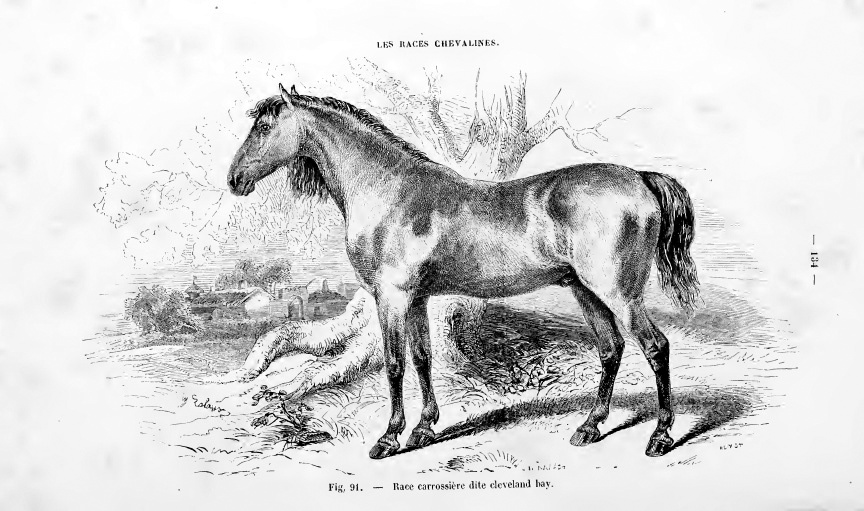
Cleveland Bay
Scientific identity
One living story. Knowledge kept together.
Understand the levels of identity.
The domestic horse profile here follows Equus caballus. Taxonomic classification identifies the species; a studbook and pedigree document particular breed populations and families.
Horses are herbivorous hindgut fermenters. Microbes in the cecum and large colon help release energy from fibrous plants after food has passed through the stomach and small intestine. This differs from cattle's rumen-based digestion. Forage and feeding arrangements therefore belong in an explanation of horse biology, rather than appearing only as a shopping list of feeds.
Horses are social animals, and feral populations form groups with relationships that change as animals mature or move. Domestic grouping is managed by people. Space and access to feed must account for competition; a herd's presence does not guarantee that every individual eats adequately. Wild or feral group descriptions are background, not a fixed template for a ranch.
Equus caballus Linnaeus, 1758
- Kingdom
- Animalia
- Phylum
- Chordata
- Taxonomic class
- Mammalia
- Order
- Perissodactyla
- Family
- Equidae
- Genus
- Equus
- Species
- Equus caballus
- GBIF treatment
- ACCEPTED
A taxonomic hierarchy places an animal in biological groups. A domestic breed or strain sits within a broader species framework; it is not automatically a separate biological species. A breed’s conservation status and a wild species’ IUCN status answer different questions.
Domestic naming is not uniform across all references. One authority may use a domestic species name while another treats it within a wild ancestor. The linked GBIF record shows the naming authority and the treatment used here, checked October 4, 2026. For this world, Cleveland Bay also has its own cultural and breeding identity.
Natural History Museum: how taxonomy works · Animal Diversity Web: group biology
Our PPR genetics article demonstrates why a trait test, an ancestry study and a breed registry provide different kinds of evidence.
What Cleveland Bay research teaches about genetic recovery
The Cleveland Bay provides an unusually well documented example of using population genetics to guide rare-breed preservation.
The Cleveland Bay provides an unusually well documented example of using population genetics to guide rare-breed preservation. A 2021 study evaluated sixteen years of management based on pedigree relationships and mean kinship. The work reported improvement in the population's genetic management after breeders adopted recommendations through the SPARKS advisory scheme.
Mean kinship asks how closely an animal is related, on average, to the breeding population. It differs from the inbreeding coefficient of a proposed foal, which concerns the relatedness of that foal's parents. Both perspectives matter. A mating can avoid an immediately close relative yet still repeatedly use ancestry already common throughout the population.
The study updated its calculations as new registrations and losses changed the population. This detail is essential: a recommendation is not timeless. A horse's conservation significance can change as other animals reproduce, cease breeding or die. Responsible preservation therefore needs current information about the breeding population, rather than a permanent list of favourite stallions.
A separate 2020 study combined pedigree and microsatellite evidence and identified restricted diversity, supporting the need for structured management. These findings concern the studied population and methods; they should not be turned into a diagnosis for every Cleveland Bay. A pedigree is a population planning tool, while an individual horse still requires its own assessment of soundness, health and suitability.
The practical lesson concerns how breeding choices affect the whole population. A famous ancestor, a show record and a distinctive appearance tell only part of the story. Family representation can explain why breeders choose a less familiar mating. A preservation programme should make those choices understandable without implying that a rare pedigree outweighs welfare or that a single numerical score answers every breeding question.
Success is best described as a continuing process. A small population needs cooperation among owners, accessible advice and accurate updates to its records. Teaching the Cleveland Bay's management history can help visitors see conservation as organized work with measurable outcomes, rather than simply admiration for a beautiful bay horse.
Sources for general species learning
Sources behind the breed’s story.
The original history, identity and conservation teaching above draws on these cited accounts. Official links open the full material for further study.
Keep learning from official information.
These research portals help locate further material. A search link is a route for exploration; it is separate from the sources used for the article above. Domestic breed information, wild-species assessment, historical books and new research need their own context.
- FAO DAD-IS · Domestic breed information
- IUCN Red List · Species assessments
- Biodiversity Heritage Library · Historical literature search
- USDA National Agricultural Library · Research search
- Google Scholar · Scholarly literature search
- Open Library · Book catalogue search
- HathiTrust · Digitized catalogue search