
Modern Game
Animal identity
One living story. Knowledge kept together.
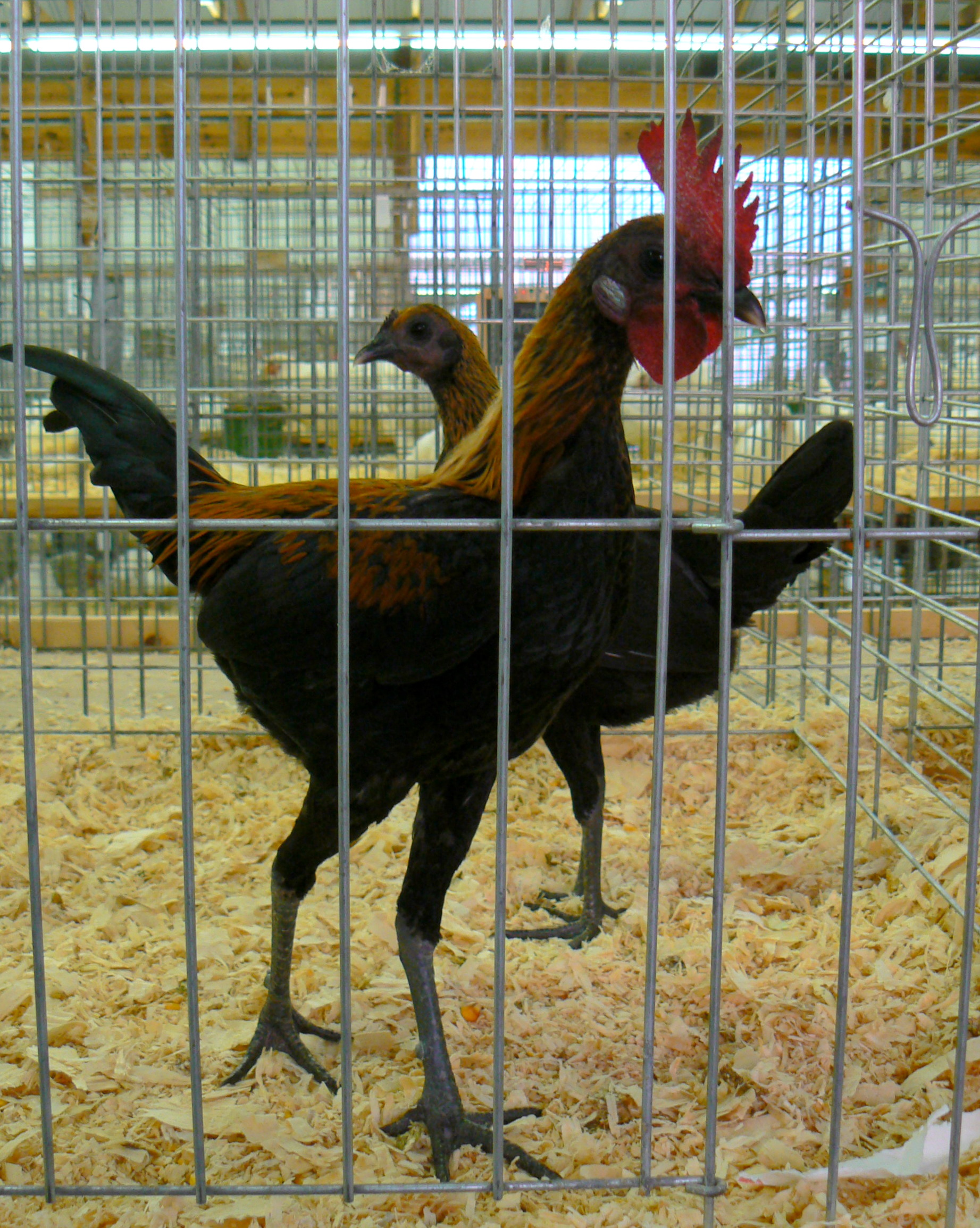
A pair of Modern Game chickens at a poultry show, with the male in the foreground. · Benny Mazur · CC BY 2.0 · License terms
Recognize what makes this population itself.
The breed's tall legs, upright stance and close, hard feathering create a highly stylized silhouette. Its purpose is chiefly exhibition and ornament, rather than abundant egg production or a fast-growing table carcass. It therefore requires evaluation against its own historical selection goals.
Its limited laying and primarily ornamental role should guide expectations. An exhibition population can have conservation value even when it does not compete economically with specialized meat or egg-producing chickens.
Appearance introduces the animal; a registry standard explains a documented breeding population. A photograph, color or familiar informal name alone cannot establish every individual’s membership.
- Recorded roles
- Ornamental
- Egg Color
- White
- Egg Size
- Medium
- Breed Weight
- Male 9 lbs. / Female 7 lbs.
Reference values from the breed’s conservation profile. Weight describes a reference animal, not a universal feeding or fitness target. Temperament varies with breeding, individual experience and handling.
Colors do not replace the breed outline
The club explains that the same general characteristics apply across its recognized colors. This is useful when building a teaching gallery: a different feather pattern should still be illustrated on the characteristic Modern Game form. A color label alone is insufficient, and a recognized British color list should not be silently substituted for another country's exhibition rules.
Interpreting this population in practice
How its documented identity shapes learning and conservation.
Modern Game birds should be evaluated within their exhibition history rather than ranked as failed egg or meat producers. Their unusual height and close feathering make posture highly visible, but responsible selection must still consider sound movement. Present the shift from historical fighting use to exhibition as a cultural change, with today's preservation centered on welfare and coherent breeding.
An exhibition silhouette shaped by selection
Modern Game chickens illustrate how exhibition priorities can reshape a domestic animal. Long legs, a slim body and close feathering became central to their distinctive appearance as breeders selected increasingly tall birds.
The Conservancy traces their development to Malay and Old English Game crosses in nineteenth-century England. The result is maintained chiefly for exhibition and ornamental interest, rather than high egg output or a heavy meat carcass.
The source describes slow maturation, activity and a preference for warmer conditions. Its reported egg output is modest, around 50–80 a year. Our interpretation is that a conservation collection should recognize such a breed’s cultural and breeding history even when commercial production measures do not favor it. The striking silhouette should remain anatomically convincing in artwork. It is a full adult form, not a generic chicken stretched vertically, and its physical identity belongs beside an explanation of how people’s selection created it.
Sources for general species learning
Sources behind the breed’s story.
The original history, identity and conservation teaching above draws on these cited accounts. Official links open the full material for further study.
Keep learning from official information.
These research portals help locate further material. A search link is a route for exploration; it is separate from the sources used for the article above. Domestic breed information, wild-species assessment, historical books and new research need their own context.
- FAO DAD-IS · Domestic breed information
- IUCN Red List · Species assessments
- Biodiversity Heritage Library · Historical literature search
- USDA National Agricultural Library · Research search
- Google Scholar · Scholarly literature search
- Open Library · Book catalogue search
- HathiTrust · Digitized catalogue search