
Modern Game
History & heritage
One living story. Knowledge kept together.
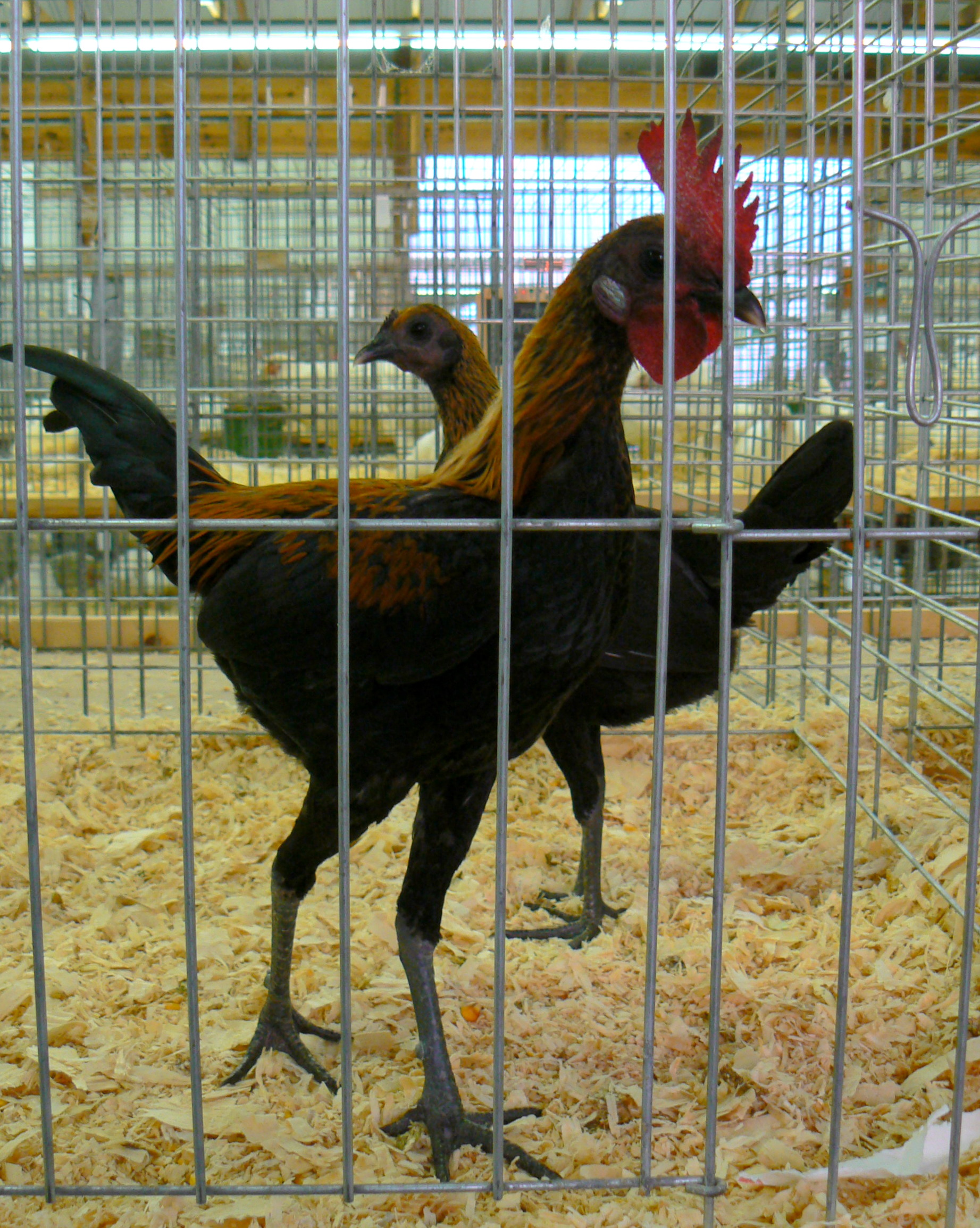
A pair of Modern Game chickens at a poultry show, with the male in the foreground. · Benny Mazur · CC BY 2.0 · License terms
Follow the story behind the name.
Modern Game chickens developed in England from Malay and Old English Game influences. As exhibition replaced the historical fighting role, selection increasingly favored the tall, closely feathered show form.
Following England's 1849 fighting ban, exhibitors increasingly selected gamefowl for show carriage. The name Exhibition Game appeared around 1870; by 1910 the Modern Game identity and its supporting club were established.
The breed's tall legs, upright stance and close, hard feathering create a highly stylized silhouette. Its purpose is chiefly exhibition and ornament, rather than abundant egg production or a fast-growing table carcass. It therefore requires evaluation against its own historical selection goals.
Its limited laying and primarily ornamental role should guide expectations. An exhibition population can have conservation value even when it does not compete economically with specialized meat or egg-producing chickens.
Malay influence and the exhibition population
The Poultry Club describes Modern Game as a product of Malay crossing and British fanciers' selection. Its color history names black-red, duckwing, brown-red, pile and birchen among the original recognized forms. These are variations within an established body identity, not different species or a single uniform ancestral gamefowl population.
Sources for general species learning
Sources behind the breed’s story.
The original history, identity and conservation teaching above draws on these cited accounts. Official links open the full material for further study.
Keep learning from official information.
These research portals help locate further material. A search link is a route for exploration; it is separate from the sources used for the article above. Domestic breed information, wild-species assessment, historical books and new research need their own context.
- FAO DAD-IS · Domestic breed information
- IUCN Red List · Species assessments
- Biodiversity Heritage Library · Historical literature search
- USDA National Agricultural Library · Research search
- Google Scholar · Scholarly literature search
- Open Library · Book catalogue search
- HathiTrust · Digitized catalogue search