
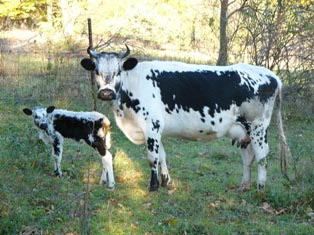
Randall or Randall Lineback
Animal identity
One living story. Knowledge kept together.
Recognize what makes this population itself.
A white back line runs through a variable dark, roan, or speckled coat. These horned New England cattle retain dairy, beef, and working-ox uses. Protective maternal behavior and an assertive disposition make regular, competent handling important.
Appearance introduces the animal; a registry standard explains a documented breeding population. A photograph, color or familiar informal name alone cannot establish every individual’s membership.
- Recorded roles
- Triple
- Adult Weight
- Cows: 600-1000 lbs.
- Temperament
- Docile, Assertive
- Experience Level
- Advanced
- Country of Origin
- United States
Reference values from the breed’s conservation profile. Weight describes a reference animal, not a universal feeding or fitness target. Temperament varies with breeding, individual experience and handling.
A lineage defined by more than colour
The Randall registry distinguishes ancestry from appearance. A pale back and darker sides occur in several cattle populations; that colour pattern does not establish Randall identity. The registry instead centres its definition on the Vermont herd’s history, documented parentage and inherited working characteristics.
Unlike many show-oriented breed societies, it publishes no detailed cosmetic breed standard. Its stated fullblood requirements include reliable documentation, registered parents and freedom from defects or disease. Within that framework, size and body type can vary between families. Preserving this variation matters because a narrow visual ideal could exclude part of an already small gene pool.
The registry describes Randalls as cattle for cool climates and forage-oriented, comparatively low-input farms, with milk production, meat and draft uses. Its discussion of milk output emphasizes how strongly management affects comparisons. Selecting breeding stock therefore requires attention to the individual animal’s function and family, rather than assuming every Randall has identical size, temperament or production. The registry’s descriptions are breeder observations, not guarantees that animals require no veterinary care.
Sources for general species learning
Sources behind the breed’s story.
The original history, identity and conservation teaching above draws on these cited accounts. Official links open the full material for further study.
Keep learning from official information.
These research portals help locate further material. A search link is a route for exploration; it is separate from the sources used for the article above. Domestic breed information, wild-species assessment, historical books and new research need their own context.
- FAO DAD-IS · Domestic breed information
- IUCN Red List · Species assessments
- Biodiversity Heritage Library · Historical literature search
- USDA National Agricultural Library · Research search
- Google Scholar · Scholarly literature search
- Open Library · Book catalogue search
- HathiTrust · Digitized catalogue search