
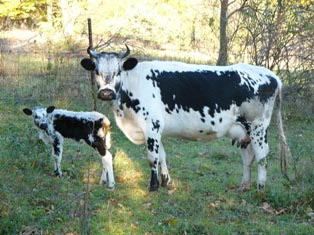
Randall or Randall Lineback
History & heritage
One living story. Knowledge kept together.
Follow the story behind the name.
Randall cattle preserve part of New England’s older lineback-patterned cattle heritage. Their precise ancestry remains uncertain; the conservation account associates them with the region’s mixed European foundation cattle and its tradition of multipurpose family herds.
The Randall family maintained a Vermont herd without outside crossing for more than eighty years. A remnant saved after its dispersal became the foundation of conservation breeding.
A white back line runs through a variable dark, roan, or speckled coat. These horned New England cattle retain dairy, beef, and working-ox uses. Protective maternal behavior and an assertive disposition make regular, competent handling important.
A rescue became a continuing conservation effort
A 2011 Cornell Small Farms account describes how the remnants of the Randall family’s Vermont herd became the focus of a rescue after Everett Randall died in 1985. It reports Cynthia Creech’s purchase of surviving animals and subsequent work rebuilding a population. The story concerns a particular closed herd and its descendants, rather than every cow with a lineback coat pattern.
The article also describes plans for satellite herds, maintaining cow families and preserving genetic material. Geographical distribution can reduce the possibility that one local disaster affects every surviving animal. Maintaining distinct families gives later breeders options that would be lost if a single fashionable sire dominated the population.
Vermont formally recognized the Randall Lineback as a heritage breed in March 2006. Recognition helped make its cultural significance visible, but a designation cannot replace continued breeding and husbandry. Population figures and organizational disputes reported in this 2011 feature belong to that historical moment; they should not be presented as the breed’s current census or current organizational arrangements.
Sources for general species learning
Sources behind the breed’s story.
The original history, identity and conservation teaching above draws on these cited accounts. Official links open the full material for further study.
Keep learning from official information.
These research portals help locate further material. A search link is a route for exploration; it is separate from the sources used for the article above. Domestic breed information, wild-species assessment, historical books and new research need their own context.
- FAO DAD-IS · Domestic breed information
- IUCN Red List · Species assessments
- Biodiversity Heritage Library · Historical literature search
- USDA National Agricultural Library · Research search
- Google Scholar · Scholarly literature search
- Open Library · Book catalogue search
- HathiTrust · Digitized catalogue search