
Hackney Horse
History & heritage
One living story. Knowledge kept together.
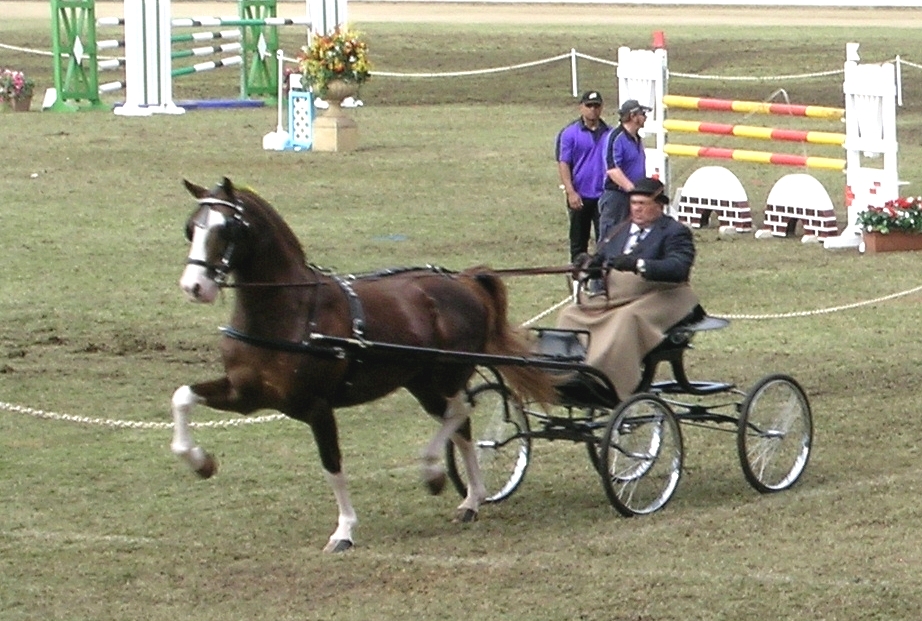
Hackney horse driving at the 2011 Sydney Royal Easter Show. · Cgoodwin · CC BY-SA 3.0 · License terms
Follow the story behind the name.
The Hackney Horse emerged from eastern England's roadster and trotting populations, including the Norfolk Trotter and Yorkshire Roadster, with Thoroughbred influence. Early selection emphasized stamina and speed for road travel. The Hackney Stud Book Society formed in 1883 as driving reached a period of strong popularity.
Changes in transport altered the breed's work. Shorter carriage journeys placed greater emphasis on style and conspicuous action. The horse's elevated, energetic trot remains a central part of its identity, but the Hackney Horse is distinct from the Hackney Pony developed through crossing with pony breeds. Conservancy concerns apply to the horse population and especially to remaining historic strains.
The Hackney Horse: a road horse beyond the show image
The Hackney Horse developed from the Norfolk trotting tradition, with selection for speed and style.
The Hackney Horse developed from the Norfolk trotting tradition, with selection for speed and style. The American Hackney Horse Society connects its development with improved British roads and the expansion of driving. Better road surfaces changed what people needed: a fast, elegant trotter could find a different role from a heavy horse pulling through deep ruts.
The association dates the British studbook society to 1883 and the American society to 1891. These institutions made pedigrees and organized promotion part of the breed's future. They followed the earlier development of the horses; a registry's founding date should not be mistaken for the beginning of every horse population it records.
AHHS distinguishes Hackney Horses from smaller Hackney ponies and describes the horse in carriage and combined driving as well as riding disciplines. Its defining trot combines elevated action with forward movement and powerful propulsion. The visual excitement is most informative when the entire movement can be seen, including the hindquarters and straightness, rather than just a still image of one raised knee.
Versatility means that different individuals can take part in different activities, not that every horse arrives trained for all of them. A carriage horse has learned a particular job involving vehicle, harness and driver. Riding, jumping and competitive trail work require their own preparation. Understanding the actual training history avoids turning a list of possible disciplines into a guarantee.
The conservation story also differs between the horse and the pony. A lively pony show scene cannot be assumed to describe the breeding base of full-sized Hackney Horses. When reporting numbers or preservation work, the size category and registry population need to remain clear.
The road history offers a useful lesson about changing demand. A breed can survive by finding new uses while still needing to retain its recognizable function and documented families. Modern driving interest gives the Hackney a visible role, but long-term continuity also depends on breeders, owners and the transfer of safe driving knowledge.
For someone learning about the breed, the best sequence is to watch correctly identified horses, understand the characteristic trot and then examine the individual's experience. Dramatic action can attract attention; dependable preparation and suitable handling determine how that action fits a real partnership. The horse's history becomes richer when glamour and practical horsemanship are understood together.
Sources for general species learning
Sources behind the breed’s story.
The original history, identity and conservation teaching above draws on these cited accounts. Official links open the full material for further study.
Keep learning from official information.
These research portals help locate further material. A search link is a route for exploration; it is separate from the sources used for the article above. Domestic breed information, wild-species assessment, historical books and new research need their own context.
- FAO DAD-IS · Domestic breed information
- IUCN Red List · Species assessments
- Biodiversity Heritage Library · Historical literature search
- USDA National Agricultural Library · Research search
- Google Scholar · Scholarly literature search
- Open Library · Book catalogue search
- HathiTrust · Digitized catalogue search