
Caspian
Animal identity
One living story. Knowledge kept together.
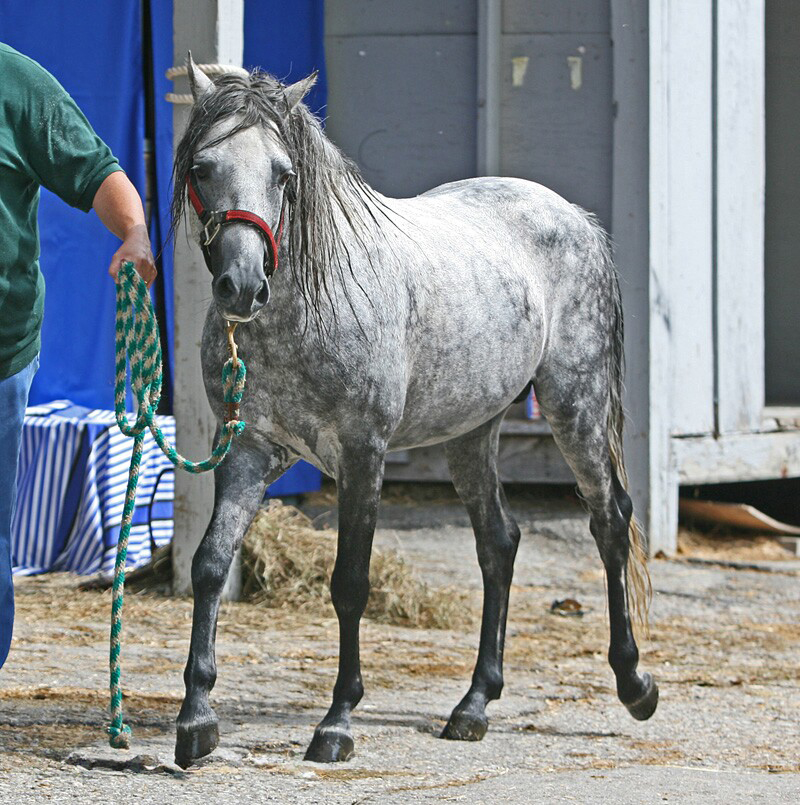
Caspian stallion, photographed in 2008. · Heather Moreton / Heather Abounader · CC BY 2.0 · License terms
Recognize what makes this population itself.
Small horses in ancient Persian art are part of the cultural and research background, but similarity in artwork is not proof of an uninterrupted registered pedigree. The Conservancy describes continuing scientific interest in the Caspian's relationships and antiquity. Its refined proportions and riding identity distinguish it from the assumption that all small equines have the same pony type.
Appearance introduces the animal; a registry standard explains a documented breeding population. A photograph, color or familiar informal name alone cannot establish every individual’s membership.
- Recorded roles
- Riding
- Adult Weight
- 400-600 lbs.
- Temperament
- Docile, Alert
- Experience Level
- Novice
- Adult Height
- Average 11.2 hands / Max. 12.2 hands
Reference values from the breed’s conservation profile. Weight describes a reference animal, not a universal feeding or fitness target. Temperament varies with breeding, individual experience and handling.
The Caspian: size, proportion and historical evidence
The Caspian is a very small horse breed associated with northern Iran and Louise Firouz's work beginning in 1965.
The Caspian is a very small horse breed associated with northern Iran and Louise Firouz's work beginning in 1965. The North American Caspian Society describes a fine head, short ears, graceful neck, slim legs and little feathering. Its proportions are an important part of why it is traditionally called a horse despite its pony-sized height.
Horse and pony are not separate zoological species. The distinction in this context describes size, type and breed convention within the domestic horse. Calling a Caspian a horse does not place it in a different genus or establish that other small breeds are genetically another animal.
The Society links the population with ancient Persian horse depictions. Such comparisons are part of the breed's interpretation, but artwork alone cannot identify every pictured ancient animal as an ancestor of a modern registered Caspian. Historical continuity needs to be discussed with the scope and limits of its evidence visible.
Firouz's search for small equines suitable for teaching children provides a concrete modern starting point. It connects rediscovery and breeding with a practical need. That account is more precise than treating the breed as an unchanged object recovered intact from antiquity.
The Society identifies two US registries recognized by the International Caspian Society. For an individual animal, pedigree and registry documentation establish its place in the modern breeding population. A small, elegant horse with similar proportions is not automatically a Caspian.
Small size also does not settle every suitability question. Rider size, training, temperament and the proposed activity need individual consideration. The breed's reputation for riding, jumping and driving describes possible roles, rather than a promise that each horse can safely perform them without preparation.
Conservation learning should therefore hold the visual appeal and the evidence together. The Caspian's compact size can make its proportions easy to study, while its history invites questions about archaeology, modern breeding and the movement of horses between countries. Its rarity makes careful documentation worthwhile; it does not remove the need for ordinary responsible care.
Sources for general species learning
Sources behind the breed’s story.
The original history, identity and conservation teaching above draws on these cited accounts. Official links open the full material for further study.
Keep learning from official information.
These research portals help locate further material. A search link is a route for exploration; it is separate from the sources used for the article above. Domestic breed information, wild-species assessment, historical books and new research need their own context.
- FAO DAD-IS · Domestic breed information
- IUCN Red List · Species assessments
- Biodiversity Heritage Library · Historical literature search
- USDA National Agricultural Library · Research search
- Google Scholar · Scholarly literature search
- Open Library · Book catalogue search
- HathiTrust · Digitized catalogue search