
Rouen – Non-Industrial
Animal identity
One living story. Knowledge kept together.
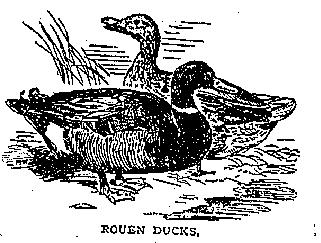
Historical illustration of Rouen ducks in Mrs Beeton's Book of Household Management (1861). It illustrates the breed's historical appearance and does not certify the lineage or production type of a modern flock. · Unknown artist / Mrs Beeton's Book of Household Management, 1861 · Public domain · License terms
Recognize what makes this population itself.
Mallard-like coloring contrasts with the domestic breed's much larger body. The deep, broad outline developed through human selection is an important identifying feature. Adult exhibition size and market weight are different measurements, so figures should state what stage or type of bird they describe.
Appearance introduces the animal; a registry standard explains a documented breeding population. A photograph, color or familiar informal name alone cannot establish every individual’s membership.
- Recorded roles
- Meat, Exhibition
- Egg Color
- White
- Egg Size
- Extra Large
- Temperament
- Docile
- Breed Weight
- Male - 10-12 lbs. Female - 9-10 lbs.
Reference values from the breed’s conservation profile. Weight describes a reference animal, not a universal feeding or fitness target. Temperament varies with breeding, individual experience and handling.
Reading identity and evidence carefully
Mallard-like colors are a comparison with ancestry and appearance, not evidence that a large domestic Rouen is a wild Mallard. The bird's substantial outline demonstrates the effects of human selection. Weight figures require the same care: mature exhibition weight, market weight, and observations from different production types should not be blended into a single statistic.
Rouen colors and the scope of exhibition descriptions
The British Waterfowl Association discusses Mallard-patterned, Blue, and Apricot Rouens. Those British descriptions concern inherited color and exhibition form; they should not be treated as certification that every pictured bird represents the Conservancy's non-industrial population.
The page describes a substantial animal that takes time to reach its full form. A photograph of a young bird may therefore differ from a mature exhibition example. Age and type need to accompany comparisons, especially where a statistic concerns eventual adult size rather than a younger market stage.
Its color discussion also shows that related plumage combinations can appear in Call ducks. Similar colors on very different body types do not make them one breed. An educational Rouen profile should connect its identifying outline with the source's label rather than using Mallard-like colors as proof of identity.
Sources for general species learning
Sources behind the breed’s story.
The original history, identity and conservation teaching above draws on these cited accounts. Official links open the full material for further study.
Keep learning from official information.
These research portals help locate further material. A search link is a route for exploration; it is separate from the sources used for the article above. Domestic breed information, wild-species assessment, historical books and new research need their own context.
- FAO DAD-IS · Domestic breed information
- IUCN Red List · Species assessments
- Biodiversity Heritage Library · Historical literature search
- USDA National Agricultural Library · Research search
- Google Scholar · Scholarly literature search
- Open Library · Book catalogue search
- HathiTrust · Digitized catalogue search