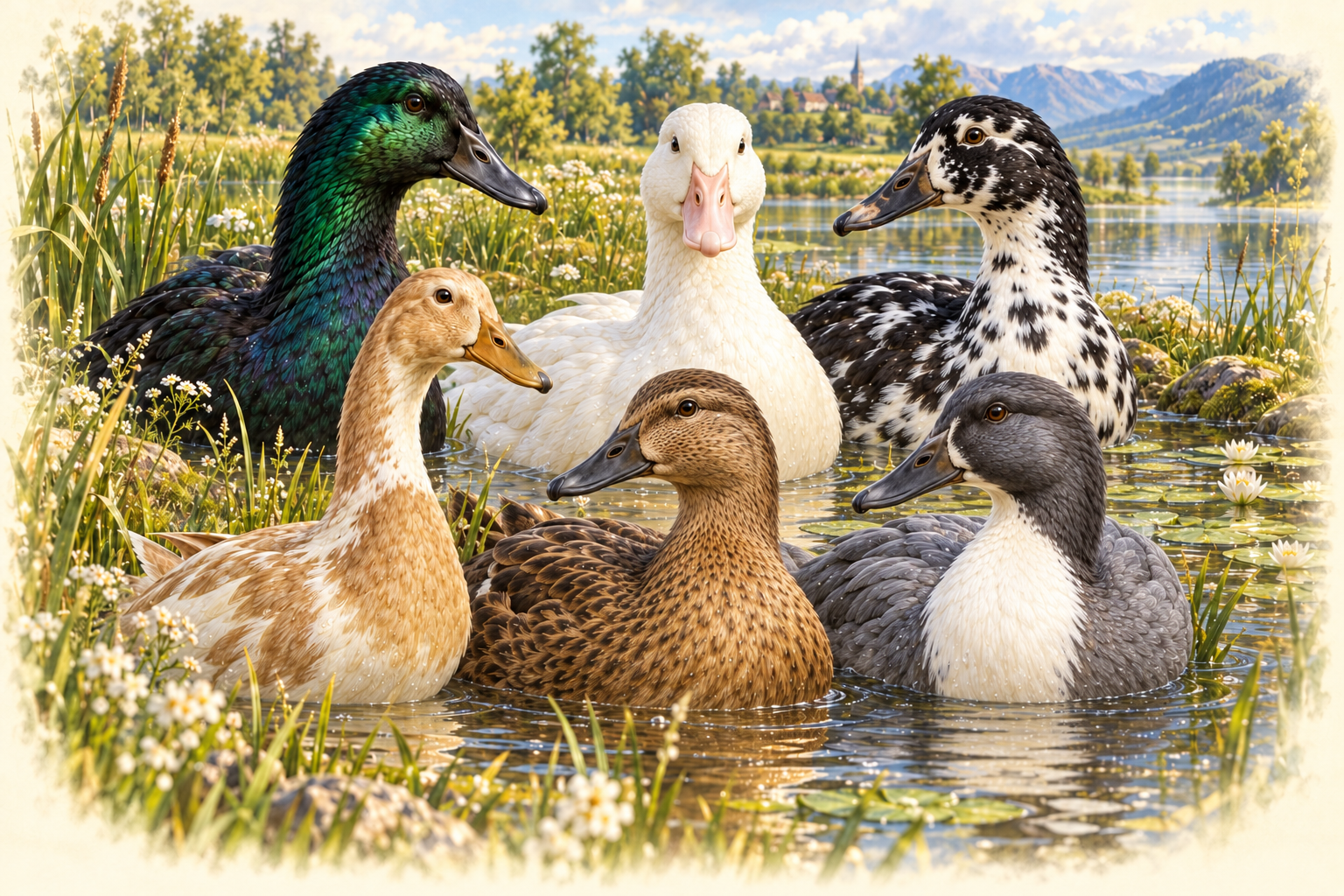
Domestic ducks bring together food production, foraging, recognizable breed traits and the everyday knowledge of their keepers. Their conservation stories are often held in small flocks. Counting those breeding flocks matters because a large number of birds sold in one season does not reveal how many independent families will reproduce the next. Explore the named breeds below, then compare their documented origins, standards and conservation categories.
This bantam duck averages roughly two pounds. Its nearly horizontal, teardrop-shaped body separates it from the upright Runner silhouette. Greenhead, Bluehead, and Silverhead varieties differ in head coloration, making variety identification part of an accurate description.
The Silver Appleyard is a large, broad-bodied duck with distinctly colored sexes. Its identity combines decorative plumage with practical dual-purpose conformation. The full-sized breed should be distinguished from smaller waterfowl sold under similar Appleyard names.
The Saxony is a substantial dual-purpose duck, combining meat-producing size with laying utility. Its distinct drake and duck colors make sex and plumage description important when selecting illustrative photographs. Mature size should not be confused with a younger bird's market weight.
White feathers, a pink bill, large size, and meat-producing conformation distinguish the traditional Aylesbury. Its identity should not be reduced to any large white duck. The source describes mature drakes around ten pounds and ducks around nine, a mature weight measure distinct from a younger market weight.
A bill that curves downward gives the Hookbill its name. Historically, birds foraged along canals and waterways and were expected to obtain much of their food there. Its identity therefore includes both an unusual profile and a practical foraging tradition.
The warm buff plumage gives this medium-weight duck its recognizable identity. A long, broad body and gracefully curved neck accompany its dual-purpose meat-and-egg role. Its name is an unusual case in which a color serves as the recognized American breed name.
Dark plumage with a striking green sheen is central to the Cayuga's visual identity. Eggshell pigmentation may be dark early in a laying season and fade toward lighter shells later. Those shell changes should not be confused with a change of breed.
The familiar Blue Swedish has slate-colored plumage and a white bib. Its stocky body reflects general farm use. The visual appeal of blue plumage should be described alongside type and breeding background; a blue duck with a pale chest is not automatically a verified Swedish.
This lightweight duck retains a practical meat-and-egg role alongside elaborate sex-specific plumage. Its Campbell origin helps explain the importance of laying ability in its identity. Photographs should identify the sex and variety rather than expecting every Harlequin to display the same colors.
Dark plumage and a pale breast marking give the duck a recognizable island identity. Its history is tied to foraging and practical farm use, but 'hardy' should not be interpreted as needing no shelter, nutrition, or protection. A landrace can carry useful variation that a narrowly uniform show description misses.
The Ancona is a practical meat-and-egg duck with an irregular colored-and-white pattern. That broken pattern gives individuals considerable visual variation. A flock should be assessed for functional body type and productivity alongside plumage, rather than expecting identical markings on every bird.
The upright carriage and walking ability make the Runner immediately recognizable. Selection emphasized movement, foraging, and egg production rather than a broad heavy market body. Several color varieties exist, so the characteristic outline is more consistent than any single plumage color.
The Campbell is especially associated with egg production. Its active temperament and lighter build reflect a different breeding emphasis from heavy market ducks. Khaki is a familiar variety, but the broader Campbell identity should not be reduced to a generic brown duck.
Mallard-like coloring contrasts with the domestic breed's much larger body. The deep, broad outline developed through human selection is an important identifying feature. Adult exhibition size and market weight are different measurements, so figures should state what stage or type of bird they describe.
The predominantly white duck carries a colored cap and a larger colored patch along its back. Those markings explain its bird-inspired name. It is a relatively light, active dual-purpose duck rather than a large industrial meat bird.
Critical, Threatened, Watch and Recovering are this organization’s domestic-breed categories. Their definitions vary between livestock, rabbits and poultry. A category threshold is not a census of this breed, and a registry’s annual registrations are not a count of every living animal.
Compare future population figures by assessment year, geography and the animals counted. Keep a wild relative’s IUCN assessment separate from a domestic breed’s status.
Scientific field notes
Where these animals belong.
Most domestic duck breeds descend from the mallard, Anas platyrhynchos. Muscovy ducks have a different species origin; the broad word duck should not replace a verified scientific identification.
Ranks follow the linked reference’s treatment. Domestic names and wild relatives may be handled differently by other authorities.
Kingdom
Animalia
Phylum
Chordata
Class
Aves
Order
Anseriformes
Family
Anatidae
Genus
Anas for mallard-derived breeds
Species / domestic context
Anas platyrhynchos (mallard-derived domestic ducks)
Explore beyond appearance
Four questions for a living legacy.
01
Breed origins and plumage standards
What does the source actually establish, and which claims still need evidence?
02
Breeding-flock numbers and census dates
How did people, place and practical use shape the population we see today?
03
Egg and meat-production traditions
Which living breeding families can carry the population into another generation?
04
Water access, shelter and flock health
What would responsible stewardship require in time, facilities and ongoing support?
Knowledge belongs with its animal world.
Explore general ducks knowledge in the species library. Each population has its own collection for breed-specific history, identity and conservation reports.