
Rouen – Non-Industrial
History & heritage
One living story. Knowledge kept together.
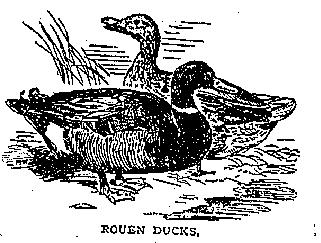
Historical illustration of Rouen ducks in Mrs Beeton's Book of Household Management (1861). It illustrates the breed's historical appearance and does not certify the lineage or production type of a modern flock. · Unknown artist / Mrs Beeton's Book of Household Management, 1861 · Public domain · License terms
Follow the story behind the name.
Rouen ducks developed from large Mallard-like domestic birds kept in France. They reached England around 1800, where breeders increased size and emphasized a deeper, heavier outline. D. W. Lincoln brought Rouens to the United States in 1850. The conservation listing here concerns non-industrial Rouens, a distinction that should remain visible in articles and photographs.
Mallard-like coloring contrasts with the domestic breed's much larger body. The deep, broad outline developed through human selection is an important identifying feature. Adult exhibition size and market weight are different measurements, so figures should state what stage or type of bird they describe.
Understanding the heritage in context
The non-industrial qualifier is essential to this profile. Material about any duck called Rouen should first be checked for the type it describes. A historic illustration can introduce the breed's appearance, but it cannot certify that a pictured animal represents a particular surviving modern line.
Sources for general species learning
Sources behind the breed’s story.
The original history, identity and conservation teaching above draws on these cited accounts. Official links open the full material for further study.
Keep learning from official information.
These research portals help locate further material. A search link is a route for exploration; it is separate from the sources used for the article above. Domestic breed information, wild-species assessment, historical books and new research need their own context.
- FAO DAD-IS · Domestic breed information
- IUCN Red List · Species assessments
- Biodiversity Heritage Library · Historical literature search
- USDA National Agricultural Library · Research search
- Google Scholar · Scholarly literature search
- Open Library · Book catalogue search
- HathiTrust · Digitized catalogue search