
Malay
Animal identity
One living story. Knowledge kept together.
Recognize what makes this population itself.
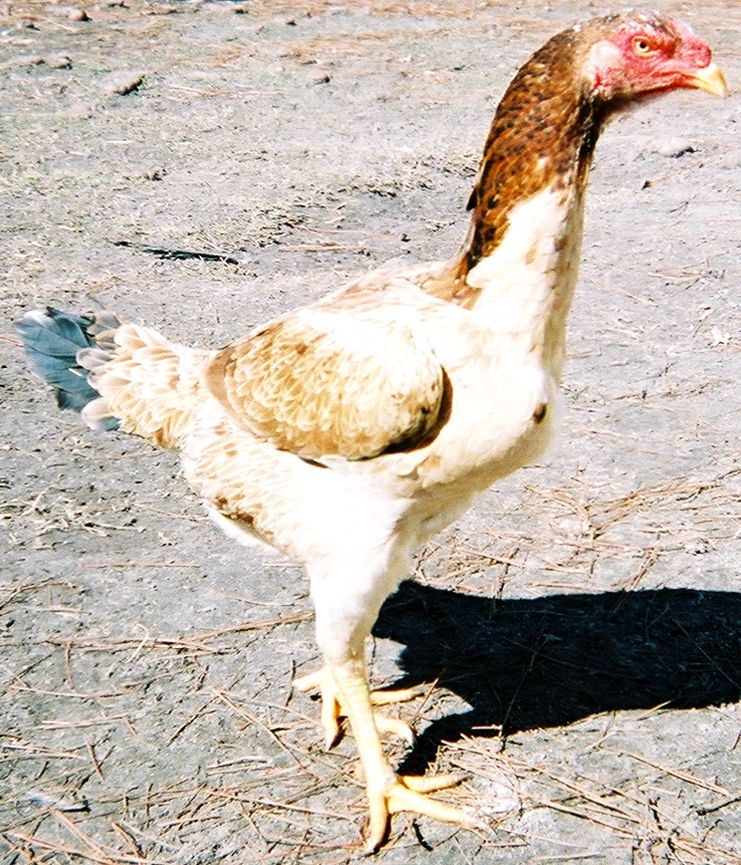
Long legs, a long neck and erect posture can bring their height to roughly 26–30 inches. Heavy bone, a broad skull and a stout beak contribute to their distinctive outline. Their lean form and strong carriage differ markedly from conventional rounded farm chickens.
Appearance introduces the animal; a registry standard explains a documented breeding population. A photograph, color or familiar informal name alone cannot establish every individual’s membership.
- Recorded roles
- Meat
- Egg Color
- Brown
- Egg Size
- Medium
- Temperament
- Active
- Breed Weight
- Male 9 lbs. / Female 7 lbs.
Reference values from the breed’s conservation profile. Weight describes a reference animal, not a universal feeding or fitness target. Temperament varies with breeding, individual experience and handling.
Bantam development retained the large-fowl identity
The reference describes bantam development around the turn of the twentieth century and the difficulty of reducing size without losing characteristic form. A small Malay should therefore not be identified merely as an arbitrary miniature game bird. This is a distinct selection history whose goal was to preserve the recognizable outline while changing body size.
Interpreting this population in practice
How its documented identity shapes learning and conservation.
Malay height and upright form are central to identity, but selecting a taller bird is not a complete conservation strategy. Structure, movement and manageable care remain relevant. Their documented pugnacity calls for deliberate separation and flock supervision. Present fighting and crossing uses as historical subjects while explaining present preservation through responsible breeding and the maintenance of a distinct population.
Tall stature is not the same as a production bird
Malay chickens stand out through long legs, heavy bone, an upright body and tight feathering. Their imposing height can suggest a heavily finished meat chicken, but the Conservancy describes a comparatively lean animal with a different history and purpose.
Its adult-weight references are about nine pounds for males and seven pounds for hens. Close feathers, small facial furnishings and a short, broad beak contribute to the distinctive head and body profile. Malay ancestry also influenced the development of other poultry populations.
Egg production is relatively limited and varies greatly among strains. The source emphasizes the breed’s need for space and the difficulty of managing aggression toward other chickens. Our interpretation is that an attractive unusual bird should be understood before it joins a household flock. Preserving the Malay involves suitable experienced keeping as well as maintaining its form. It cannot be evaluated only by egg totals, nor should its height be presented as evidence that it has the same role as a modern broiler.
Sources for general species learning
Sources behind the breed’s story.
The original history, identity and conservation teaching above draws on these cited accounts. Official links open the full material for further study.
Keep learning from official information.
These research portals help locate further material. A search link is a route for exploration; it is separate from the sources used for the article above. Domestic breed information, wild-species assessment, historical books and new research need their own context.
- FAO DAD-IS · Domestic breed information
- IUCN Red List · Species assessments
- Biodiversity Heritage Library · Historical literature search
- USDA National Agricultural Library · Research search
- Google Scholar · Scholarly literature search
- Open Library · Book catalogue search
- HathiTrust · Digitized catalogue search