
2 beatsDiagonal pair
1
LHRF
2
RHLF
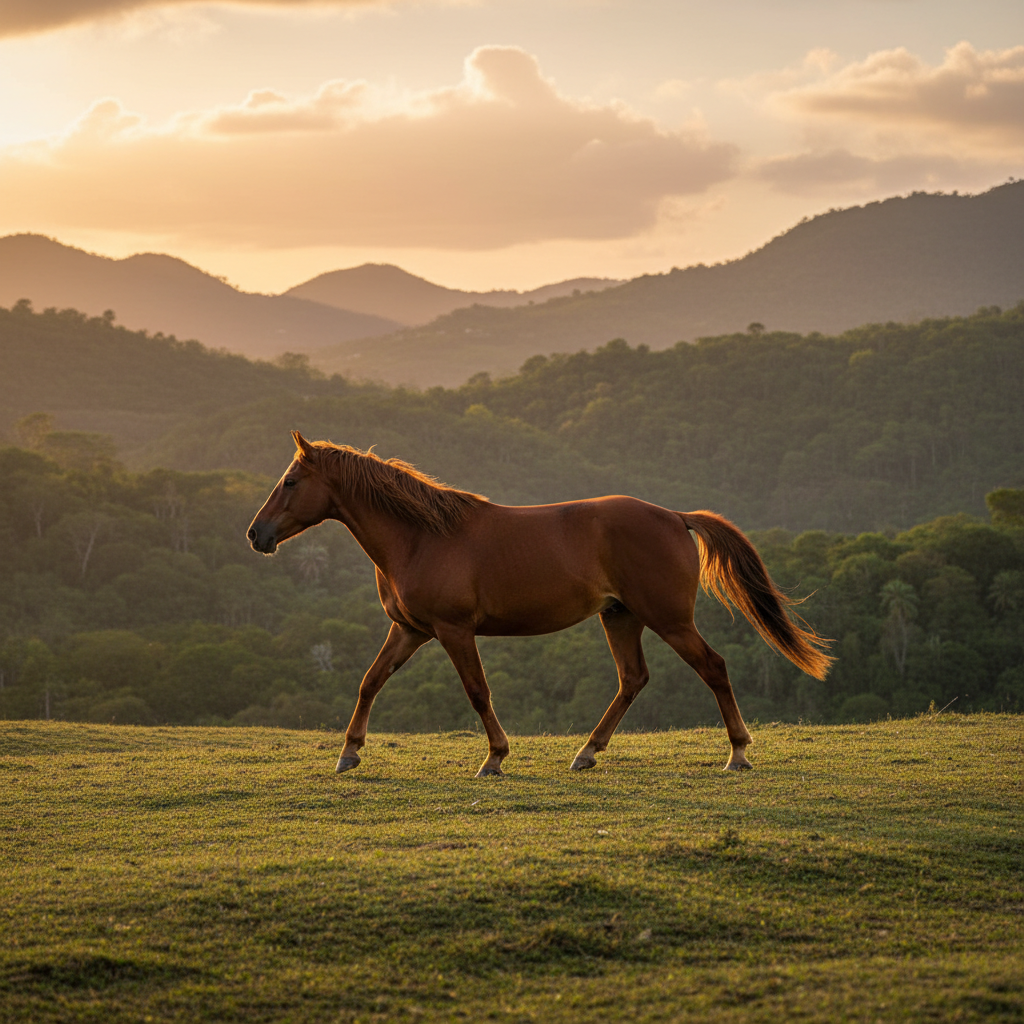
What makes a horse gaited, why a pace is different from a paso, and where the Puerto Rican Paso Fino belongs in the conversation.
Visual guide · gait diagrams · breed comparisons · researchIllustrative image created for Conservation Legacy. The horse pictured is not identified as a registered Puerto Rican Paso Fino.
Most horses walk, trot and canter. Some also have an inherited tendency toward alternative intermediate gaits. The word gaited is useful, but it does not name one single movement: a running walk, tölt, fox trot and paso can feel smooth while organizing their hoofbeats differently.
The easiest place to start is timing. A beat is a distinct landing sound. Two feet can land together and make one beat, or they can land separately and make two. Lateral means the same-side limbs are associated in the order; diagonal means opposite-side limbs are associated. Those terms describe a movement pattern, not a breed or its pedigree.
These diagrams show one simplified stride cycle. Real horses vary in timing, speed and collection; slow-motion video is better than a still photograph for identifying a gait.
The hind foot is followed by the forefoot on the same side, then the opposite hind and fore. Each footfall is separate and ideally evenly timed.
Read the numbered beats left to right. Two hoof labels in one beat land as a pair.
In a true pace, left front and left hind land together, then right front and right hind land together. That makes two beats in a stride. In the Paso Fino gait, the same-side feet are related in the sequence but land one after another: left hind, left fore, right hind, right fore, then repeat. Four separate, ideally even hoofbeats give the cadence associated with the breed. The Paso Fino Horse Association describes the gait this way and distinguishes its classic fino, paso corto and paso largo by speed and collection. Read the PFHA gait description
A normal walk can also follow a lateral footfall order. The sequence alone does not make every walking horse a Paso Fino. Cadence, timing, speed, posture and how the horse uses its body help distinguish the performed gait. Equally, a four-beat footfall is not automatically smooth or correct just because a label says it is.
Same-side sequence tells you the gait family. Separate, even beats tell you why a paso is not a true pace.
Other four-beat lateral gaits, including tölt, running walk and paso llano, share aspects of footfall order. They differ in rhythm, speed range, frame, movement and breed standard. The Missouri fox trot provides a useful counterexample: it is a smooth four-beat broken diagonal gait. See the Fox Trotter association's explanation
A breed can have a signature gait without every horse moving identically. These are breed-associated patterns, not a diagnostic test for an individual horse.
An island-developed breed and distinct conservation population. Its gait belongs to the broader lateral family, but shared rhythm does not erase its Puerto Rican ancestry.
Breed or research sourceThe gait name overlaps. Research on Colombian paso horses also describes trocha and Colombian trot; breeding histories and populations require their own records.
Breed or research sourcePaso llano is an evenly spaced four-beat lateral gait. Its breed standard also recognizes the more lateral-timed sobreandando.
Breed or research sourceTölt separates four footfalls. Flying pace brings same-side pairs close together at high speed; not every Icelandic horse is five-gaited.
Breed or research sourceIts signature running walk is a ground-covering, smooth walking gait with characteristic head motion; individual horses may offer other gait variants.
Breed or research sourceA useful comparison: smoothness does not always mean a lateral gait.
Breed or research sourceThe association describes a natural lateral gait with four distinct hoofbeats.
Breed or research sourceHarness racing selects trotters and pacers. Many carry the gait-associated DMRT3 variant, but that gene alone does not determine which racing gait a horse uses.
Breed or research source
The pure Puerto Rican Paso Fino belongs among gaited horses because its characteristic paso is a natural four-beat lateral gait. Yet a shared hoofbeat is not a shared identity. The horse developed through selection in Puerto Rico, from the island's older horse population, within its own culture, breeding history and records.
A 2022 genomic study sampled Puerto Rican Criollo and Puerto Rican Paso Fino horses and found evidence consistent with a genetic connection between them. The authors propose that gait-associated variation existed in the island's earlier horse population before the modern breed was established, while later selection shaped the Puerto Rican Paso Fino. The findings should be read as evidence about the studied populations, not as a genetic test that can certify an individual horse's pedigree. Read the research abstract
Puerto Rican and Colombian horses may both appear under the broad name “Paso Fino” in some contexts. When preservation is the goal, identify which population and registry a claim refers to. A horse's smooth gait alone cannot establish Puerto Rican ancestry. The Peruvian Horse is another distinct breed despite the shared Spanish word paso.
Research identified a variant of the DMRT3 gene associated with the ability to perform several alternative gaits. It occurs at high frequency in multiple gaited and harness-racing populations. That matters for understanding movement, but it does not make a Paso Fino, an Icelandic Horse and a Standardbred interchangeable. Nor does it guarantee which precise gait a horse will show: Standardbred pacers and trotters illustrate that distinction. Read the original DMRT3 research
Additional genetics, breeding selection, individual conformation, training and biomechanics matter. The Puerto Rican study reported that its sampled purebred group carried the studied gait-associated variant; its main value here is the population history around that finding. To protect the breed, keep the gait alongside verified identity and genetic diversity, rather than reducing the whole horse to one marker. Read the Puerto Rican population study
Compare the diagrams with moving horses in the PFHA gait guide. Watch at normal speed first, then slow down and listen for four separate landings. Do not use a still photo to decide whether a horse is gaiting correctly.
Watch the PFHA gait demonstrationsResearch describes observed populations; breed organizations describe their respective ideals. We label those source types separately because they answer different questions.