
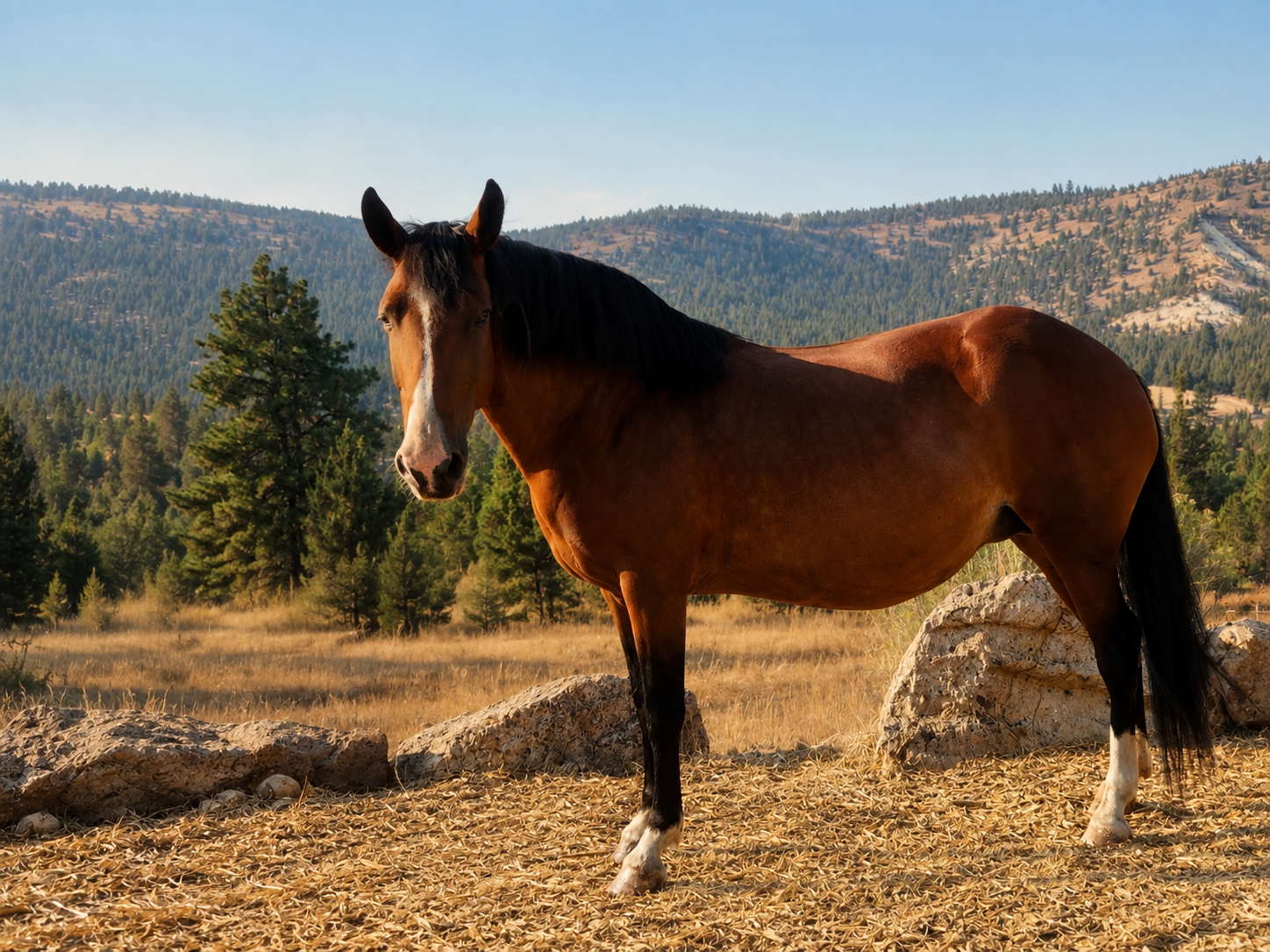
A horse shaped across generations
To know the Puerto Rican Paso Fino, follow the lives that shaped it.
This breed was not created in a single moment or by one famous horse. It was shaped over generations by the lives Puerto Ricans actually lived with their horses—traveling mountain roads, working farms, moving cattle, carrying families, competing, breeding and deciding which horses were worth keeping. Those choices became bloodlines; bloodlines became pedigrees and registries; and those records now let us trace how a working island horse became a distinct population whose history, identity and genetic diversity still depend on the horses alive today.Puerto Rico shaped a horse for the life Puerto Ricans lived.
Before the ribbons, registries and show ring, the horse was woven into everyday Puerto Rican life. Horses carried people between farms and towns, traveled mountain roads, worked long days, helped with cattle, and moved riders and goods across an island where comfort, sure-footedness and endurance mattered mile after mile.
Puerto Ricans did not simply inherit a finished breed. Generation after generation, they chose the horses that suited their lives—the ones they wanted to ride again, breed again and pass forward. Over time, usefulness became tradition; the smooth gait that made a long journey easier became something people admired, compared, celebrated and deliberately preserved.
Puerto Rico was not merely where this horse lived. Puerto Rico was part of how the horse became what it is.
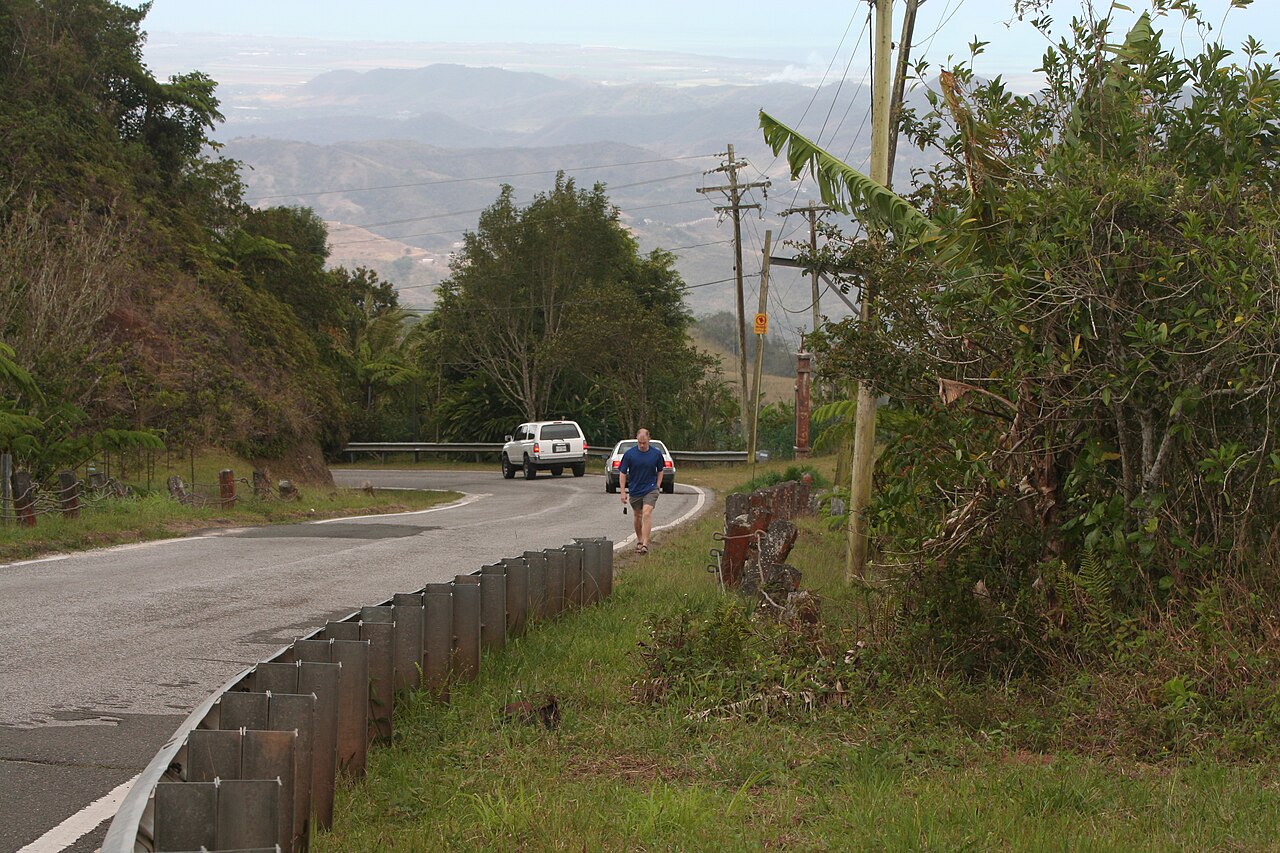
By 1797, the way Puerto Rico's horses moved was already distinctive enough to draw attention beyond the island.
That matters because it lets us look backward and see that the gait did not appear with the modern show horse. It was already part of a population being ridden, bred and selected in Puerto Rico generations before the breed was formally defined on paper.
In his account of Puerto Rico, the French naturalist recorded a way of moving distinctive enough to comment on. His observation does not begin the gait's history; it confirms that the characteristic was already visible to an outside observer by the end of the eighteenth century.
Open the 1797 source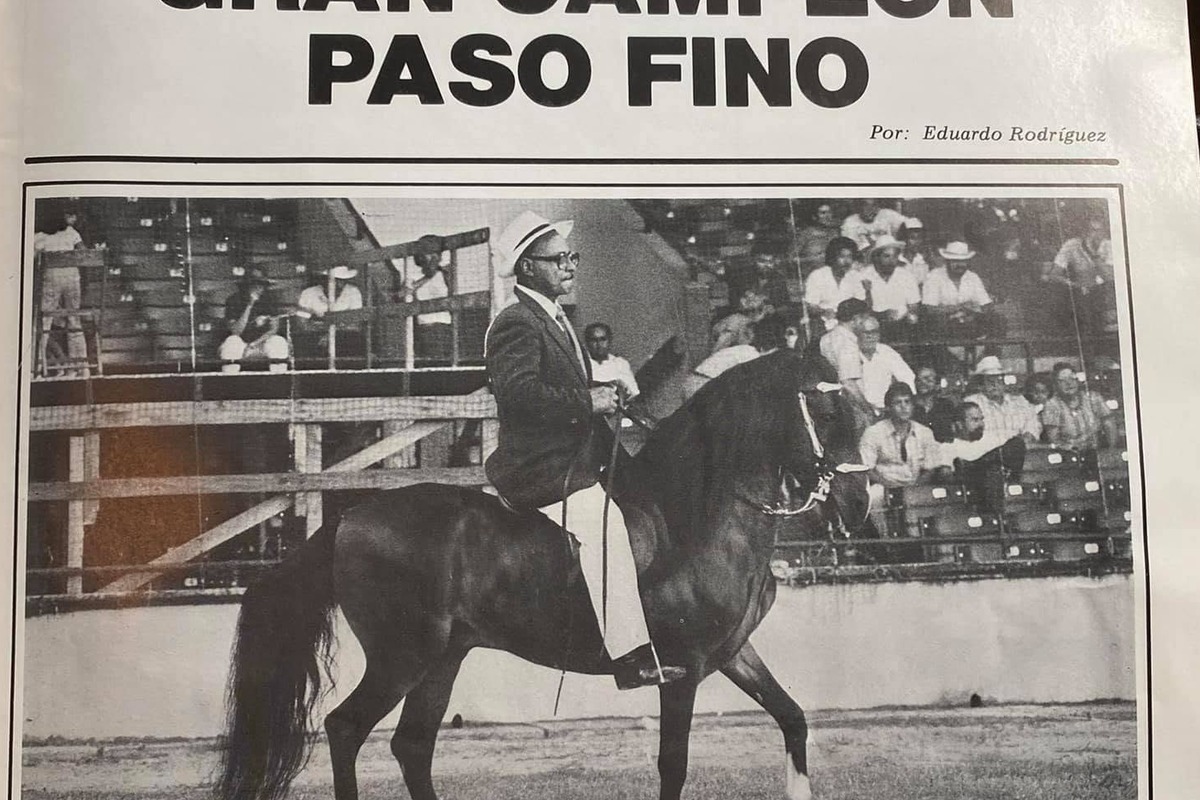
Puerto Rico, too, was carried on horseback.
From the earliest colonial period onward, horses were woven deeply into Puerto Rican life. Their ancestors arrived with Spanish expansion, and over time horses became essential to soldiers, farms, cattle work, transport, communication and family life across the island. In a very real sense, they helped carry Puerto Rico's work, movement and development.
That history also helps explain the breed itself. Breeding choices were not made in the abstract. Puerto Ricans kept and bred the horses that best served their needs—the ones that could travel difficult roads, work long days, move people and goods comfortably, and still show presence, spirit and pride. The show ring came later; it refined and celebrated qualities that had already proved their worth in everyday life.
The tack tells part of that same story. Tereques, saddles, bits, reins and saddlery should be documented by era and origin so Puerto Rican traditions are preserved on their own terms.
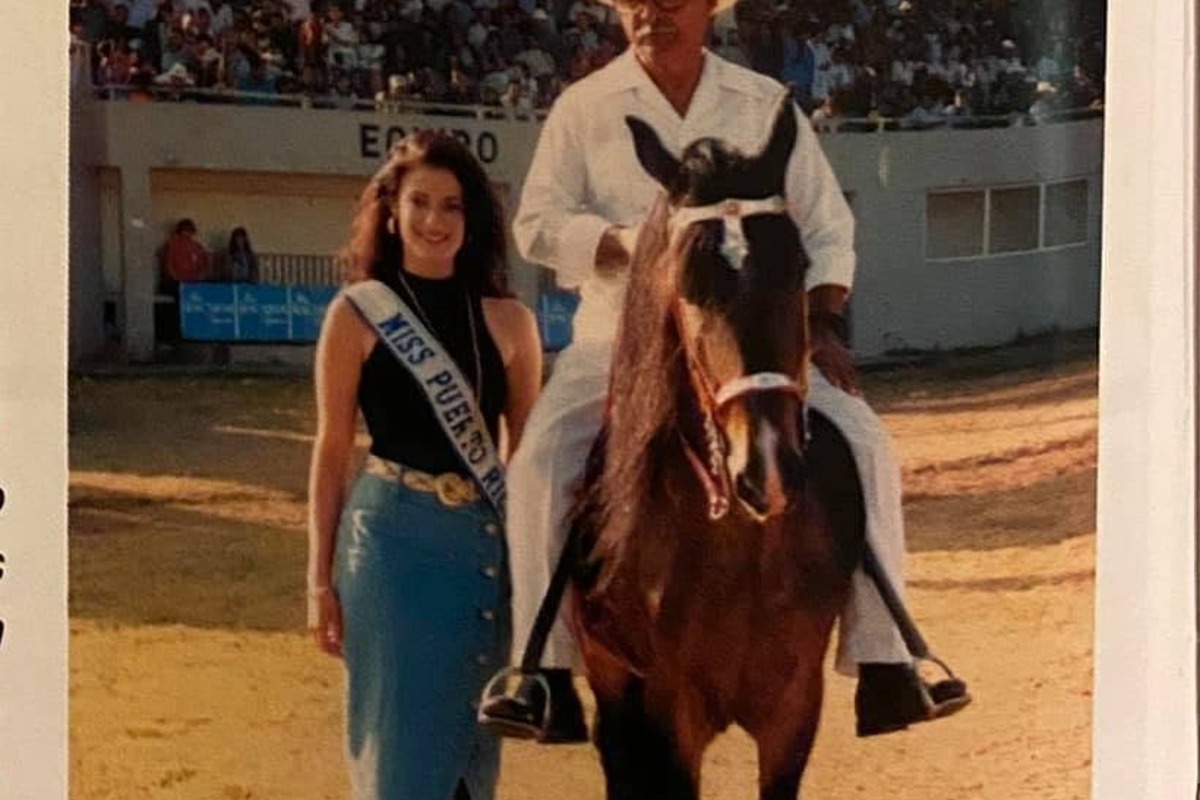
Over time, certain horses left footprints that still appear generation after generation.
The modern registered population does not begin with one horse, but it narrows strongly around certain individuals. Dulce Sueño belongs at that transition point: centuries of Puerto Rican horses behind him and the modern registered population spreading out ahead.
The formal registry established in 1943 allowed memory, farm knowledge and tradition to begin living beside written pedigrees. Today we can follow those decisions backward and forward.
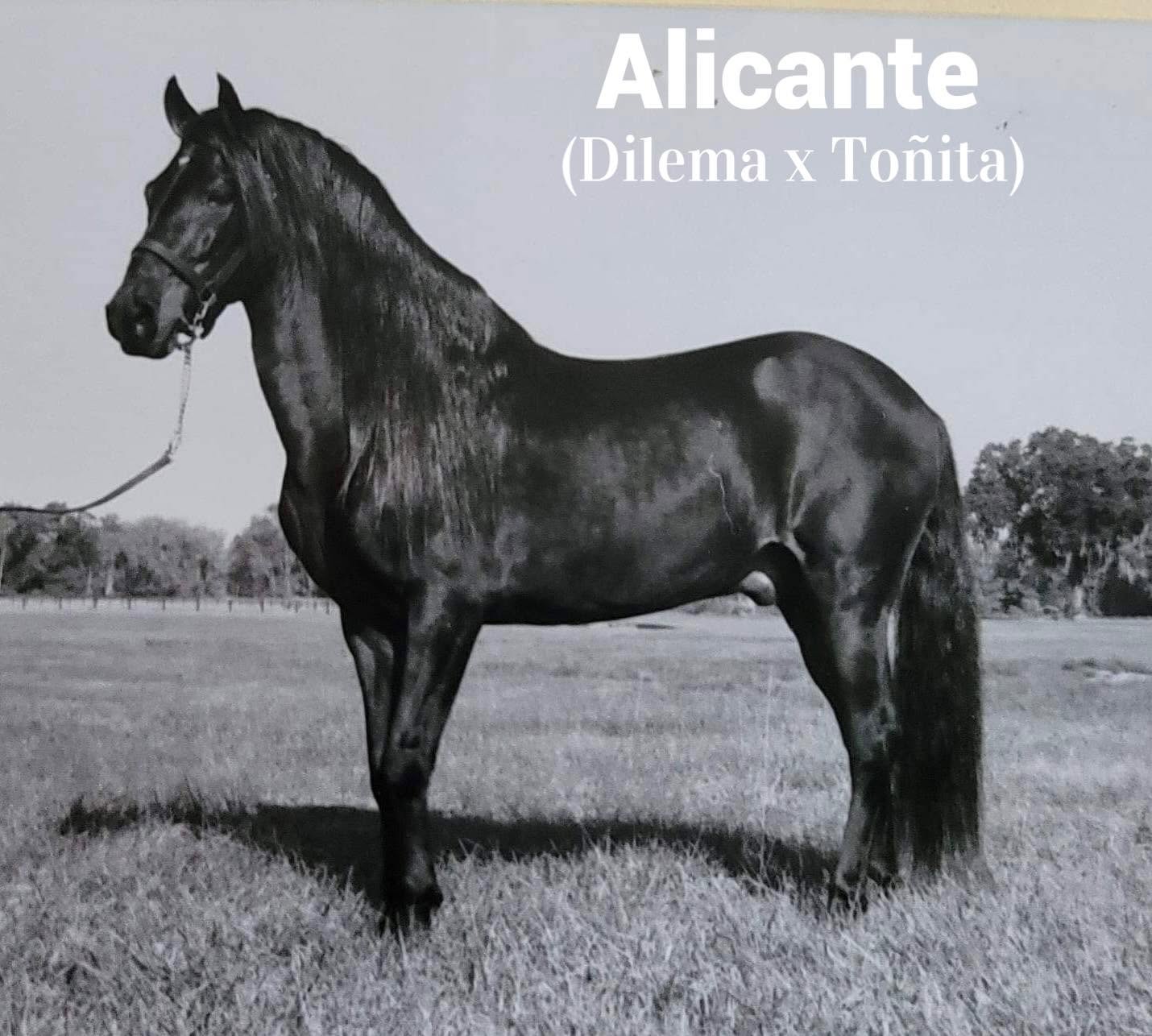
After World War II, Puerto Rican horses began reaching the U.S. mainland.
PFHA's published breed history dates the beginning of imports from Puerto Rico to the mid-1940s, when American servicemen stationed on the island encountered the Paso Fino and began taking horses home. Puerto Rico's Federación also identifies military personnel at Ramey Base in Aguadilla among those early export routes. A population shaped in Puerto Rico was therefore establishing mainland families decades before the U.S. Paso Fino world expanded through major Colombian imports.
Once the horses were on the mainland, people needed registries, shows and common rules.
Puerto Rico's Federación identifies the American Paso Fino Pleasure Horse Association, formed in 1964, as the first U.S. Paso Fino organization. The organization known today as PFHA traces its own institutional lineage to the Paso Fino Owners and Breeders Association formed in 1972. Both dates matter: they mark different stages in building the mainland registry and show system.
The horse's success also broadened what the American public understood by the name “Paso Fino.” That created opportunity, but it also began complicating the identity of the source populations.
About two decades after the first Puerto Rican imports, major Colombian imports began.
PFHA summarizes the sequence clearly: Americans began importing Paso Finos from Puerto Rico in the mid-1940s, and two decades later many horses began to be imported from Colombia. That places the major Colombian influx around the mid-1960s. The broader U.S. system eventually registered and showed horses from several countries of origin. Puerto Rican and Colombian horses could be bred separately, but crossbreeding also occurred, so the shared name “Paso Fino” could include pure Puerto Rican horses, pure Colombian horses and mixed descendants.
For conservation, that is a serious problem. A rare population is not preserved simply because the name “Paso Fino” survives; conservation requires knowing which animals actually retain the Puerto Rican lines and how they are related.
The answer was not to leave the Paso Fino world—it was to identify clearly which horses were Pure Puerto Rican.
In 1987 the Pure Puerto Rican Paso Fino Federation of America was founded specifically to protect, promote and maintain an accurate registry of the Puerto Rican horse on the mainland. That separation of purpose was a conservation response: keep a small population visible inside a much larger Paso Fino category.
From that point forward, preserving a line could mean something more precise: follow the pedigree, verify parentage, identify founders and keep scarce families from disappearing unnoticed.
Paper pedigrees say who the family is supposed to be. DNA helps verify it.
Genetic parentage verification became a central tool for modern registries. Puerto Rico law addresses parentage verification and biological archives; PFHA now verifies bloodlines through DNA testing. That is different from modern population genomics, which can also study diversity, population relationships and how much genetic variation remains in a small population.
Confirming sire and dam protects the integrity of a closed population and helps catch pedigree errors before they multiply.
DNA does not replace the pedigree; used with it, genetics can help measure relatedness, scarce lines and loss of diversity.
Modern conservation needs the registry, genetic sample, individual horse and family line connected so each decision can be traced.
The expansion did not stop in the United States.
Breed-history accounts describe an initiative to introduce the Puerto Rican horse in Canada, including a delegation of breeders, trainers and Puerto Rico agriculture officials at Spruce Meadows Equi-Fair in Calgary. Some horses remained there and began a small Canadian breeding presence.
Canarico is remembered in those accounts as the first Pure Puerto Rican Paso Fino foaled in Canada—a name joining “Cana” for Canada with “rico” for Puerto Rico.

Compact, expressive, comfortable—and full of brío.
The Federación describes a horse generally around 13 to 15 hands, with a balanced body, strong back, durable hooves, abundant mane and tail and an alert expression. The ideal temperament combines nobility and tractability with energy, presence and willingness.
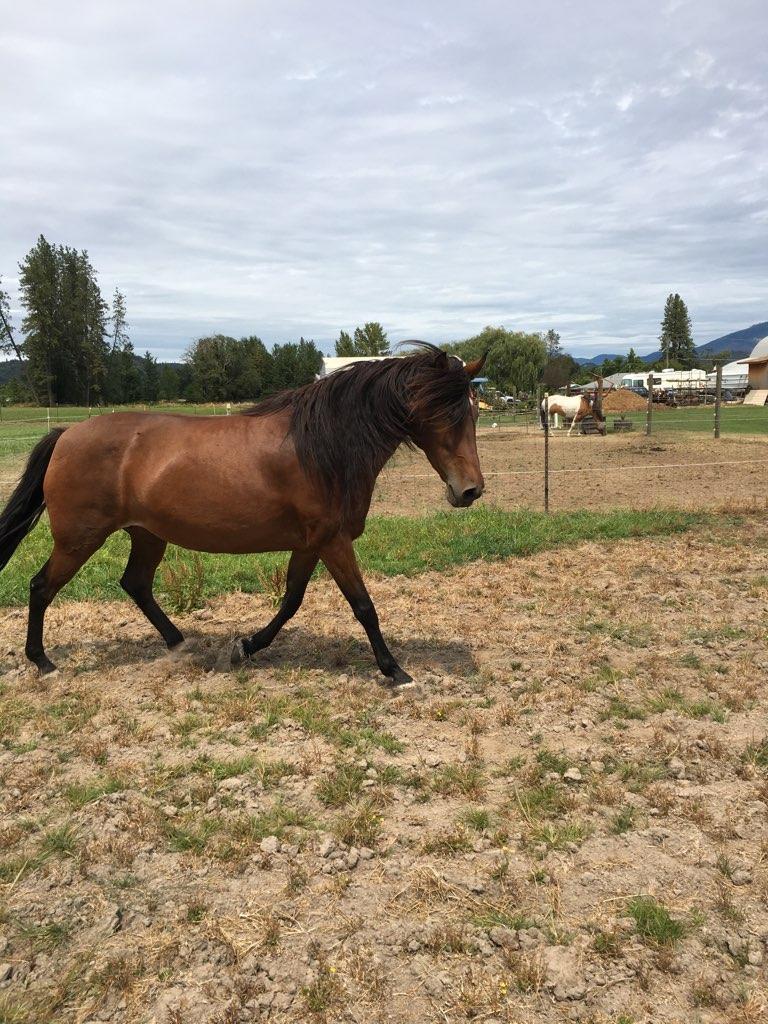
The rhythm that made the horse famous had value long before it had a genetic explanation.
Its natural four-beat lateral gait places each hoof on the ground independently. The comfort produced by that rhythm helped make these horses valued riding mounts for travel and, later, exhibition and competition.
The comparison showed two things at once: shared island roots and a clearly differentiated PPR population.
Researchers compared 200 horses from 27 locations around Puerto Rico: 162 Puerto Rican non-purebred horses and 38 Pure Puerto Rican Paso Finos. They used mitochondrial DNA, DMRT3 and genome-wide markers to ask not only where the populations came from, but what they still shared and where they had diverged.
Maternal lineages were interwoven between the two populations, supporting shared island ancestry. But the genome-wide analysis separated the PPR as a distinct population.
The gait-associated allele was 87.4% in the non-purebred population, with 142 of 143 carrying at least one copy. In the PPR sample the ancestral allele was absent: the gait-associated allele was fixed. That points to gait selection before the formal breed and still stronger selection within the PPR.
The PPR showed greater homozygosity and inbreeding than the non-purebred population, consistent with a small, intensively selected population. Because DMRT3 was already nearly fixed, later selection appears to have acted on other genomic regions as well.
The eye color was studied by comparing horses within the PPR—and then checking whether the same variants appeared in related breeds.
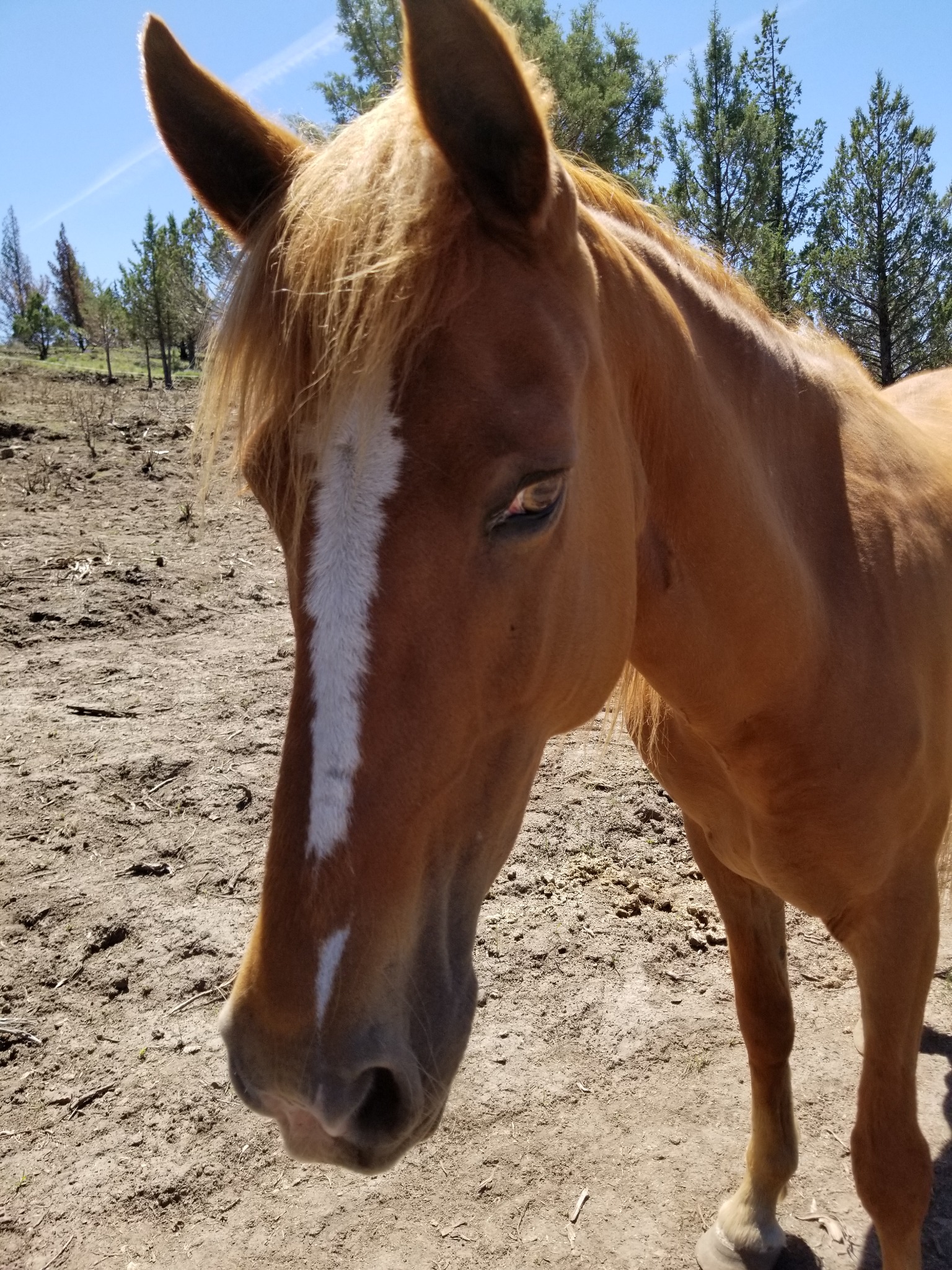
The study began with 216 photographed and phenotyped PPR horses. After excluding intermediate eye colors, blue eyes and coat dilutions that could complicate the analysis, the main comparison included 32 tiger-eye horses and 122 dark brown/black-eyed PPR horses. The candidate variants were then tested in 196 horses from four related breeds.
Pedigree patterns and observed matings supported recessive inheritance. Two SLC24A5 variants explained 28 of the 32 tiger-eye cases—about 88%—leaving four cases unexplained.
 RELATED BREEDS196
Researchers screened 90 Colombian Pasos, 20 Mangalargas, 44 Lusitanos and 42 Andalusians. None carried the two tiger-eye variants identified in the studied PPR population.
The comparison strongly supported an association between these SLC24A5 variants and tiger-eye in the PPR. It also shows why the result needs context: the variants explained most, not all, cases, and an eye-color trait does not define the breed itself.
The island still shapes what it means to breed, care for, and preserve this horse.
After following the breed from its island roots through the United States, Canada and modern genetics, the story returns to the island where it is still being lived. Preserving the horse today means connecting identity, regulation, real farms, water, feed, shelter, transport and everyday cost.
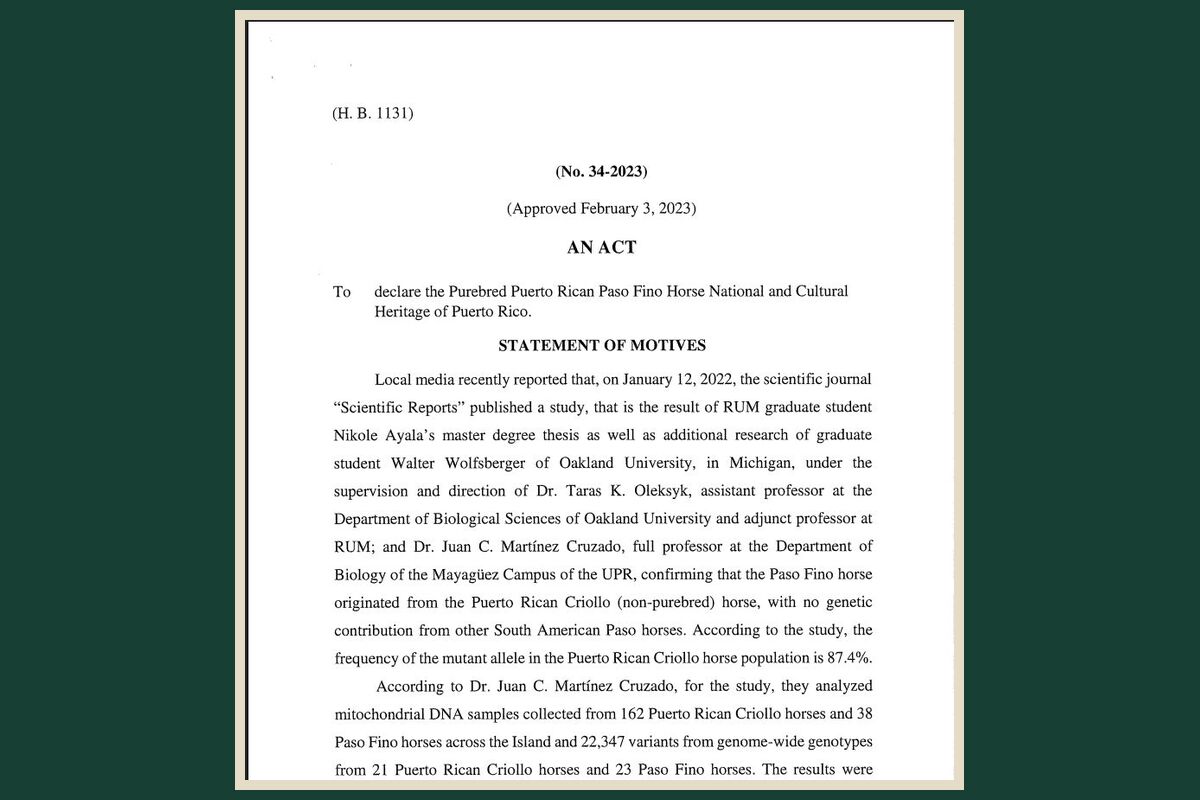
Law 169-1988 established the framework for the Central Genealogical Registry and addresses parentage verification, census work, assisted reproduction, semen preservation, and historical archives. Law 34-2023 recognized the Paso Fino as National and Cultural Heritage.
Hay, grain, medications, fencing materials, equipment, and replacement parts can depend on local availability, importation, freight, and storage. When those costs change, breeding decisions and the number of horses a farm can sustain can change with them.
Farms need practical plans for reliable water, shade, ventilation, drainage, protected feed, and safe shelter. Cisterns, tanks, open or well-ventilated roofs, and dry storage areas can matter to preservation as much as any pedigree.
Farms vary widely, from small family operations to specialized breeding programs. What they share is the need for safe fencing, handling areas, dry storage, feed-delivery access, places for farrier and veterinary work, and enough space to keep horses healthy and breed responsibly.
The history only ends here if we stop following the horses.
Today the breed is listed as Threatened by The Livestock Conservancy. Preserving it means keeping living horses, breeding families, diversity, knowledge, photographs, farms, tack, memories and enough continuity that the next generation can still know the horse Puerto Rico created.
Meet the living population