
Meet the
Poitou.
The Baudet du Poitou developed in western France for producing large mules. Organized breeding and an 1884 studbook helped formalize a much older regional mule-production tradition.
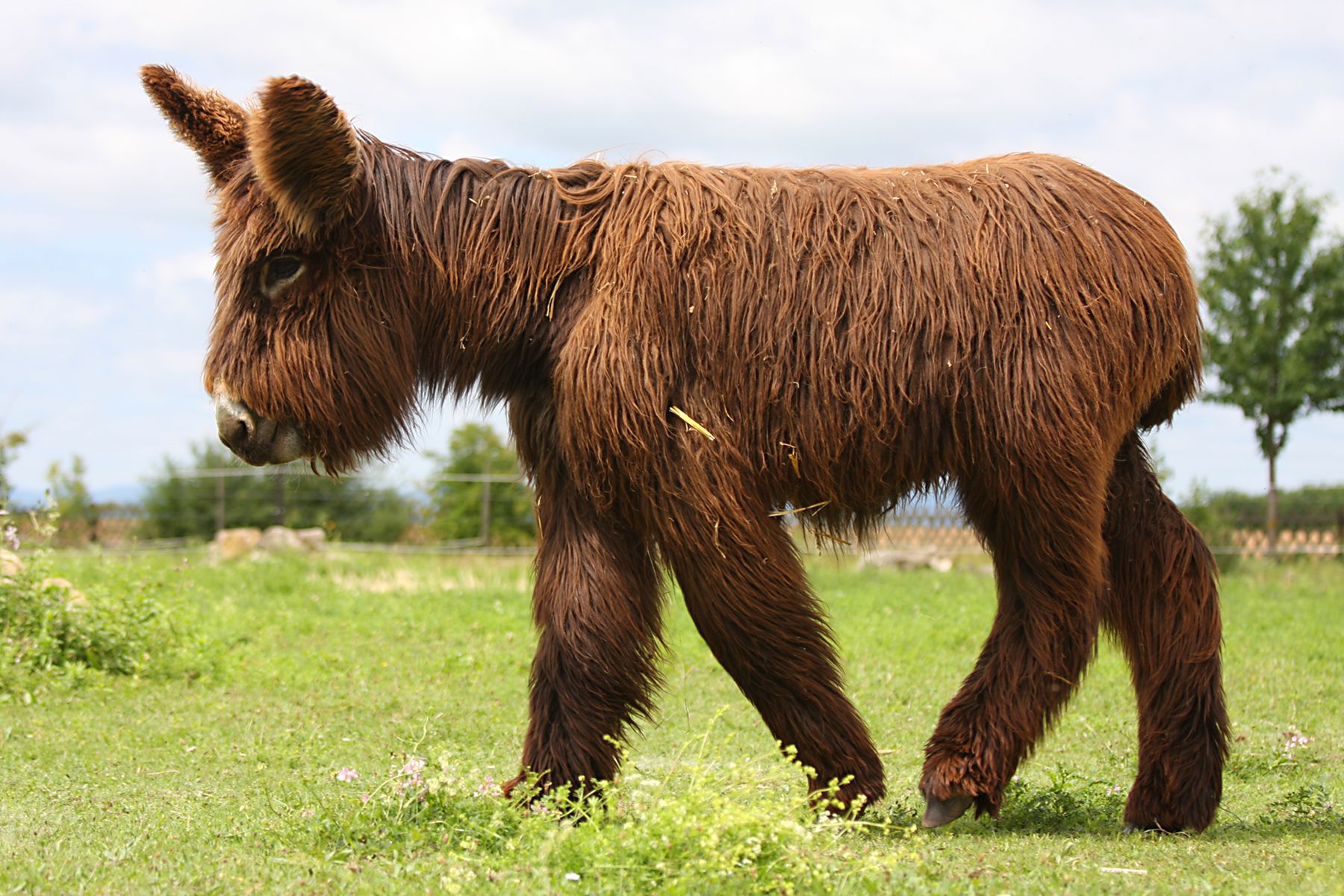
Sudorculus · CC BY-SA 3.0 ↗ · Reuse terms
Origins, people & changing purpose
History & heritage
The Baudet du Poitou belongs to the mule-producing tradition of western France. Standardization developed around 1700, followed by a studbook in 1884. Poitou jacks were paired with Poitevin or Mulassier mares to produce large working mules. Falling demand after World War II brought this regional breeding system close to collapse.
Sources for this passage
Understanding the heritage in context
The Poitou belonged to a regional breeding system involving both a donkey population and horse mares. Explaining that system reveals why falling demand for mules affected more than one kind of animal. The donkey's coat is visually memorable, but its historical importance cannot be reduced to hanging hair.
Recognizing the breed
Size, details & appearance
Look closely at the features that make this animal distinctive.
Sudorculus · CC BY-SA 3.0 · License
Size reference
Source-reported weight references ↗ · checked October 5, 2026.
Market weight and adult weight describe different stages. Values are reference information, not individual growth guarantees.
Historically, producing large mules when bred with draft horses
Docile
Color & pattern cards
This card highlights a documented appearance feature. Appearance alone does not establish registered breed identity. Screen colors are illustrative; they are not calibrated feather, skin or coat samples.
Animal identity
Heavy bone, a large head, extraordinarily long ears, and a dark coat distinguish the breed. Its famous long hair can form hanging cords, although coat length varies. The Conservancy describes mature animals at approximately 14–15 hands; their appearance should be understood together with their historical work.
Sources for this passage
Reading identity and evidence carefully
Historical survivor and registration figures should keep their dates and definitions. Registered animals over a period are not automatically the number alive today. Identification and DNA work address another question again. Distinguishing these measures makes the conservation story more informative while avoiding a fabricated current census.
Scientific identity & inheritance
Equus asinus Linnaeus, 1758
- Kingdom
- Animalia
- Phylum
- Chordata
- Taxonomic class
- Mammalia
- Order
- Perissodactyla
- Family
- Equidae
- Genus
- Equus
- Species
- Equus asinus
- Domestic population
- Poitou
Scientific identity
Donkeys are herbivores with teeth adapted to grinding plant material. Their food choices can include grasses, herbaceous plants and browse, depending on availability. Like horses, they use hindgut fermentation, but their nutritional management should not simply copy that of a horse of similar size.
Merck's equid nutrition guidance explains the importance of high-fiber feeding and attention to energy intake for donkeys. Reducing excessive dietary energy is different from starving an animal: severe restriction can contribute to hyperlipemia. A teaching foundation should connect body condition, dental function and the animal's job to the way forage is supplied, without prescribing one ration for all donkeys.
Sources for this passage
The animal in its landscape
Ecology & human landscapes
Grazing and browsing put donkeys in direct contact with plant communities and soil. Their land impact depends on stocking, seasonal forage and access to sensitive areas. An animal can be culturally valuable and still require careful management to avoid damaging the landscape.
The conservation story should therefore join animal welfare with breed identity. Historical usefulness explains why people maintained a population, while changed farm economics can explain why it declined. Breed preservation and conservation of African wild asses are distinct subjects, even though their evolutionary history connects them.
Sources for this passage
Keeping and raising the animal
Care foundations
Donkey feeding cannot be assumed to match a similarly sized horse. Merck describes lower energy requirements and high-fiber, low nonstructural-carbohydrate feeding approaches. Rich pasture or unnecessary concentrate can promote excessive body condition. Conversely, severe restriction or starvation is dangerous because donkeys can develop hyperlipemia. A sound teaching article should explain the distinction between reducing excess energy and depriving an animal of forage and essential nutrients. Individual condition, teeth, workload and reproductive state matter.
These are general species foundations. The breed's own history and traits help explain how it developed, while an individual animal's age, environment and purpose shape its daily needs. Preservation includes keeping animals healthy enough to express normal behavior and maintain future generations. Compare dependable husbandry guidance with breed registry descriptions, and distinguish inherited traits from assumptions about toughness. Teaching the reasons behind care decisions gives readers a stronger foundation than applying one feeding formula to every animal.
Sources for this passage
Donkey care beneath the breed's appearance
The Poitou's long coat makes grooming an opportunity to observe the animal beneath its memorable appearance. General donkey care includes checking condition and noticing changes in appetite or behavior. The breed's foal-care concerns require experienced guidance; a broad introductory article cannot supply a universal protocol. A striking coat should never obscure the everyday observation needed to understand the individual.
Sources for this passage
Read this article in its own place →A donkey’s beginning, a donkey’s needs.
Follow the animal from its beginning through the changes in feeding, shelter, behavior and care. Select a stage to look closer.
Healthy adults can contribute to the next generation; care and documented ancestry connect the cycle.

First milk & contact
Confirm that the foal receives colostrum and nurses. Neonatal feeding needs assessment separately from the adult donkey’s lower-energy feeding requirements.
What to observe
Watch successful nursing, warmth, contact with the mother and the condition of each youngster.
Raised with the jenny
The mother normally provides milk and social contact. The keeper checks feeding, health and the safety of the setting.
Fostering or orphan care
A foal whose mother cannot nurse needs an experienced neonatal plan, assessment of colostrum intake and appropriate milk. A suitable foster may help; feeding by people does not replace donkey companionship.
Life-stage teaching sources
- Merck Veterinary Manual · approximate gestation periods ↗
- The Donkey Sanctuary · care of the orphan donkey foal ↗
Conservation Legacy original teaching. Image captions identify the pictured animal; general species examples remain separate from selected-breed images.
See when life changes.
Body growth, reproductive development and managed weaning describe different changes. Explore the reference windows beside the care they help explain.
Approximate gestation
365 daysApproximate species reference for planning.
Evidence ↗Gestation documented range
11–14.5 monthsApproximate species reference for planning.
Evidence ↗After birth or hatch · reference windows
Domestic donkey veterinary/welfare references. Bars share a time axis measured from birth or hatch; each label retains its source units.
What its future depends on
Conservation & challenges
The source reports fewer than 80 survivors by 1980 and about 2,500 pure animals registered in 2012; these are dated historical measures, not today's living census. American conservation work beginning in 2020 combined identification and DNA testing. Foal care and fertility remain important areas for experienced owners and their veterinarians.
For learners, the key distinction is between a donkey breed, a registry's standard, and the hybrid mules a jack may produce. Each answers a different question about identity. Those distinctions help readers compare photographs and historical accounts accurately.
Sources for this passage
Conservation as a regional, reproductive effort
CREGENE, a regional conservation organization, anchors the Poitou's documented history in a 1717 royal-council memoir describing an established mule-producing industry. This is firmer evidence than presenting an uncertain ancient origin as a proven founding date. It records a 1977 population of 44 animals—20 males and 24 females—distributed among fourteen owners. That is a historical warning about a severe bottleneck, not a contemporary census.
The organization's account describes a coordinated rescue decision in November 1979 involving the Marais Poitevin regional park, national studs, and mule-breeding organizations. The experimental breeding center at Dampierre-sur-Boutonne combined genetics, husbandry improvement, preservation of local knowledge, and public education. CREGENE also reports that its work following the park's herd continued until 2024, when an absorption-breeding conservation program reached its seventh generation.
This history explains why the Poitou's shaggy coat is only the starting point of its identity. Recovery required coordinated reproduction across a geographically dispersed population and attention to ancestry. An educational collection should distinguish purebred conservation from mule production: the latter explains the breed's historic purpose, while sustaining the donkey population requires donkey offspring. The account's undated total of 400 purebred animals in France is not used here as a current statistic.
Conservation status and source-reported population evidence
Surviving donkeys
- Assessment year / period
- By 1980
- Geography / scope
- Geography not explicitly delimited in profile
Historical breed-survival figure; do not label a present-day census.
Read the source →Pure Poitous registered in studbook
- Assessment year / period
- 2012
- Geography / scope
- Studbook; geographic boundary not explicit
Registration population may include historical entries; not independently confirmed living stock.
Read the source →Animals identified and DNA tested
- Assessment year / period
- 2020–2022 search
- Geography / scope
- United States
Conservancy began census in 2020 and searched two years; identified animals entered new studbook.
Read the source →These measures describe different dates, places and populations. They should not be added together or treated as a new census conducted by Conservation Legacy.
Carry this animal’s story forward.
A documented photograph, a keeper’s experience or a carefully sourced correction can strengthen the next person’s understanding. This account connects with the breed’s own knowledge collection and common area.