
Yokohama
History & heritage
One living story. Knowledge kept together.
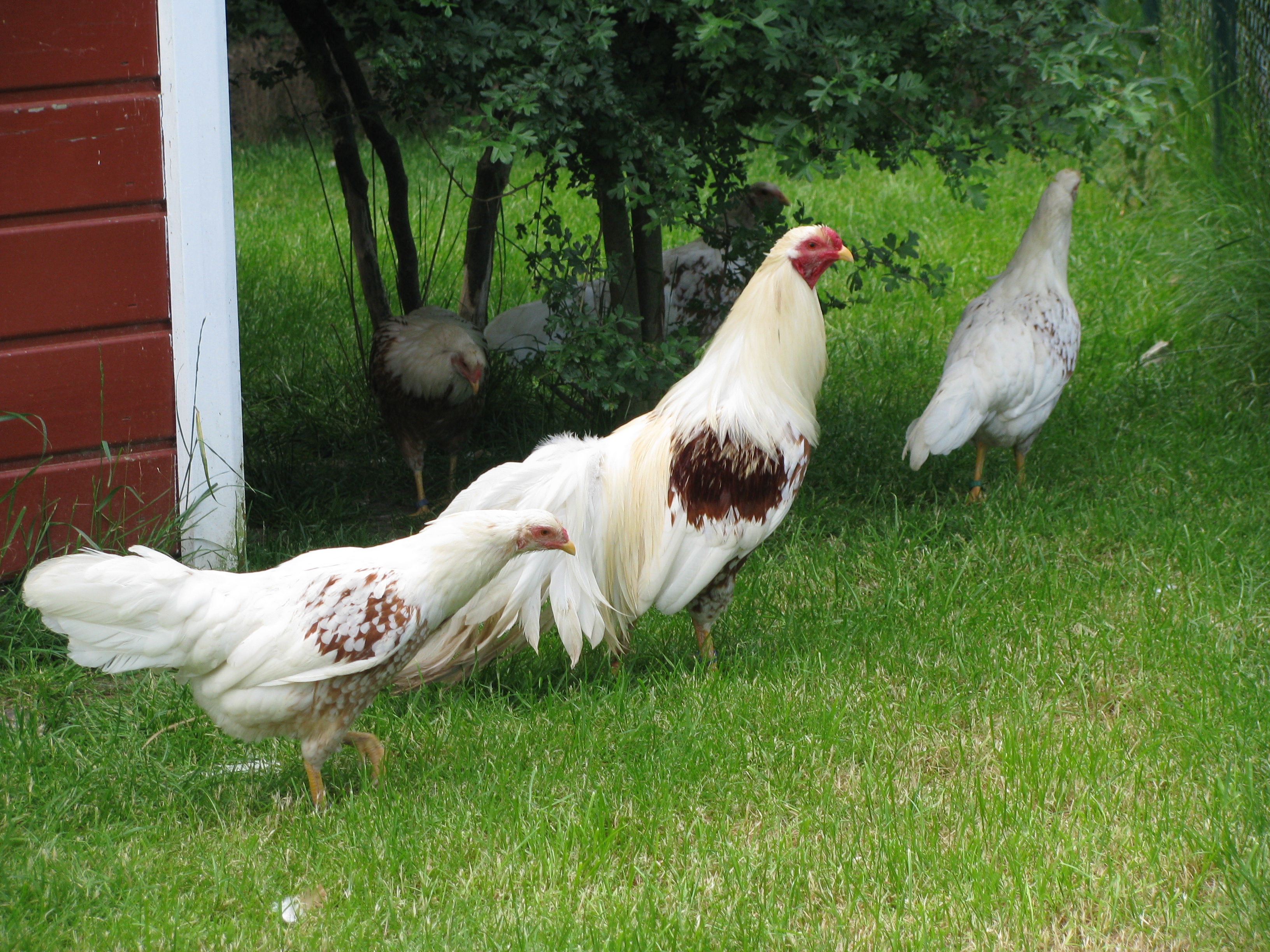
Yokohama chickens at the scientific poultry center in Sinsteden, Germany. · Hagen Graebner · CC BY-SA 3.0 · License terms
Follow the story behind the name.
The Yokohama’s exhibition identity emphasizes flowing tails and refined carriage. Its appearance illustrates how generations of ornamental selection can produce a population with very specific feather-maintenance needs.
Long-tailed Japanese chickens were exported through Yokohama to France and Germany in 1864. German breeders refined the population, which acquired the export port's name rather than retaining every Japanese original designation.
Long tail, saddle and sickle feathers create its dramatic outline. Red-Shouldered birds contrast red markings with a white background; White birds form another established color. Small tinted eggs are secondary to its ornamental purpose.
The Conservancy's reference profile describes small eggs with light tinted brown shells. These descriptions help compare the population's traditional farm role; actual performance also depends on age, breeding line and management.
Long feathering within a defined silhouette
The society's British description emphasizes a long, deep body, abundant narrow saddle feathering and a low, flowing tail. Head requirements vary with the variety; its Red Saddled form does not use the single comb permitted in other British forms. This is why a single checklist detached from its variety can mislead. The standard describes the desired mature appearance, not a promise that every young bird will already display an adult tail.
Sources for general species learning
Sources behind the breed’s story.
The original history, identity and conservation teaching above draws on these cited accounts. Official links open the full material for further study.
Keep learning from official information.
These research portals help locate further material. A search link is a route for exploration; it is separate from the sources used for the article above. Domestic breed information, wild-species assessment, historical books and new research need their own context.
- FAO DAD-IS · Domestic breed information
- IUCN Red List · Species assessments
- Biodiversity Heritage Library · Historical literature search
- USDA National Agricultural Library · Research search
- Google Scholar · Scholarly literature search
- Open Library · Book catalogue search
- HathiTrust · Digitized catalogue search