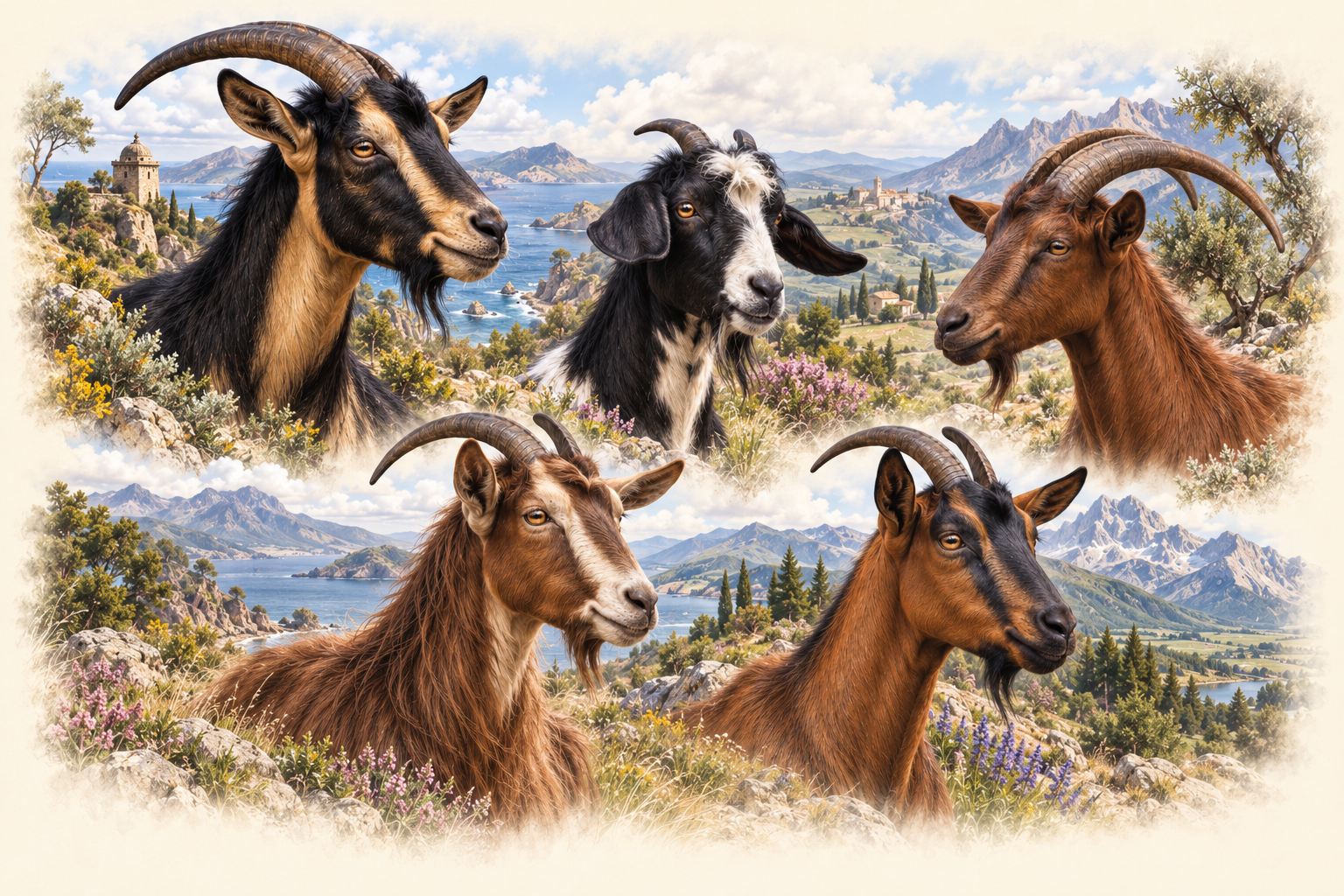
Island populations, farm traditions and distinct families.
Goat conservation links the value of a living herd with the history of the population behind it. A heritage breed may reflect a particular island, a regional farming system or generations of selection by keepers. Useful traits deserve documentation, but conservation also asks which families remain and whether they have a realistic future. Preserve breed names carefully and distinguish registered animals from animals identified only by appearance.
These relatively small goats preserve an island-developed combination of traits. Does can be attentive mothers, and the population has potential uses in milk, meat, and fiber. Variation within the breed should be recorded rather than erased by assuming one fixed commercial production type.
They are primarily meat and browsing goats, with variation among established bloodlines. Adaptation to local conditions and forage use matter more than a uniform coat color. Predation, particularly of young kids, is an important management issue identified in breed accounts.
The breed is a dairy goat, commonly recognized by its chamois coloring and dark markings. Milk production and a generally approachable temperament explain its appeal to family farms. Secure fencing remains important: a dairy identity does not remove normal climbing and escape behavior.
Myotonia causes temporary muscle stiffness, giving rise to 'fainting' and 'wooden leg' names. It is not a loss of consciousness. Their meat-production identity and active foraging deserve attention alongside the trait that attracts online videos.
Long coats and mixed black, brown, and white coloring characterize many animals; badger-like facial markings also occur. They are medium-sized goats with meat and some dairy potential. Their distinctiveness comes from the island population as a whole, not one mandatory color pattern.
Critical, Threatened, Watch and Recovering are this organization’s domestic-breed categories. Their definitions vary between livestock, rabbits and poultry. A category threshold is not a census of this breed, and a registry’s annual registrations are not a count of every living animal.
Compare future population figures by assessment year, geography and the animals counted. Keep a wild relative’s IUCN assessment separate from a domestic breed’s status.
Scientific field notes
Where these animals belong.
Animal Diversity Web describes domestic goats as Capra hircus, in the family Bovidae. Breed names describe domestic populations within that biological context.
Ranks follow the linked reference’s treatment. Domestic names and wild relatives may be handled differently by other authorities.
Kingdom
Animalia
Phylum
Chordata
Class
Mammalia
Order
Artiodactyla
Family
Bovidae
Genus
Capra
Species / domestic context
Capra hircus (domestic goat)
Explore beyond appearance
Four questions for a living legacy.
01
Island and regional histories
What does the source actually establish, and which claims still need evidence?
02
Breed registries and herd books
How did people, place and practical use shape the population we see today?
03
Reproduction and genetic-family representation
Which living breeding families can carry the population into another generation?
04
Species-specific feeding and secure housing
What would responsible stewardship require in time, facilities and ongoing support?
Knowledge belongs with its animal world.
Explore general goats knowledge in the species library. Each population has its own collection for breed-specific history, identity and conservation reports.