
Meet the
American Buff.
The American Buff’s precise foundation history is unresolved. Accounts propose either buff mutations in gray goose flocks or development from imported buff-colored European geese.
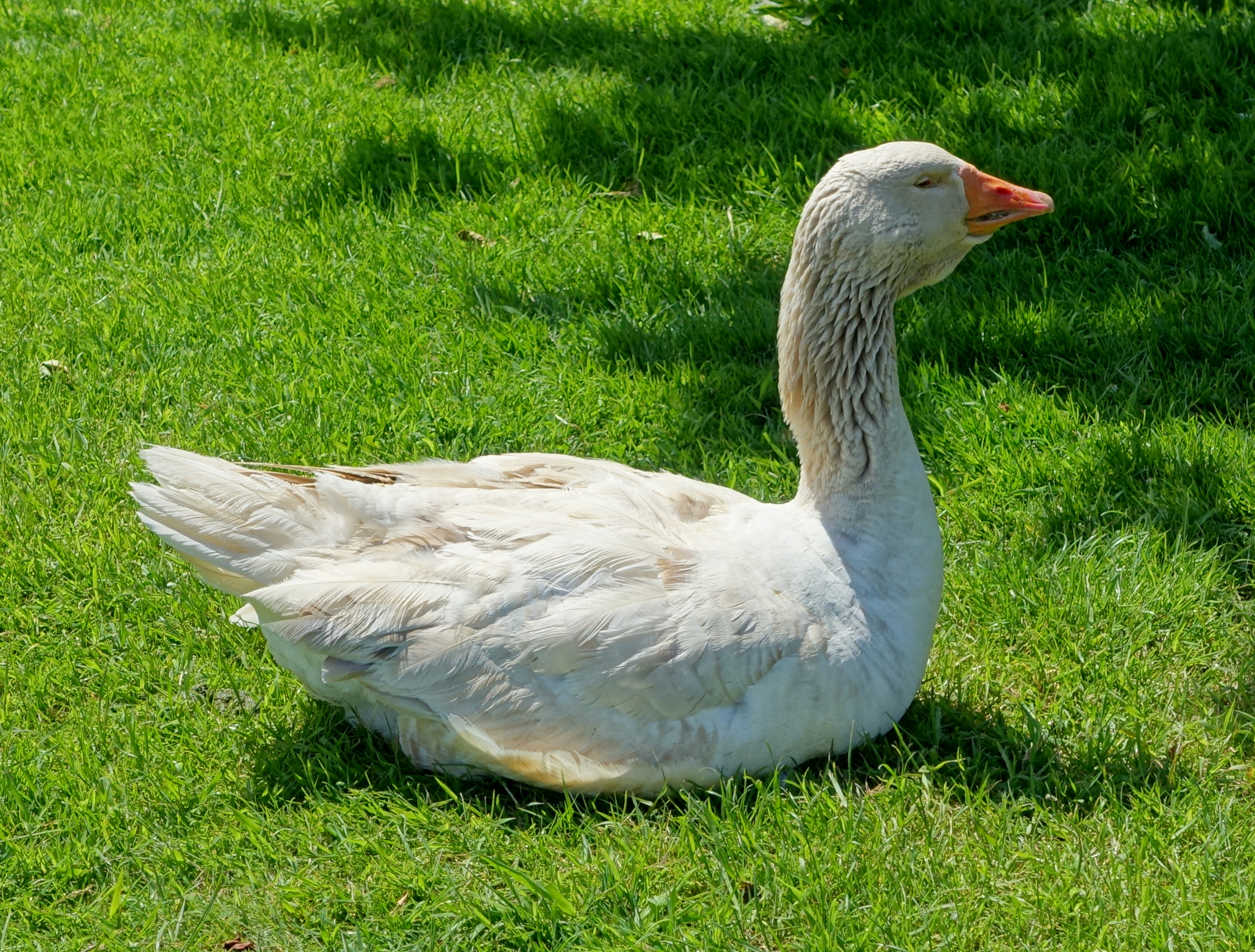
Daderot · CC0 1.0 ↗ · Reuse terms
Origins, people & changing purpose
History & heritage
The American Buff's complete founding history remains unresolved. One explanation involves buff mutations in gray flocks; another suggests refinement of imported European buff geese. Its resemblance to the Welsh Brecon Buff does not make them the same breed. The Conservancy treats these proposals as alternatives rather than a settled genealogy.
Sources for this passage
Understanding the heritage in context
The unresolved American Buff origin is a reason to show alternative explanations openly. A mutation within gray stock and development from imported buff birds are different historical hypotheses. Choosing one merely because it makes a simpler story would make the library less reliable.
Sources for this passage
Read this article in its own place →Recognizing the breed
Size, details & appearance
Look closely at the features that make this animal distinctive.
Daderot · CC0 1.0 · License
Size reference
Source-reported weight references ↗ · checked October 5, 2026.
Market weight and adult weight describe different stages. Values are reference information, not individual growth guarantees.
Meat
White
Shell color can vary between individuals and through a laying season.
Large
Source-reported size category; not a measured weight for every egg.
Docile, Curious
Color & pattern cards
This card highlights a documented appearance feature. Appearance alone does not establish registered breed identity. Screen colors are illustrative; they are not calibrated feather, skin or coat samples.
Animal identity
Soft buff coloring gives the goose its warm visual identity. American Buff bills and legs are orange to orange-red, contrasting with the reddish-pink coloration described for Brecon Buffs. Useful farm size and a generally calm reputation accompany the ornamental appeal.
Sources for this passage
Reading identity and evidence carefully
Comparison with the Brecon Buff should explain differences as well as resemblance. Bill and leg coloration can help readers understand why similar names and feather colors do not collapse two populations into one. A calm reputation is also a population description, not assurance about every individual's behavior or every social grouping.
Sources for this passage
Read this article in its own place →Similar buff feathers can belong to different breeding histories
The British Waterfowl Association's Brecon Buff account identifies the smaller Welsh population by pink feet and bill, distinguishing it from the American Buff. The comparison supports accurate visual education: a warm buff coat alone does not establish which population a goose belongs to.
The Brecon account describes Rhys Llewellyn's documented development work and later British recognition. That history belongs to the Welsh breed and should not be transplanted into an American Buff article merely because both names include Buff. The American population's unresolved foundation remains a separate question.
Placed side by side, the sources teach how to compare without merging. Photographs should state the identified breed, and weight or production descriptions should retain their scope. A similar color can be a useful starting point for learning while conformation, historical continuity, and reliable source identification complete the explanation.
Scientific identity & inheritance
Anser anser (Linnaeus, 1758)
- Kingdom
- Animalia
- Phylum
- Chordata
- Taxonomic class
- Aves
- Order
- Anseriformes
- Family
- Anatidae
- Genus
- Anser
- Species
- Anser anser
- Domestic population
- American Buff
Scientific identity
Wild greylag geese are social birds that form family groups and larger flocks. Their diet includes grasses, roots and other foods. Wild migration and flock size are natural-history background, not universal facts about how a domestic flock must live or how far a heavy domestic bird can fly.
Domestic geese can use considerable pasture vegetation. Extension guidance describes adaptations that help them consume high-fiber foods, but pasture contribution varies with quality, season and the birds themselves. Goslings and mature breeding birds occupy different life stages. A grazing reputation is therefore a starting point for learning, not proof that supplemental nutrition or dependable water is unnecessary.
The animal in its landscape
Ecology & human landscapes
Geese link grazing land, water and human settlement. Their feeding changes vegetation, while their care affects manure distribution and the condition of frequently used ground. Teaching should connect those effects to the particular managed site rather than claim a flock always benefits any pasture.
Heritage conservation should also respect the boundary between domestic geese and wild waterfowl. Preserving identified domestic breeding lines does not justify collecting wild birds or releasing domestic ones. The strongest species overview gives readers the ancestral framework and ecology, then sends them into breed chapters that explain the traits, uses and conservation challenges of each population.
Keeping and raising the animal
Care foundations
Geese can consume substantial amounts of pasture vegetation. Their digestive system has adaptations for high-fiber feed, but pasture contribution depends on plant quality, season, bird size and breed. Grazing should therefore be explained as one component of nutrition, with needs assessed throughout growth and reproduction. Goslings require different management from mature birds. As domestic poultry, geese also need reliable drinking water, suitable shelter and protection from disease introduction. Domestic heritage geese should be distinguished from wild protected waterfowl in both identity and care explanations.
These are general species foundations. The breed's own history and traits help explain how it developed, while an individual animal's age, environment and purpose shape its daily needs. Preservation includes keeping animals healthy enough to express normal behavior and maintain future generations. Compare dependable husbandry guidance with breed registry descriptions, and distinguish inherited traits from assumptions about toughness. Teaching the reasons behind care decisions gives readers a stronger foundation than applying one feeding formula to every animal.
From the nest to the grazing flock.
Follow the animal from its beginning through the changes in feeding, shelter, behavior and care. Select a stage to look closer.
Healthy adults can contribute to the next generation; care and documented ancestry connect the cycle.

New gosling
Warmth, appropriate food, drinking equipment and dry bedding support the young bird. Water spills can create chilling conditions.
What to observe
Watch access to warmth, water and starter feed, the way young birds gather or spread out, and whether each bird can reach the essentials.
Raised with a broody bird
A suitable goose, duck or chicken hen may rear goslings under appropriate management. Maternal care still needs keeper observation and a protected setting.
Managed gosling brooder
Supply artificial heat, safe drinking and feeding access and dry bedding. Keep water spills away from the resting area and adapt the setting as birds grow.
Life-stage teaching sources
- Mississippi State University Extension · incubation factors ↗
- Missouri Extension · rearing ducklings and goslings ↗
Conservation Legacy original teaching. Image captions identify the pictured animal; general species examples remain separate from selected-breed images.
See when life changes.
Body growth, reproductive development and managed weaning describe different changes. Explore the reference windows beside the care they help explain.
Incubation
28–34 daysApproximate species reference for planning.
Evidence ↗What its future depends on
Conservation & challenges
Conservation should retain distinct American breeding lines and functional traits rather than equating all buff geese. Where the origin is uncertain, standards and documented breeding continuity become especially useful. Honest uncertainty is part of a trustworthy breed library: an incomplete founding story should be marked as such rather than filled with an invented ancestor.
For learners, ancestry, named domestic breed, and color variety are separate levels of description. A goose's wild ancestor explains scientific background; its breed history explains the human selection and farm setting that produced today's domestic population.
Sources for this passage
Conservation status and source-reported population evidence
A directly verified population measure has not yet been established for this page. Its conservation category remains useful, but does not supply a current head count.
Carry this animal’s story forward.
A documented photograph, a keeper’s experience or a carefully sourced correction can strengthen the next person’s understanding. This account connects with the breed’s own knowledge collection and common area.